
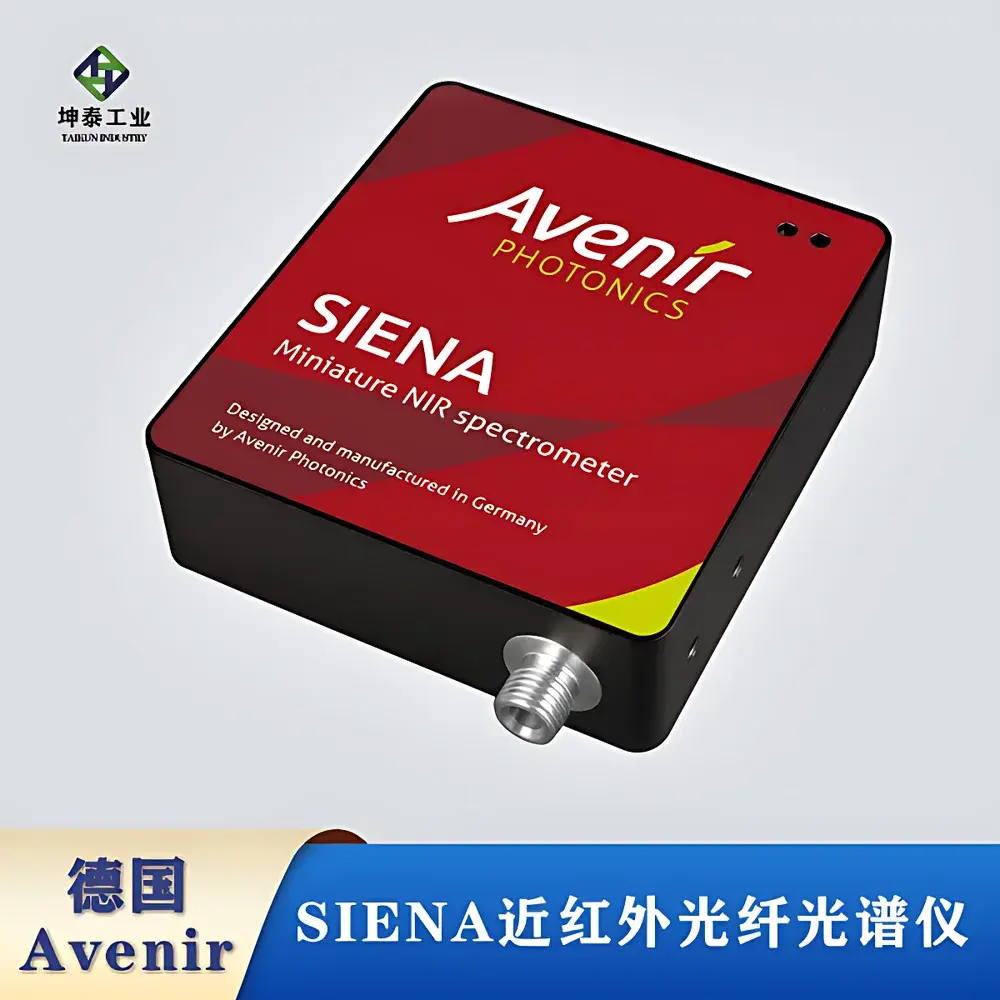
Avenir Siena Non-Cooled InGaAs Fiber Optic Spectrometer
| Brand | Avenir |
|---|---|
| Origin | Germany |
| Detector Type | InGaAs Linear Array (Non-Cooled) |
| Spectral Range | 900–1700 nm / 800–1900 nm / 900–2100 nm |
| Resolution (FWHM) | 8–15 nm (configurable) |
| Signal-to-Noise Ratio | 1000 (max, unaveraged) |
| Dynamic Range | 12,000:1 |
| Stray Light | < 0.08 % |
| Entrance Slit | User-Replaceable (default 20 µm) |
| Optical Design | Symmetric Czerny-Turner, f = 30 mm, NA = 0.19 |
| Interface | USB 2.0 Full-Speed (Type-C), UART, optional SPI/I²C |
| Power | 5 V DC (4.4–5.5 V), ≤60 mW |
| Dimensions | 52.0 × 57.0 × 17.0 mm |
| Weight | 80 g |
| Operating Temperature | −20 to +60 °C |
| Compliance | EU EMC Directive 2014/30/EU, RoHS, REACH SVHC, U.S. Conflict Minerals Act |
Overview
The Avenir Siena Non-Cooled InGaAs Fiber Optic Spectrometer is an engineered solution for robust, high-fidelity near-infrared (NIR) spectral acquisition in resource-constrained environments. Unlike conventional cooled InGaAs spectrometers—whose thermoelectric cooling adds bulk, power demand, and reliability risk—the Siena leverages a proprietary non-cooled 256-pixel InGaAs linear array with integrated dark-current compensation. This enables stable operation from 800 nm to 2100 nm at ambient temperatures, eliminating fan noise, thermal drift, and cold-condensation failure modes. Its symmetric Czerny-Turner optical architecture (f = 30 mm, NA = 0.19) delivers high throughput and low aberration across all standard configurations. The instrument operates on a single 5 V supply (<60 mW), features onboard 16-bit ADC conversion at 2 MHz, and supports exposure times from 4 µs to 10 minutes—making it suitable for both rapid process monitoring and high-sensitivity laboratory-grade measurements.
Key Features
- Uncooled InGaAs detection up to 2100 nm: Eliminates thermoelectric coolers while maintaining dark-current stability through real-time hardware compensation—enabling continuous operation without thermal equilibration delays or condensation risks.
- Three standardized spectral bands: Siena 1.7 (850–1700 nm), Siena 1.9 (800–1900 nm), and Siena 2.1 (900–2100 nm), each optimized for resolution, stray light suppression, and signal fidelity.
- User-replaceable entrance slits: Default 20 µm slit; optional slits (10–300 µm) allow trade-offs between resolution and sensitivity tailored to application-specific optical throughput requirements.
- Onboard spectral processing: Embedded microcontroller executes real-time auto-exposure, spectral averaging, offset correction, nonlinearity compensation, dark/reference subtraction, and buffer management—reducing host dependency and latency.
- Low-stray-light optical design: <0.08 % stray light (measured with halogen source + longpass filter), achieved via optimized baffling, order-sorting filters (included), and precision-aligned reflective optics.
- Industrial-grade I/O and interface flexibility: USB 2.0 Full-Speed (Type-C), UART, and optional SPI/I²C; programmable GPIO, trigger I/O, analog input/output, and flash pulse generation support embedded OEM integration.
Sample Compatibility & Compliance
The Siena interfaces seamlessly with standard SMA-terminated fiber optic probes, integrating into flow cells, reflectance heads, transmission cuvettes, and process stream analyzers. Its compact form factor (52 × 57 × 17 mm) and wide operating temperature range (−20 to +60 °C) make it suitable for inline pharmaceutical blending, agricultural grain analysis, polymer sorting, and fuel quality verification. The instrument complies with EU Electromagnetic Compatibility Directive 2014/30/EU, RoHS 2011/65/EU, REACH SVHC regulations, and the U.S. Dodd-Frank Conflict Minerals Act. While not certified for FDA 21 CFR Part 11 out-of-the-box, its deterministic firmware behavior, reproducible spectral output, and audit-ready calibration reports (provided with each unit) support validation under GLP/GMP frameworks when deployed with traceable reference standards and documented SOPs.
Software & Data Management
Avenir provides a Windows-compatible application suite (Windows 7+) featuring spectral visualization, calibration management, batch export (CSV, ASCII, binary), and real-time overlay of reference spectra. The SDK includes C/C++, Python, and LabVIEW libraries with full API documentation, enabling custom algorithm integration—for example, PLS regression models for concentration prediction or spectral derivative analysis for peak-shape discrimination. All spectral data are timestamped and include metadata (exposure time, average count, slit ID, calibration date). The device supports hardware-triggered acquisition with ≤1 µs jitter, ensuring synchronization with external events such as pump cycles or conveyor belt encoders. Raw spectra are buffered in 426-frame memory prior to USB transfer (≤6 ms for 32-bit packets), minimizing dead time during high-throughput acquisition.
Applications
- Pharmaceutical QA/QC: Identification of active pharmaceutical ingredients (APIs) and excipients in tablets via NIR fingerprinting; moisture content quantification in lyophilized powders.
- Agricultural & Food Analysis: Protein, oil, and starch estimation in grains; sugar content (Brix) in fruit juices; authenticity screening of olive oil and honey.
- Polymer & Plastics Sorting: Real-time classification of PET, HDPE, PP, and ABS in recycling streams using characteristic C–H and O–H overtone bands.
- Industrial Process Monitoring: In-line monitoring of chemical reactions (e.g., esterification, hydrogenation) via time-resolved absorbance changes at key NIR wavelengths.
- Environmental Sensing: Soil organic carbon assessment; hydrocarbon contamination detection in water via CH stretch harmonics (1650–1750 nm).
FAQ
Does the Siena require external cooling or temperature stabilization?
No. The InGaAs detector operates uncooled from −20 to +60 °C, with built-in dark-current compensation ensuring spectral stability without thermoelectric modules or active heat sinking.
Can resolution be improved beyond the standard specifications?
Yes—by selecting narrower entrance slits (e.g., 10 µm) or custom grating options. However, resolution gains are accompanied by reduced optical throughput; optimal slit width must balance signal-to-noise ratio and required spectral separation.
Is the Siena compatible with third-party fiber probes and illumination sources?
Yes. It accepts standard SMA-905 connectors and is calibrated using NIST-traceable tungsten-halogen and deuterium lamps. Users may integrate LED, laser, or broadband sources provided spectral irradiance falls within the detector’s linear response range.
How is wavelength calibration maintained over time and temperature?
Each unit ships with a factory-generated calibration file referencing Hg/Ar emission lines. Onboard firmware applies polynomial correction; users may perform field recalibration using known spectral references. Wavelength accuracy remains within ±1/3 of FWHM across the specified operating temperature range.
What documentation and traceability are provided with the instrument?
Every Siena includes a calibration certificate (with uncertainty budget), factory test report (stray light, SNR, linearity), RoHS/REACH compliance statement, and full CE marking documentation—all archived digitally and supplied on USB drive.





