
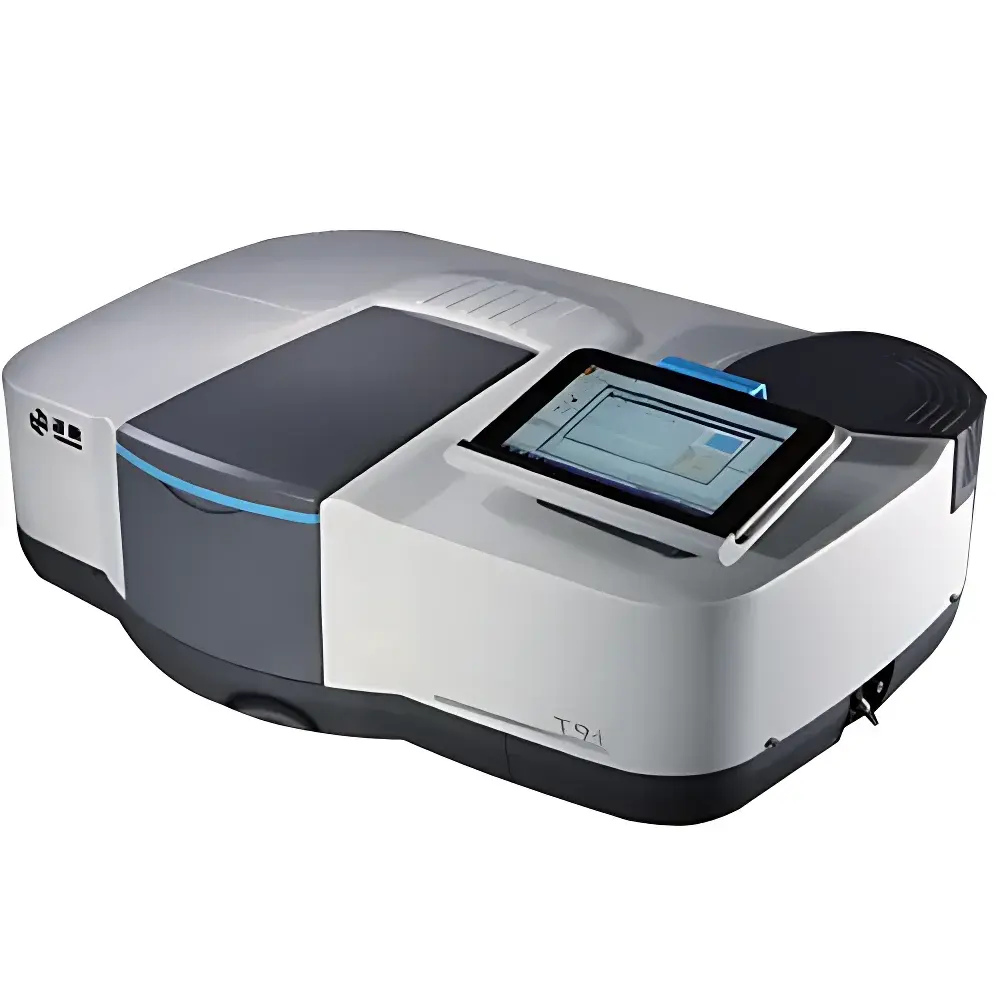
Persee T9CS Dual-Beam Ultraviolet-Visible Spectrophotometer
| [Brand | Persee |
|---|---|
| Origin | Beijing, China |
| Manufacturer Type | Direct Manufacturer |
| Instrument Architecture | Dual-Beam |
| Detector | Photomultiplier Tube (PMT) |
| Wavelength Range | 185 nm – 900 nm |
| Wavelength Accuracy | ±0.1 nm (at D₂ line, 656.1 nm) |
| Wavelength Repeatability | ≤0.05 nm (at D₂ line, 656.1 nm) |
| Spectral Bandwidth | Continuously Adjustable from 0.1 nm to 5.0 nm |
| Stray Light | ≤0.0001% T (NaI, 220 nm) |
| Photometric Range | –6 Abs to +6 Abs |
| Baseline Flatness | ±0.0008 Abs |
| Absorbance Accuracy | ±0.002 Abs (0–0.5 Abs), ±0.004 Abs (0.5–1.0 Abs), ±0.3% T (>1.0 Abs) |
| Absorbance Repeatability | ≤0.001 Abs (0–0.5 Abs), ≤0.002 Abs (0.5–1.0 Abs), ≤0.1% T (>1.0 Abs) |
| Drift | ≤0.1% T/h |
| Optical System | Hybrid Czerny-Turner Dual-Monochromator with High-Reflectivity Coated Optics |
| Light Sources | Integrated Deuterium Lamp, Tungsten-Halogen Lamp, and Mercury Calibration Lamp (Auto-Switching)] |
Overview
The Persee T9CS Dual-Beam Ultraviolet-Visible Spectrophotometer is an advanced analytical instrument engineered for high-fidelity absorbance, transmittance, and reflectance measurements across the ultraviolet, visible, and near-infrared spectral regions (185–900 nm). Its hybrid Czerny-Turner dual-monochromator optical architecture—featuring specially coated high-reflectivity mirrors and precision diffraction gratings—delivers exceptional spectral resolution and minimizes stray light to ≤0.0001% T at critical wavelengths (220 nm and 360 nm), as verified in official metrological type evaluation reports. This low stray light performance enables reliable quantification of highly absorbing samples up to 6 Abs and accurate detection of weak transitions down to –6 Abs. The instrument operates on a true dual-beam principle, continuously comparing sample and reference beam intensities in real time to compensate for source drift, detector instability, and environmental fluctuations—ensuring long-term photometric stability and measurement reproducibility required in regulated environments.
Key Features
- Continuously variable spectral bandwidth (0.1–5.0 nm in 0.1 nm increments), implemented via a discrete three-slit combinatorial slit mechanism that supports automated bandwidth scanning to identify optimal resolution for analyte-specific absorption maxima.
- Integrated triple-light-source system: deuterium lamp (UV), tungsten-halogen lamp (VIS-NIR), and mercury calibration lamp—all auto-switched and aligned for seamless wavelength validation and traceable calibration without manual intervention.
- Low-noise photomultiplier tube (PMT) detector coupled with optimized signal conditioning electronics, delivering high signal-to-noise ratio and enabling sub-millioptical-density detection sensitivity.
- Modular open-platform design with standardized electrical and mechanical interfaces, supporting third-party hardware integration (e.g., temperature-controlled cells, flow cells, integrating spheres) and custom firmware or driver-level software development.
- Rugged mechanical construction (62 kg mass, precision-machined aluminum alloy chassis) ensures vibration resistance and thermal stability—critical for extended acquisition protocols and compliance with GLP/GMP laboratory infrastructure requirements.
Sample Compatibility & Compliance
The T9CS accommodates standard 10 mm, 50 mm, and 100 mm pathlength cuvettes, as well as specialized accessories including dual-beam five-position thermostatted cell holders (DTC5-1), eight-cell autosampler modules (DC8-1), dual-channel peristaltic pump systems (DPS-1), and 60 mm / 150 mm integrating spheres (DIS60-1, DIS150-1) for diffuse reflectance and total transmittance analysis. All optical components comply with ISO 9001 manufacturing controls, and the instrument’s photometric accuracy and wavelength fidelity meet ASTM E275, ISO 6223, and USP spectrophotometer verification criteria. Audit-trail-capable data logging (via UVWin software) supports 21 CFR Part 11 readiness when deployed with appropriate IT governance policies.
Software & Data Management
Controlled by UVWin—a Windows-based, CE-compliant application—the T9CS provides full instrument parameterization, kinetic scan scheduling, multi-wavelength quantitative analysis, and derivative spectroscopy. Raw spectral data are stored in vendor-neutral ASCII format (.txt) and compatible .csv structures, facilitating import into MATLAB, Python (NumPy/Pandas), or LIMS platforms. The software implements role-based user accounts, electronic signatures, and configurable audit trails—including timestamped records of method changes, calibration events, and data exports—to align with GLP and GMP documentation standards. Optional API libraries enable programmatic control via LabVIEW, Python, or .NET frameworks for automated assay workflows.
Applications
The T9CS serves as a core analytical platform in diverse technical domains: quantitative determination of nucleic acid and protein concentration (A₂₆₀/A₂₈₀), enzyme kinetics assays under controlled thermal conditions, dissolution testing of pharmaceutical tablets (with DDA-1 accessory), heavy metal speciation in environmental water matrices (e.g., Cr(VI) at 350 nm), pigment characterization in coatings and inks, and validation of optical filter transmission profiles. Its extended dynamic range and low stray light make it particularly suitable for measuring turbid suspensions, highly concentrated dyes, and thin-film interference spectra where conventional single-beam instruments exhibit nonlinearity or saturation artifacts.
FAQ
What regulatory standards does the T9CS support for quality-controlled laboratories?
The instrument meets photometric and wavelength accuracy requirements defined in ASTM E275, ISO 6223, and USP . With UVWin software configured for electronic signatures and audit trails, it supports 21 CFR Part 11 compliance when deployed in validated IT environments.
Can the T9CS perform reflectance measurements?
Yes—when equipped with the DSR-1 relative mirror reflectance accessory or DIS60-1/DIS150-1 integrating sphere units, the system supports both specular and diffuse reflectance quantification across the full 185–900 nm range.
Is the spectral bandwidth truly continuous, or are discrete steps used?
The 0.1–5.0 nm bandwidth is continuously adjustable in 0.1 nm increments via motorized slit positioning, enabling precise optimization for narrow absorption bands without interpolation artifacts.
How is wavelength calibration maintained over time?
The integrated mercury lamp provides primary wavelength references at 253.7 nm, 365.0 nm, 404.7 nm, 435.8 nm, and 546.1 nm. Automated calibration routines verify and correct grating position offsets, ensuring long-term traceability to NIST-traceable standards.
Does the T9CS support external triggering or synchronization with other lab equipment?
Yes—via TTL-compatible digital I/O ports, the instrument accepts external start/stop triggers and outputs status signals, enabling synchronized acquisition with HPLC fraction collectors, electrochemical workstations, or environmental chambers.





