
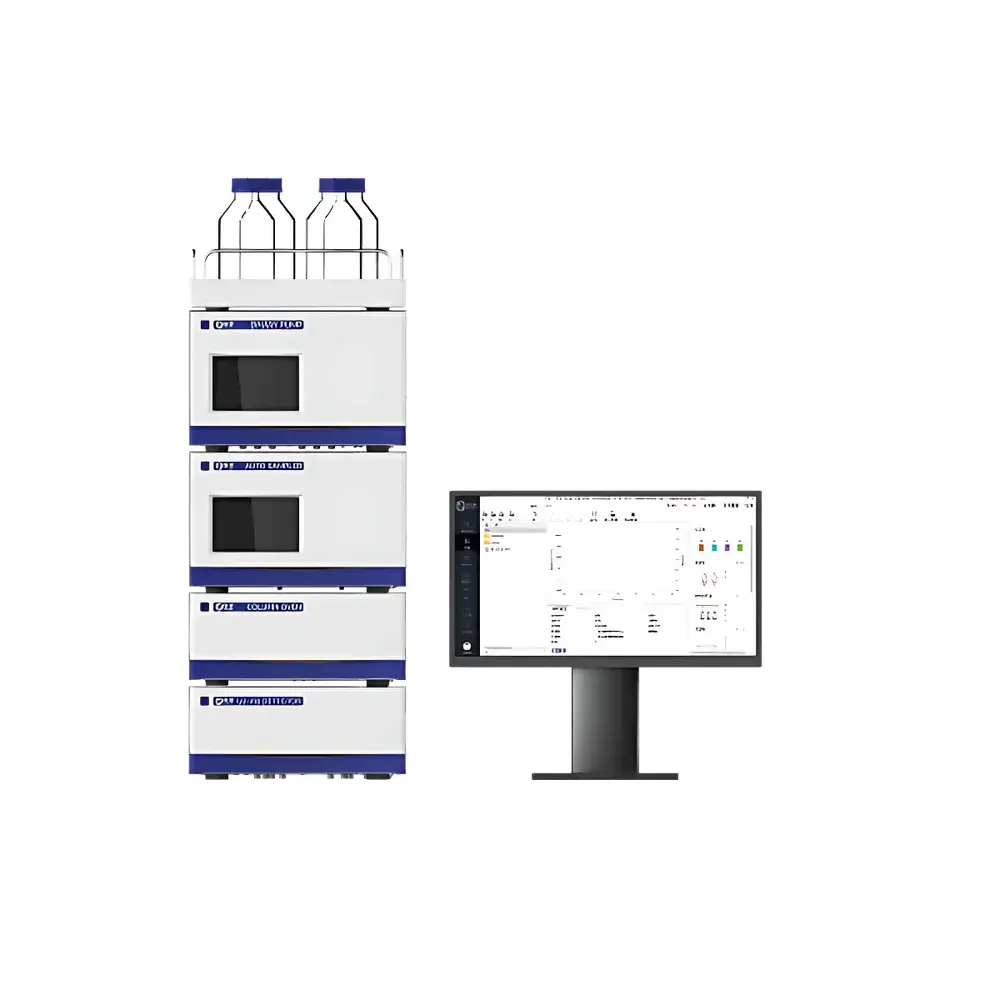
Persee L820 High-Performance Liquid Chromatograph
| Brand | Persee |
|---|---|
| Origin | Beijing, China |
| Manufacturer Type | Original Equipment Manufacturer (OEM) |
| Regional Classification | Domestic (China-made) |
| Model | L820 |
| Instrument Type | Conventional HPLC System |
| Application Scope | General-purpose analytical HPLC |
| Price Range | USD 56,000 – 84,000 (FOB Beijing) |
| Compliance | GLP/GMP, FDA 21 CFR Part 11, Chinese Pharmacopoeia 2020 Edition, Chinese Veterinary Pharmacopoeia 2020 Edition |
Overview
The Persee L820 High-Performance Liquid Chromatograph is a domestically engineered, general-purpose HPLC system designed for routine analytical laboratories requiring robustness, regulatory compliance, and method transfer fidelity. Built upon classical reversed-phase and normal-phase separation principles, the L820 employs isocratic or gradient elution modes with dual-piston reciprocating high-pressure pumps, delivering consistent mobile phase delivery under variable backpressure conditions. Its architecture adheres to fundamental HPLC design tenets—low dwell volume, minimized extra-column dispersion, and thermally stabilized detection pathways—to ensure retention time reproducibility and peak shape integrity across multi-day sequences. While not rated for ultra-high-pressure applications (e.g., UHPLC), the system is optimized for standard 3–5 µm particle-packed columns operating at pressures up to 40 MPa (6,000 psi), making it suitable for pharmaceutical QC, environmental residue analysis, food safety testing, and academic research workflows where method ruggedness and long-term operational stability are prioritized over extreme speed or resolution.
Key Features
- Floating plunger pump design with integrated post-column solvent flush mechanism—reduces seal wear and extends pump head service life by minimizing particulate accumulation and pressure-induced extrusion.
- Precision-machined cam profile drive combined with active pressure pulsation suppression and solvent compressibility compensation algorithms—ensures flow accuracy and consistency across viscosity gradients and temperature fluctuations.
- Transmissive dual-lamp optical path (deuterium + tungsten-halogen) with fixed-position lamp housing—eliminates mechanical lamp-switching actuators, enhancing photometric stability and reducing maintenance-induced downtime.
- Automatic mobile phase degassing via vacuum membrane module, coupled with a high-precision syringe-type injection pump—delivers sub-microliter volumetric repeatability (RSD < 0.3% for 10 µL injections) and minimizes bubble-induced baseline noise.
- Fuzzy PID-based column oven temperature control (ambient +5 °C to 80 °C)—maintains thermal equilibrium within ±0.2 °C across the entire column length, critical for retention time reproducibility in regulated environments.
Sample Compatibility & Compliance
The L820 supports standard 4.6 mm × 150 mm analytical columns (as well as 3.0 mm and 2.1 mm ID variants) packed with C18, C8, phenyl-hexyl, HILIC, or ion-exchange phases. It accommodates aqueous-organic mobile phases (e.g., water/acetonitrile, water/methanol, buffered systems with pH 2–8), and is compatible with post-column derivatization modules when configured with auxiliary ports. Regulatory alignment includes full support for Good Laboratory Practice (GLP) and Good Manufacturing Practice (GMP) documentation requirements. The system meets data integrity criteria per FDA 21 CFR Part 11 through mandatory electronic signature enforcement, role-based access control (Administrator / Supervisor / Analyst tiers), immutable audit trails recording all method edits, sequence modifications, and raw data handling events, and database-level encryption of acquisition and processing metadata.
Software & Data Management
The Persee ChromaStation software operates on a relational database architecture (Microsoft SQL Server Express or compatible), ensuring ACID-compliant transaction handling and long-term data traceability. Pre-loaded method libraries include fully validated chromatographic protocols from the 2020 Chinese Pharmacopoeia (ChP) and Chinese Veterinary Pharmacopoeia (CVetP), covering assays for antibiotics, steroids, mycotoxins, and veterinary drug residues. All raw chromatograms, integration parameters, calibration curves, and report templates are stored with hash-verified immutability. Software validation packages—including IQ/OQ documentation, configuration change logs, and electronic record retention policies—are provided to support laboratory qualification under ISO/IEC 17025 and ICH M10 guidelines.
Applications
The L820 serves as a workhorse platform for quality control laboratories in pharmaceutical manufacturing (assay, dissolution, impurity profiling), contract research organizations (bioanalytical method development), food safety agencies (pesticide multiresidue screening), and environmental monitoring institutions (PAHs, phthalates, endocrine disruptors). Its deterministic flow control and thermal management make it particularly suited for compendial methods requiring strict adherence to USP <621>, EP 2.2.46, and ChP general chapters. Routine use cases include stability-indicating assays, forced degradation studies, excipient compatibility testing, and extractables/leachables screening using UV-Vis detection at fixed or scanned wavelengths.
FAQ
Does the L820 support gradient elution?
Yes—the system is equipped with a low-dead-volume, four-channel solvent selection valve and dual-pump gradient mixing capability, enabling linear, step, or multi-step gradients with ≤ 0.2% organic solvent composition accuracy.
Is the software compliant with FDA 21 CFR Part 11?
Yes—ChromaStation implements electronic signatures, audit trail logging, user authentication, and data encryption in accordance with Part 11 Subpart B requirements for closed systems.
Can the L820 be integrated into a LIMS environment?
Yes—it supports ASTM E1384 and HL7-compatible data export formats (CSV, XML, PDF/A-2), and provides ODBC-compliant database connectivity for direct LIMS synchronization.
What column oven temperature range is supported?
The thermostatically controlled column compartment operates from ambient +5 °C to 80 °C, with ramp rate programmability and real-time sensor feedback for thermal equilibration verification.
Are validation documents included with the instrument?
Yes—factory-provided IQ/OQ protocols, software validation summary reports, and GxP implementation guides are supplied to facilitate site-specific PQ execution and regulatory inspections.





