
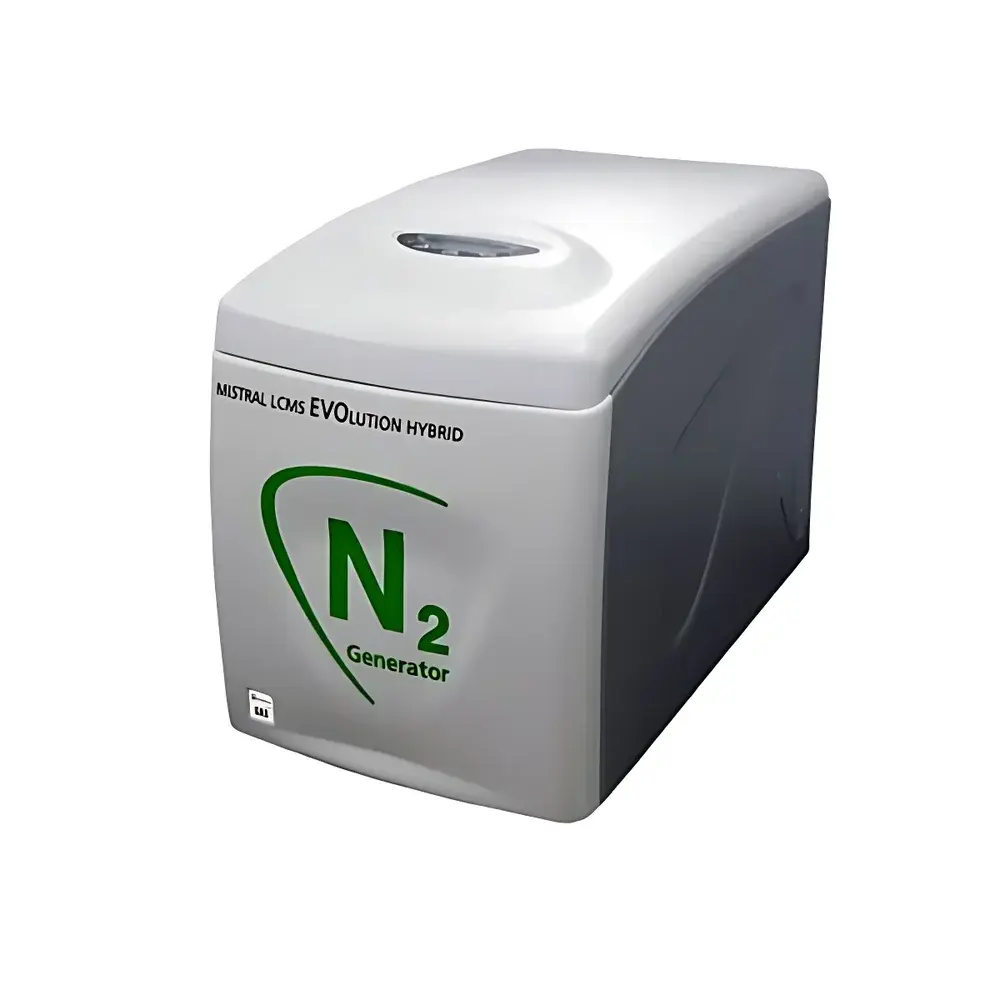
Chemtron MISTRAL EVO HYBRID Nitrogen & Air Generator
| Brand | JULABO-Chemtron |
|---|---|
| Origin | Germany |
| Model | MISTRAL EVO HYBRID |
| Nitrogen Flow Rate | up to 12 L/min at 80 psi |
| Source Air Flow | up to 25 L/min at 100 psi |
| Exhaust Air Flow | up to 10 L/min at 80 psi |
| Nitrogen Purity | >98% |
| Dew Point | −40 °C |
| Operating Temperature | 15–40 °C |
| Power Supply | 110 V / 60 Hz or 230 V / 50 Hz |
| Power Consumption | 1800 W |
| Pressure Stability | ±0.5% (0.1 bar) |
| Display | 128×64 px graphical LCD |
| Noise Level | 55 dB(A) |
| Weight | 90 kg |
| Dimensions (L×W×H) | 482×835×641 mm |
| Certifications | CE, MET, FCC |
| Protection Class | IP2X |
| Output Interface | Quick-connect fitting for 6 mm OD tubing |
Overview
The Chemtron MISTRAL EVO HYBRID Nitrogen & Air Generator is an integrated, laboratory-grade gas supply system engineered for high-reliability operation in analytical instrumentation environments—particularly LC/MS platforms from AB SCIEX and other OEMs requiring stable, on-demand nitrogen and compressed air streams. It employs a dual-stage purification architecture based on Pressure Swing Adsorption (PSA) technology, utilizing carbon molecular sieve (CMS) media to selectively remove oxygen, CO2, and residual moisture from compressed air feedstock. Unlike oil-lubricated compressors or cryogenic nitrogen sources, this generator delivers continuous, dry, particle-free nitrogen (>98% purity) and instrument-grade air without liquid condensate or phthalate contamination—ensuring compliance with ISO 8573-1:2010 Class 2:2:2 for particulate, water, and oil content.
Key Features
- Integrated dual-output design: Simultaneous generation of high-purity nitrogen (up to 12 L/min at 80 psi) and clean compressed air (up to 25 L/min at 100 psi), eliminating the need for separate air compressors and nitrogen generators
- Advanced PSA-CMS core: Two-stage adsorption columns with automated cycling ensure consistent purity and extended CMS service life; dew point maintained at −40 °C (ISO 8573-1 Class 2 for water)
- Intelligent monitoring system: Real-time display of pressure, flow rate, internal temperature, and CMS saturation status via 128×64 px backlit LCD panel
- Robust safety architecture: Dual independent sensors for pressure and temperature with audible/visual alarms and relay-triggered shutdown; consumables replacement alert with usage-based counter
- Lab-integrated form factor: Compact footprint (482 × 835 × 641 mm) and castor-mounted chassis enable under-bench installation and repositioning without disassembly
- Power resilience: Optional auto-restart function after power interruption, configurable via front-panel menu to meet lab continuity protocols
- Low-noise operation: Acoustic emission limited to 55 dB(A) at 1 m distance—suitable for shared analytical labs and open-plan facilities
Sample Compatibility & Compliance
The MISTRAL EVO HYBRID is validated for use with mass spectrometry systems requiring inert, low-hydrocarbon, low-moisture carrier and nebulizer gases—including AB SCIEX TripleTOF®, QTRAP®, and X500B platforms. Its output meets ASTM D6349-20 requirements for nitrogen used in chromatographic applications and complies with USP <797> and <800> environmental control guidance for pharmaceutical QC labs. All wetted materials are certified non-leaching and phthalate-free per EU REACH Annex XIV and US FDA 21 CFR 177.2600. The unit carries CE marking per Machinery Directive 2006/42/EC, electromagnetic compatibility certification (FCC Part 15 / EN 61326-1), and electrical safety approval (MET Listed to UL 61010-1). Its IP2X enclosure rating ensures protection against solid objects ≥12.5 mm while permitting routine maintenance access.
Software & Data Management
While the MISTRAL EVO HYBRID operates as a standalone hardware system with no embedded Ethernet or USB interface, its analog sensor outputs (4–20 mA pressure/flow signals) and dry-contact alarm relays (250 VAC / 16 A max) support integration into centralized lab infrastructure monitoring systems (e.g., Siemens Desigo, Schneider EcoStruxure, or custom SCADA). Event logs—including pressure excursions, temperature anomalies, and CMS cycle count—are retained locally and accessible via LCD navigation. For GLP/GMP-regulated environments, the device supports audit-trail-ready operation when paired with external data loggers compliant with FDA 21 CFR Part 11 requirements for electronic records and signatures.
Applications
- LC/MS carrier and curtain gas supply for AB SCIEX and other TOF, QqQ, and ion trap instruments
- Nebulizer and drying gas for HPLC-ESI and APCI sources
- Blanketing and purge gas in gloveboxes, solvent evaporation stations, and sample preparation hoods
- Instrument air for GC detectors (ECD, NPD), autosamplers, and pneumatic actuators
- Continuous nitrogen supply for elemental analyzers (CHNS/O), thermal gravimetric analyzers (TGA), and FTIR purge lines
- Backup or primary gas source in labs transitioning from liquid nitrogen dewars to sustainable on-site generation
FAQ
What is the expected service life of the CMS columns?
CMS lifetime is application-dependent but typically exceeds 20,000 operating hours under standard lab conditions (25 °C, 50% RH feed air); replacement intervals are tracked automatically and displayed on the LCD.
Can the unit operate continuously for 24/7 applications?
Yes—the MISTRAL EVO HYBRID is rated for uninterrupted duty cycle with thermal management designed for ambient temperatures up to 40 °C and full-load operation.
Is external air pre-filtration required?
A dedicated coalescing + activated carbon pre-filter (e.g., Chemtron AIR-PROTECT series) is strongly recommended upstream of the intake to extend CMS life and maintain ISO 8573-1 Class 2 air quality.
Does the generator require regular calibration?
No field calibration is needed; factory-calibrated pressure and flow sensors maintain traceability to NIST standards, and performance verification is performed via built-in self-test routines during startup.
How is exhaust air managed?
Exhaust air (up to 10 L/min at 60 psi) is vented through a dedicated port and must be routed to a fume hood or external exhaust duct—never recirculated within the lab space.



