
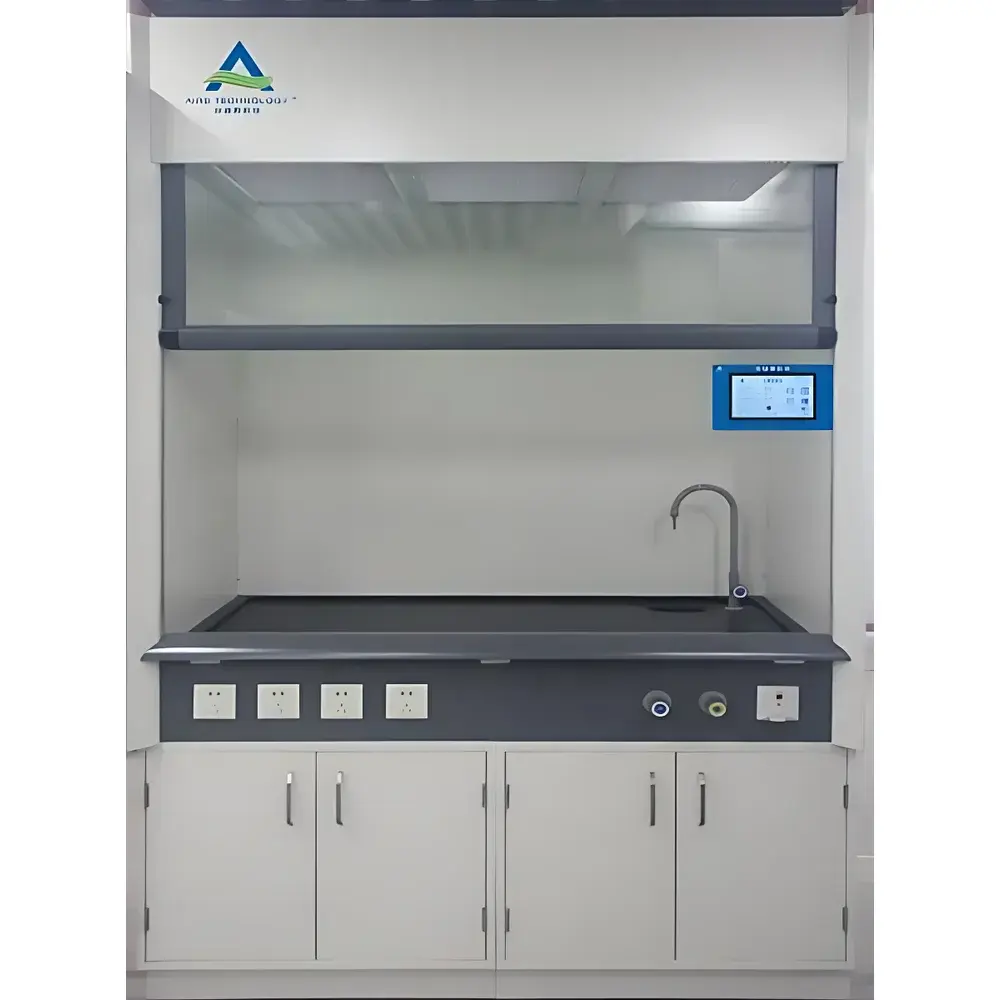
Airs ATH Advanced Ductless Fume Hood
| Brand | Airs |
|---|---|
| Origin | Beijing, China |
| Manufacturer Type | Authorized Distributor |
| Product Category | Domestic |
| Model | ATH |
| Quotation | Upon Request |
| Construction Material | Polypropylene (PP) |
| Ventilation Type | Ductless (Self-Contained Filtration System) |
| External Dimensions (L) | 1500 mm (ATH-1503), 1800 mm (ATH-1804) |
| Airflow Capacity | 690 m³/h (ATH-1503), 920 m³/h (ATH-1804) |
| Filter Module Rows | 3 (ATH-1503), 4 (ATH-1804) |
Overview
The Airs ATH Advanced Ductless Fume Hood is an engineered solution for localized chemical containment in laboratories where ducted exhaust infrastructure is unavailable, impractical, or cost-prohibitive. Unlike conventional ducted hoods that rely on building HVAC systems and external exhaust stacks, the ATH operates as a self-contained recirculating unit—drawing ambient laboratory air through a multi-stage filtration system, removing hazardous vapors, particulates, and aerosols, and returning purified air to the room. Its core principle is based on dynamic adsorption kinetics and mechanical interception, utilizing layered filter media optimized for broad-spectrum capture of volatile organic compounds (VOCs), inorganic acids (e.g., HCl, HF, HNO₃), ammonia, formaldehyde, and fine particulate matter (PM₂.₅). Designed for compliance with ANSI/ASHRAE 110–2016 and EN 14175–3:2022 performance testing protocols, the ATH delivers consistent face velocity (0.4–0.6 m/s) across its sash aperture while maintaining low turbulence and high containment integrity under variable load conditions.
Key Features
- Ergonomic dual-motion sash: Vertically sliding upper sash and horizontally adjustable lower sash enable flexible access and optimal operator positioning during both preparative and instrumental workflows.
- Real-time environmental monitoring: Integrated sensors continuously track face velocity, internal temperature, relative humidity, fan status, and cumulative filter saturation—displayed on a 5-inch medical-grade capacitive touchscreen running Airs–Touch OS.
- Modular, field-replaceable filtration architecture: Three-stage (ATH-1503) or four-stage (ATH-1804) filter cartridges—comprising pre-filters (synthetic fiber), activated carbon (impregnated for acidic/gaseous species), and HEPA/ULPA-grade particulate media—allow tailored configurations per application profile.
- Polypropylene (PP) monocoque construction: Chemically inert, seamless welded housing resists corrosion from aggressive reagents including strong oxidizers, halogenated solvents, and alkalis—eliminating galvanic degradation risks associated with stainless steel or painted steel enclosures.
- Smart connectivity: Embedded Wi-Fi and Bluetooth modules support remote diagnostics, firmware updates, and secure cloud-based data logging via the Airs LabConnect mobile application (iOS/Android), enabling audit-ready operational history export.
Sample Compatibility & Compliance
The ATH series is validated for safe handling of over 600 common laboratory chemicals—including acetone, methanol, chloroform, sulfuric acid, sodium hydroxide, and silica nanoparticles—based on independent third-party breakthrough testing per ISO 10121–2:2018. Each filter configuration undergoes challenge testing using tracer gases (e.g., isobutylene, ammonia, sulfur dioxide) at concentrations exceeding typical exposure thresholds. Units comply with OSHA 1910.1450 (Laboratory Standard) requirements for local exhaust ventilation and meet GLP/GMP documentation standards for traceability of filter replacement cycles, airflow calibration records, and containment verification reports. Optional integration with laboratory BMS platforms supports 21 CFR Part 11–compliant electronic signatures and audit trails.
Software & Data Management
Airs–Touch OS provides role-based access control (administrator/operator/user), configurable alarm thresholds (e.g., low airflow, high filter resistance, sash-out-of-range), and automatic event logging with timestamp, operator ID, and contextual metadata. All operational data—including real-time sensor streams, filter life estimation algorithms, and calibration logs—is stored locally on encrypted internal memory and synchronized to secure AWS-hosted instances upon network availability. Export formats include CSV, PDF (for SOP-compliant printouts), and XML (for LIMS interoperability). Historical trend analysis tools support predictive maintenance scheduling and regulatory inspection readiness.
Applications
The ATH is purpose-built for benchtop-scale applications where full-room fume hood installation is infeasible: sample preparation in analytical chemistry labs (e.g., SPE, digestion, derivatization), operation of open-vessel instrumentation (e.g., ICP-OES sample introduction, GC autosamplers, viscometers), low-heat exothermic reactions, and routine handling of cytotoxic or odoriferous compounds. Its compact footprint and plug-and-play deployment make it ideal for retrofitting into existing lab benches, mobile labs, cleanroom antechambers, and teaching facilities. When deployed alongside ducted hoods, the ATH reduces overall HVAC energy demand by minimizing conditioned air loss—contributing to LEED EBOM v4.1 energy efficiency credits.
FAQ
How often must the filter modules be replaced?
Filter service intervals depend on usage intensity and chemical profile; typical replacement ranges from 6–18 months. The system calculates remaining service life dynamically using cumulative airflow, concentration-weighted exposure models, and real-time pressure differential monitoring.
Can the ATH be used for perchloric acid or hydrofluoric acid work?
No—perchloric acid requires water-wash ducted hoods due to explosive perchlorate salt accumulation risk; HF handling mandates specialized polyethylene-lined ducted systems with calcium gluconate emergency kits. The ATH is not rated for either application.
Is third-party certification available for containment validation?
Yes—Airs partners with ILAC-accredited test laboratories to perform ASHRAE 110 tracer gas tests (SF₆ or R134a) and provide certified reports documenting face velocity uniformity, smoke visualization results, and containment leakage rates (<0.05 ppm at 15 cm from sash opening).
Does the unit require external electrical grounding beyond standard outlet connection?
Yes—a dedicated earth-ground connection (≤5 Ω resistance) is mandatory per IEC 61000-6-3 EMC requirements and to ensure electrostatic discharge safety when handling flammable solvents.
Can multiple ATH units be networked for centralized monitoring?
Yes—via Airs LabConnect Enterprise Server, up to 64 units can be managed from a single dashboard, with customizable alerts, group-level firmware updates, and consolidated compliance reporting aligned with ISO/IEC 17025 clause 7.9.



