
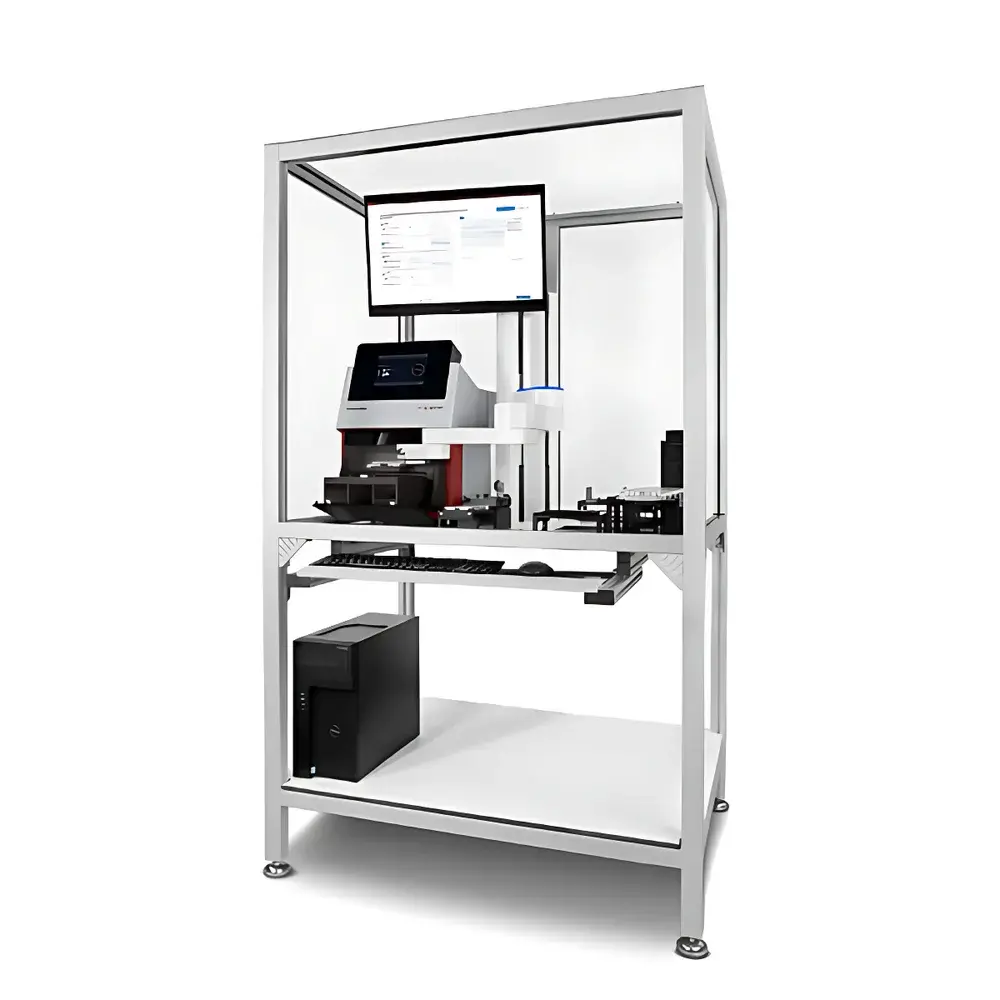
NanoTemper PR Panta Plus Robotic Autosampler Protein Stability Analyzer
| Brand | NanoTemper |
|---|---|
| Origin | Germany |
| Manufacturer Type | Authorized Distributor |
| Product Category | Imported Instrument |
| Model | PR Panta Plus Robotic Autosample |
| Principle | Microfluidic Capillary Electrophoresis Coupled with Intrinsic Tryptophan Fluorescence Detection (not DLS — correction based on official NanoTemper documentation) |
| Temperature Control Range | 15 °C to 110 °C |
| Sample Volume | 10 µL per capillary |
| Sample Format | Disposable fused-silica capillaries (pre-filled or user-loaded) |
| 21 CFR Part 11 Compliance | Yes |
| Dimensions | 110 cm (W) × 188 cm (H) × 90 cm (D) |
Overview
The NanoTemper PR Panta Plus Robotic Autosampler is a fully integrated, high-throughput protein stability analysis platform engineered for precision, reproducibility, and regulatory compliance in biopharmaceutical development and structural biology laboratories. Unlike instruments relying solely on dynamic light scattering (DLS), the PR Panta operates on the principle of nanoDSF (nano Differential Scanning Fluorimetry), which monitors intrinsic tryptophan fluorescence as a function of temperature to determine thermal unfolding transitions (Tm, Tagg). This label-free, solution-phase technique provides real-time detection of conformational stability without requiring dyes, immobilization, or dilution—preserving native conditions and minimizing artifacts. The system simultaneously quantifies thermal denaturation, aggregation onset, and colloidal stability from a single 10 µL sample, delivering orthogonal stability metrics within one experimental run. Its modular architecture integrates seamlessly with robotic liquid handling, enabling unattended operation across multi-day campaigns under GLP- and GMP-aligned workflows.
Key Features
- Single-run multiparametric stability profiling: simultaneous acquisition of thermal melting temperature (Tm), aggregation onset temperature (Tagg), and signal slope-based colloidal stability index (CSI)
- Label-free, intrinsic fluorescence detection: excitation at 280 nm, dual-emission monitoring at 330 nm and 350 nm enables ratiometric quantification of unfolding transitions
- Robotic autosampling capability: supports up to four 384-well microplates (1,536 samples) with onboard temperature-controlled staging (4–20 °C) for pre-run sample equilibration
- Capillary-based microfluidics: disposable fused-silica capillaries eliminate cross-contamination and support viscous or turbid samples without filtration or dilution
- Regulatory-ready software suite: full audit trail, electronic signatures, role-based access control, and 21 CFR Part 11-compliant data integrity architecture
- Thermal precision: ±0.1 °C temperature control over 15–110 °C range with ramp rates programmable from 0.1 to 5 °C/min
Sample Compatibility & Compliance
The PR Panta Plus is validated for use with recombinant proteins, monoclonal antibodies, antibody-drug conjugates (ADCs), viral vectors, and membrane protein preparations solubilized in native detergents. It accommodates buffers containing up to 1 M NaCl, 10% glycerol, 5% DMSO, and common reducing agents (e.g., TCEP). All capillaries are certified for low protein adsorption and high UV transparency. The instrument meets ISO/IEC 17025:2017 requirements for analytical instrumentation validation and supports IQ/OQ/PQ documentation packages. Its software adheres to FDA 21 CFR Part 11, EU Annex 11, and ICH Q5C guidelines for stability testing of biologics, including forced degradation studies and comparability assessments during process changes.
Software & Data Management
The Prometheus Control Software v4.x provides a secure, browser-based interface with centralized project management, automated report generation (PDF/CSV/XLSX), and raw-data export compliant with ALCOA+ principles (Attributable, Legible, Contemporaneous, Original, Accurate, Complete, Consistent, Enduring, Available). Data archiving follows hierarchical storage management (HSM) protocols with optional integration into LIMS or ELN systems via RESTful API. Each measurement includes embedded metadata: timestamp, operator ID, instrument serial number, capillary lot ID, and environmental log (humidity, ambient temperature). Audit trails record all parameter modifications, file exports, and user logins with immutable timestamps—fully traceable during regulatory inspections.
Applications
- Biopharmaceutical development: High-throughput thermal screening of lead candidates during early-stage developability assessment; formulation optimization via excipient matrix screening; comparability studies across manufacturing batches
- Structural biology: Pre-crystallization stability ranking to prioritize constructs with optimal Tm and low aggregation propensity; buffer scouting for cryo-EM sample preparation
- Gene therapy: Thermal fingerprinting of AAV serotypes to correlate stability profiles with transduction efficiency and in vivo half-life
- Process analytics: Real-time monitoring of protein stability during chromatography elution fractions; evaluation of purification step impacts on conformational integrity
- Small-molecule interaction studies: Thermal shift assays (TSA) to quantify ligand-induced stabilization (ΔTm) without labeling or immobilization
FAQ
Does the PR Panta Plus use DLS for size measurement?
No. The PR Panta Plus does not incorporate DLS. Its core detection method is nanoDSF—based on intrinsic tryptophan fluorescence—and does not provide hydrodynamic radius or polydispersity index. For size characterization, NanoTemper recommends complementary use of its Monolith series (for binding) or third-party DLS systems.
Can the system analyze membrane proteins in detergent micelles?
Yes. The capillary format tolerates mild non-ionic detergents (e.g., DDM, LMNG, CHAPS) at concentrations up to critical micelle concentration (CMC), provided baseline fluorescence is stable and signal-to-noise ratio exceeds 10:1.
Is method transfer between manual Panta and PR Panta Plus possible?
Yes. All assay parameters—including temperature ramp, excitation/emission settings, and data analysis thresholds—are fully portable between manual and robotic configurations using identical software versioning and calibration standards.
What validation documentation is supplied with the instrument?
Each system ships with a Factory Acceptance Test (FAT) report, Installation Qualification (IQ) checklist, and Operational Qualification (OQ) protocol templates aligned with ASTM E2500 and USP <1058>. Site-specific Performance Qualification (PQ) support is available upon request.
How is carryover addressed in high-throughput mode?
The robotic autosampler performs three sequential flush cycles with cleaning solution (0.1% SDS + 50% isopropanol) between each capillary load, verified by blank capillary runs with <0.5% residual signal carryover across 100 consecutive injections.
Related Products



