
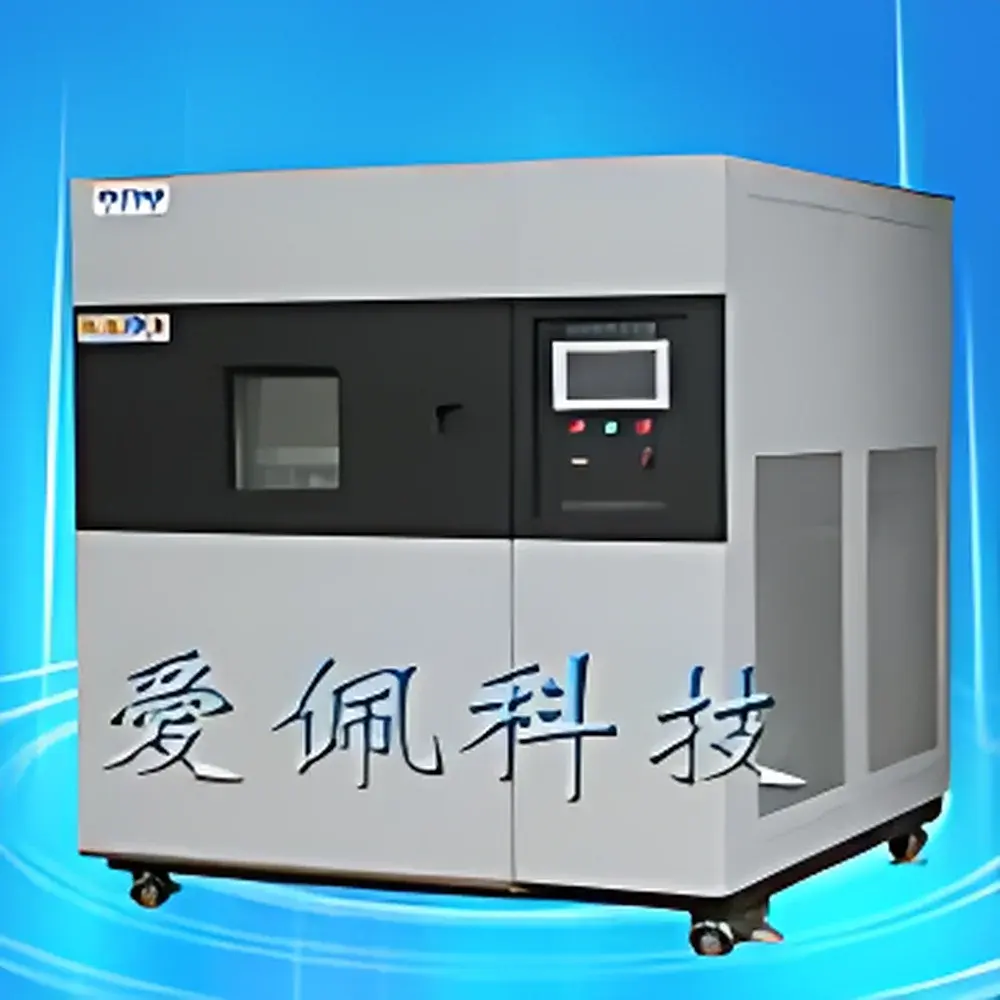
APKJ AP-CJ-C Three-Zone Thermal Shock Test Chamber
| Brand | APKJ |
|---|---|
| Origin | Guangdong, China |
| Manufacturer Type | Direct Manufacturer |
| Model | AP-CJ-C |
| Temperature Range | +150°C to –65°C |
| Preheat Range | RT to +200°C |
| Precool Range | RT to –70°C |
| Transfer Time | ≤10 s |
| Recovery Time | 3–5 min |
| Temperature Uniformity | ±2°C (per IEC 60068-3-5) |
| Compliance | GB/T 2423.1–2008, GB/T 2423.2–2008, GB/T 2423.22–2012, GJB 150.5–1986, GJB 360.7–1987, GJB 367.2–1987, QC/T 17–1992, EIA-364-32, IEC 60068-2-14 |
| Refrigeration System | Dual-stage cascade refrigeration |
| Low-stage Refrigerant | R23 or R508B |
| High-stage Refrigerant | R404A or R507 |
| Compressor Options | Tecumseh (hermetic), Bitzer or Copeland (semi-hermetic) |
| Interior Dimensions (W×H×D) | 60×40×40 cm |
| Exterior Dimensions (W×H×D) | 180×180×144 cm |
| Safety Protections | Overtemperature/overcooling cutouts (dual independent controllers), leakage circuit breaker (200/220/380 V AC), main supply breaker (400/415 V AC), redundant thermal fuses |
Overview
The APKJ AP-CJ-C Three-Zone Thermal Shock Test Chamber is an engineered environmental test system designed for accelerated evaluation of material and component reliability under rapid, extreme temperature transitions. Based on the principle of forced-air thermal transfer between isolated high-temperature, low-temperature, and test zones, the chamber subjects specimens to controlled, repeatable thermal shocks without mechanical movement of the sample—ensuring mechanical stability and measurement integrity during transient thermal loading. Unlike two-zone systems that rely on specimen shuttle mechanisms, the AP-CJ-C maintains samples stationary in a thermally isolated test compartment while alternately injecting pre-conditioned air from dedicated hot and cold reservoirs. This architecture eliminates vibration-induced artifacts and supports precise correlation between thermal stress and observed failure modes—critical for qualification testing in aerospace, automotive electronics, and semiconductor packaging applications.
Key Features
- Three-zone configuration: independent high-temperature zone (RT to +200°C), low-temperature zone (RT to –70°C), and static test zone—enabling true zero-movement thermal shock exposure.
- Programmable test profiles supporting single-zone high-temp/low-temp soak, dual-zone thermal cycling, and three-zone thermal shock—including optional ambient-temperature shock sequences not feasible with standard two-chamber designs.
- Dual-stage cascade refrigeration system optimized for deep-cold capability down to –65°C, using environmentally compliant refrigerants (R23/R508B low-stage; R404A/R507 high-stage) aligned with current U.S. EPA SNAP program guidelines.
- Selectable compressor configurations: hermetic Tecumseh units for general-purpose operation; semi-hermetic Bitzer or Copeland compressors for extended duty cycles and enhanced low-temperature stability.
- Temperature uniformity validated per IEC 60068-3-5: ±2°C across the effective test volume, measured at positions located 10% inward from each interior wall surface.
- Fast thermal transition performance: ≤10 seconds transfer time between thermal states; recovery to target setpoint within 3–5 minutes after shock initiation.
Sample Compatibility & Compliance
The AP-CJ-C accommodates rigid and semi-rigid specimens up to 60 × 40 × 40 cm (interior usable volume: 96 L), including printed circuit assemblies (PCBAs), molded plastic housings, metal castings, elastomeric seals, and hybrid microelectronic modules. Its static test zone design minimizes mechanical disturbance during shock events—essential for detecting microcrack propagation, interfacial delamination, or solder joint fatigue in high-reliability components. The system is fully compliant with internationally recognized environmental stress screening (ESS) and qualification standards, including GB/T 2423 series (China National Standards), GJB 150.5 and GJB 360.7 (PLA General Specifications), QC/T 17 (Automotive Industry Standard), EIA-364-32 (Electronic Industries Alliance), and IEC 60068-2-14 (Environmental Testing – Part 2-14: Tests – Test N: Change of temperature). All thermal profiles are traceable to NIST-traceable reference sensors calibrated prior to delivery.
Software & Data Management
The integrated control system features a 10.1-inch capacitive touchscreen HMI running proprietary firmware with real-time data logging at configurable intervals (1–60 s). Test sequences—including ramp rates, dwell times, cycle counts, and alarm thresholds—are defined via intuitive graphical workflow editors. Raw temperature data (hot zone, cold zone, test zone, and specimen surface if equipped with optional thermocouple inputs) are stored internally and exportable via USB or Ethernet as CSV files compliant with ASTM E29–23 formatting conventions. Audit trails record operator logins, parameter changes, and alarm events with timestamp and user ID—supporting GLP and GMP documentation requirements. Optional software add-ons enable remote monitoring via secure HTTPS interface and integration with enterprise MES/QMS platforms through Modbus TCP or OPC UA protocols.
Applications
This thermal shock chamber serves critical roles in product development and quality assurance workflows across regulated industries. In electronics manufacturing, it validates solder joint integrity and substrate CTE mismatch resistance per IPC-9701A. Automotive suppliers use it to verify connector housing dimensional stability and sealant adhesion under repeated thermal excursions simulating under-hood conditions. Aerospace component manufacturers apply it for MIL-STD-810G Method 503.5 qualification of avionics enclosures and composite structural panels. Research institutions employ the AP-CJ-C to study phase-transition kinetics in shape-memory alloys and polymer crystallinity shifts under cyclic thermal loading. Its ability to replicate field-relevant thermal transients—without introducing extraneous mechanical stress—makes it indispensable for root-cause analysis of thermally induced failures.
FAQ
What distinguishes the three-zone architecture from conventional two-zone thermal shock chambers?
The stationary test zone eliminates mechanical shuttle motion, reducing vibration artifacts and enabling higher-resolution detection of thermally induced microstructural defects.
Can the AP-CJ-C perform tests at –65°C continuously?
Yes—the dual-stage cascade refrigeration system with R23/R508B low-stage refrigerant enables sustained operation at –65°C, subject to ambient cooling water temperature and facility ventilation specifications.
Is the system compliant with FDA 21 CFR Part 11 for electronic records?
While the base controller does not include Part 11–compliant electronic signatures, optional validation packages provide audit trail generation, role-based access control, and electronic signature capability for regulated pharmaceutical and medical device testing environments.
How is temperature uniformity verified during factory acceptance testing?
Per IEC 60068-3-5, nine PT100 sensors are positioned at standardized locations (10% from each wall, plus center), and uniformity is confirmed over a 30-minute stabilization period at both +150°C and –40°C setpoints.
Are non-standard interior dimensions available?
Yes—APKJ offers custom engineering services for modified chamber volumes, extended temperature ranges (e.g., –70°C), and specialized airflow manifolds to accommodate oversized or geometrically complex test articles.



