
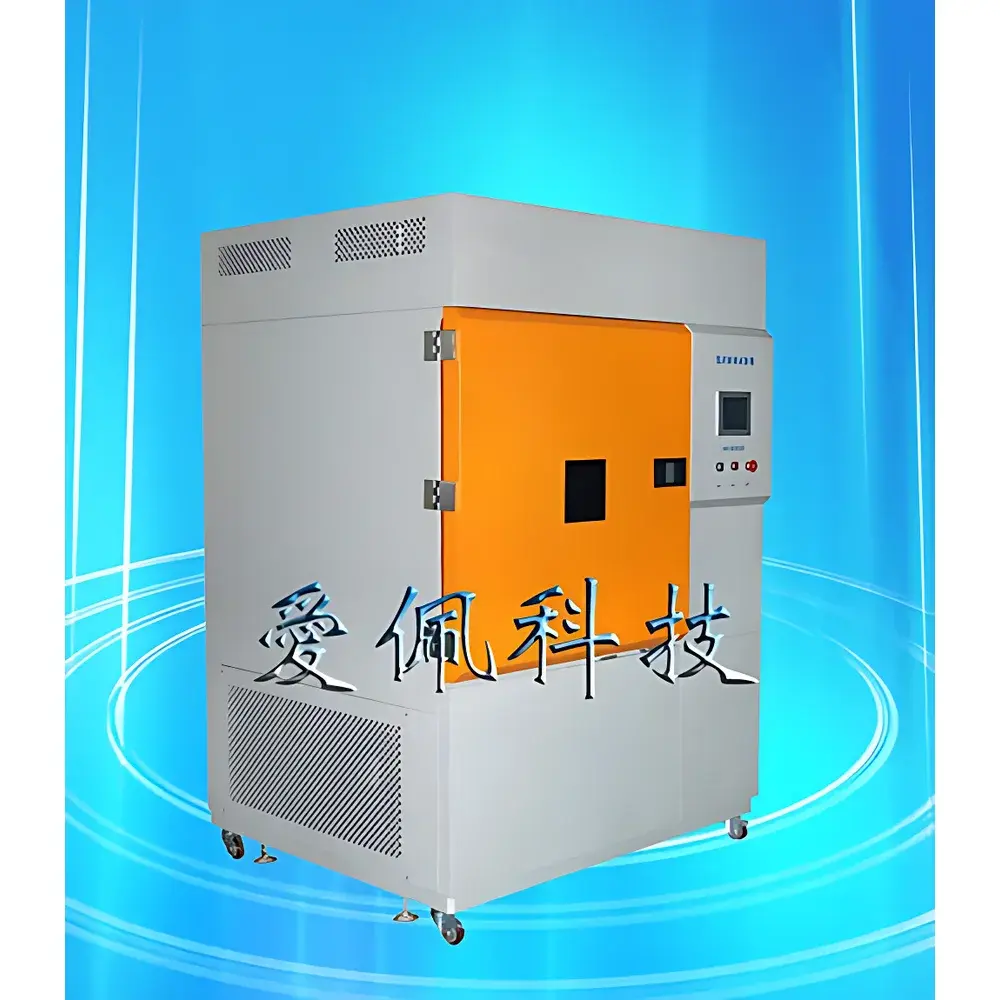
Apkji AP-XD-500C Air-Cooled Xenon Arc Weathering Test Chamber
| Brand | Apkji |
|---|---|
| Origin | Guangdong, China |
| Manufacturer Type | Direct Manufacturer |
| Country of Origin | China |
| Model | AP-XD-500C |
| Price | Upon Request |
| Internal Dimensions (D×W×H) | 500×760×500 mm |
| External Dimensions (D×W×H) | 1350×1350×1700 mm |
| Sample Tray Size | 450×720 mm |
| Temperature Range | RT+10°C to 70°C |
| Humidity Range | 65–98% RH |
| Black Panel Temperature Range | 63–100°C |
| Temperature Uniformity | ±2.0°C |
| Temperature Stability | ±0.5°C |
| Light Source | 4 × Imported Air-Cooled Xenon Lamps (3 operational + 1 spare) |
| Lamp Power | 1.8 kW per lamp |
| Total Heating Power | 2 kW |
| Humidification Power | 0.75 kW |
| Irradiance Spectrum | 290–800 nm |
| Max Irradiance | ≤300 W/m² |
| Distance Between Lamp and Sample Holder | 230–280 mm |
| Rainfall Duration | 0–999 min (continuous) |
| Rainfall Cycle | 0–240 min (intermittent) |
| Water Spray Cycle Options | 18 min ON / 102 min OFF or 12 min ON / 48 min OFF |
| Nozzle Orifice Diameter | Ø0.8 mm |
| Compliance | GB/T 2423.24–1995, ISO 4892-2 Method A |
Overview
The Apkji AP-XD-500C Air-Cooled Xenon Arc Weathering Test Chamber is an engineered environmental simulation system designed to replicate the photodegradative effects of natural sunlight, heat, and moisture—critical for evaluating material durability under accelerated aging conditions. Utilizing a high-stability air-cooled xenon arc lamp array, the chamber delivers a spectral power distribution closely aligned with terrestrial solar irradiance (290–800 nm), enabling accurate simulation of UV, visible, and near-infrared exposure. Unlike water-cooled systems, its air-cooled architecture eliminates dependency on external chilled water infrastructure, reducing installation complexity while maintaining thermal stability across extended test cycles. The unit operates within a controlled temperature range of RT+10°C to 70°C and humidity range of 65–98% RH, with precise black panel temperature monitoring (63–100°C) to reflect surface-level thermal stress experienced by real-world specimens. Designed in strict conformance with GB/T 2423.24–1995 and ISO 4892-2 Method A, it supports standardized weathering protocols for polymers, coatings, textiles, automotive interiors, and architectural materials.
Key Features
- Four imported air-cooled xenon lamps (three active + one redundant), each rated at 1.8 kW, ensuring long-term spectral consistency and operational redundancy.
- Programmable irradiance control with real-time feedback, supporting continuous or cyclic light exposure from 1 to 999 hours or minutes.
- Integrated rain simulation system with adjustable duration (0–999 min), cycle timing (0–240 min), and configurable spray intervals (e.g., 18/102 min or 12/48 min), using precision Ø0.8 mm nozzles.
- High-fidelity black panel temperature sensor with ±0.5°C stability and ±2.0°C uniformity across the test chamber workspace.
- Robust stainless-steel interior construction with quartz glass filter assemblies optimized for spectral filtering and UV transmission fidelity.
- Intelligent climate control algorithm managing simultaneous regulation of temperature, humidity, and irradiance without cross-interference.
- Dual-mode sample mounting: fixed-angle exposure platform (450×720 mm tray) with adjustable lamp-to-specimen distance (230–280 mm) for optimal irradiance homogeneity.
Sample Compatibility & Compliance
The AP-XD-500C accommodates flat-panel, molded, or flexible specimens up to 450 mm × 720 mm in footprint, including polymer films, painted metal substrates, composite laminates, and textile swatches. Its chamber geometry and lamp configuration ensure ≥90% irradiance uniformity across the sample plane per ISO 4892-2 Annex B requirements. All operational parameters—including irradiance intensity, temperature ramp rates, humidity setpoints, and wet/dry cycling—are traceable and repeatable under GLP-aligned test execution workflows. The system meets the technical validation criteria specified in GB/T 2423.24–1995 for xenon arc testing and supports full documentation compliance for internal quality audits, ISO 9001-certified labs, and regulatory submissions requiring evidence of environmental test repeatability.
Software & Data Management
The chamber integrates with Apkji’s proprietary Windows-based control software, providing intuitive scheduling of multi-step test profiles (e.g., light/heat → spray → dark condensation). Real-time data logging records irradiance (W/m²), black panel temperature (°C), chamber humidity (%RH), and elapsed cycle time at user-defined intervals (1 s to 60 min resolution). Export formats include CSV and PDF reports compliant with 21 CFR Part 11 requirements when configured with optional electronic signature and audit trail modules. All calibration events, maintenance logs, and parameter deviations are timestamped and stored locally with password-protected access levels for operators, supervisors, and QA reviewers.
Applications
This instrument is routinely deployed in R&D laboratories and QC departments for: accelerated weathering qualification of automotive exterior trim per SAE J2527; UV resistance validation of architectural sealants per ASTM D4329; colorfastness assessment of textile dyes per ISO 105-B02; photochemical stability screening of pharmaceutical packaging materials; and comparative degradation analysis of biodegradable polymers exposed to simulated subtropical climates. Its reproducible output enables direct correlation between laboratory test hours and field service life estimates—particularly valuable during early-stage material selection and formulation optimization.
FAQ
What standards does the AP-XD-500C comply with?
It conforms to GB/T 2423.24–1995 and ISO 4892-2 Method A for xenon arc exposure testing, with design parameters validated against both specifications.
Is distilled or deionized water required for operation?
Yes—the humidification and rain systems require water with resistivity ≥500 Ω·m to prevent nozzle clogging and heater scaling.
Can the chamber operate continuously for extended durations?
Yes—engineered for unattended 24/7 operation with built-in safety interlocks, lamp life monitoring, and thermal runaway protection.
What maintenance is recommended for long-term reliability?
Quarterly quartz filter inspection, biannual lamp replacement (based on accumulated irradiance dose), and annual calibration of temperature/humidity sensors per ISO/IEC 17025 guidelines.
Does Apkji provide installation support and operator training?
Yes—on-site commissioning, SOP development assistance, hands-on operation training, and remote diagnostic support are included in standard service packages.



