
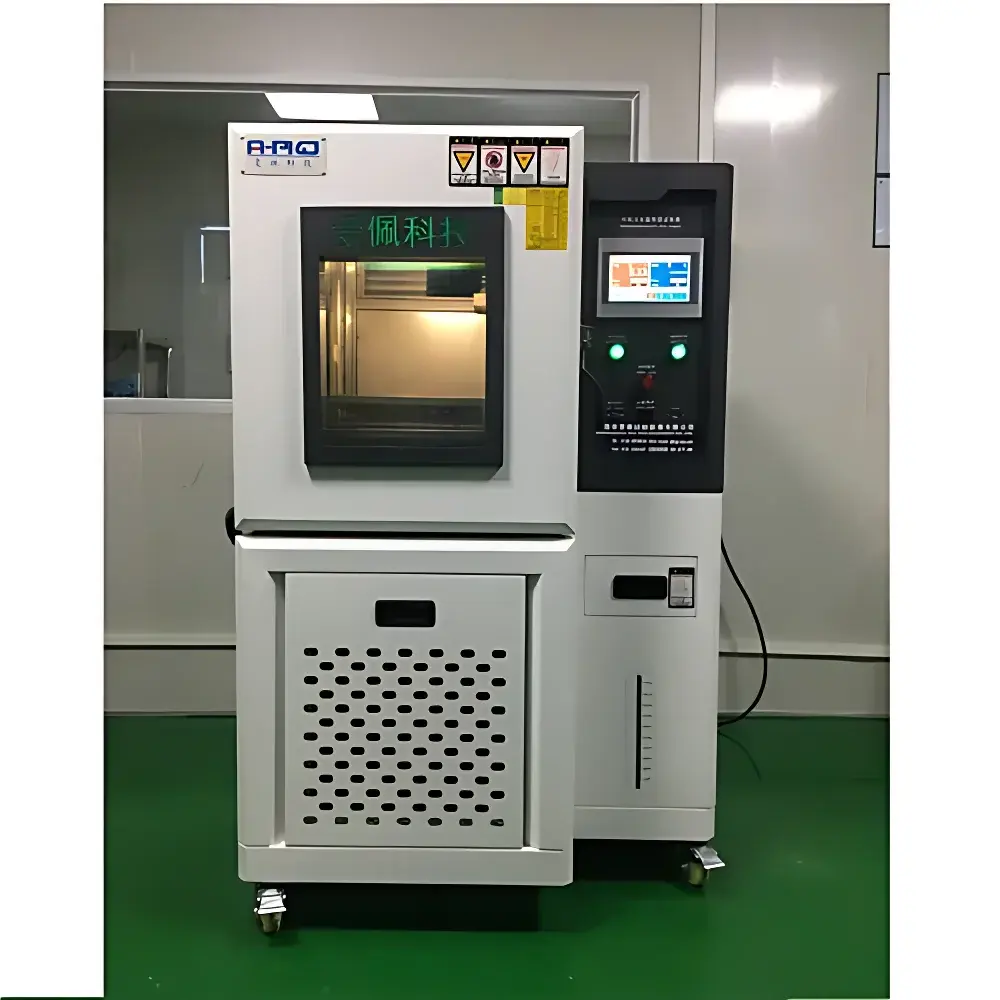
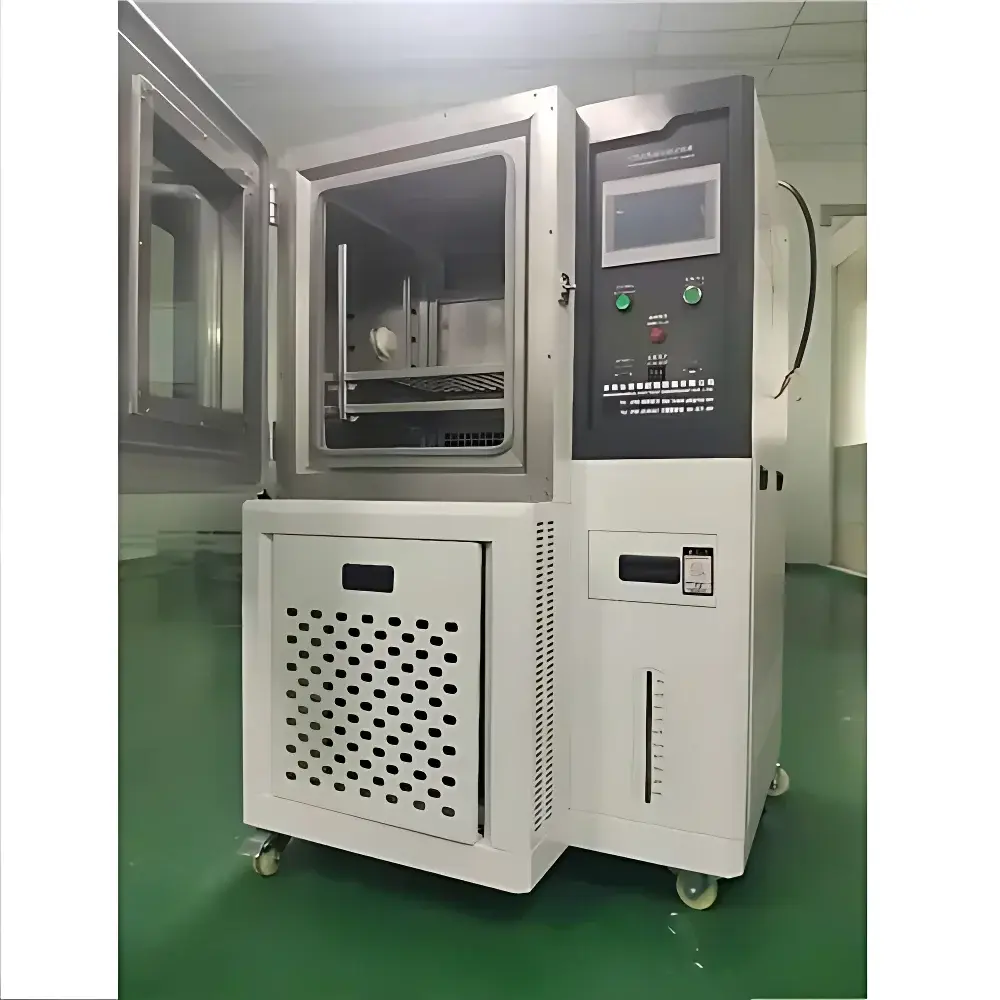
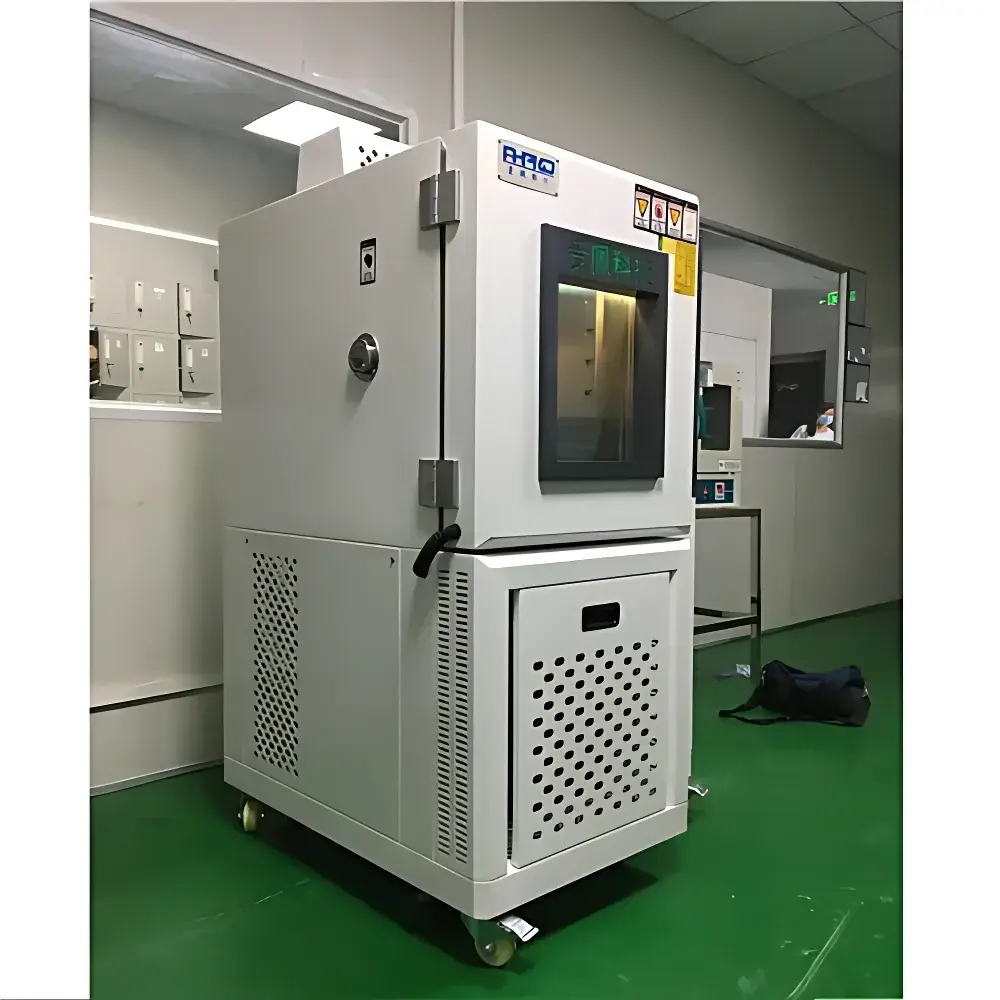
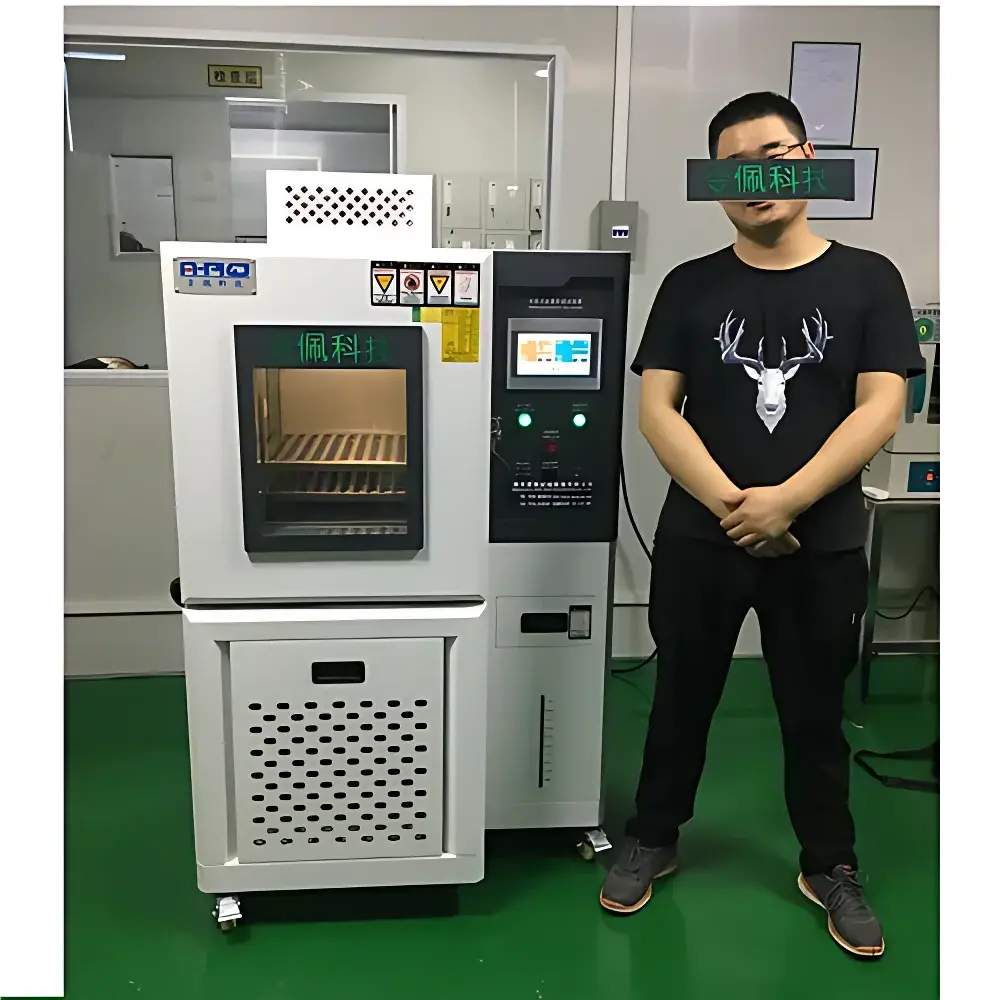
APKJ AP-GD-800 Walk-in Environmental Test Chamber for Automotive Component Testing
| Brand | APKJ |
|---|---|
| Origin | Guangdong, China |
| Manufacturer Type | Direct Manufacturer |
| Origin Category | Domestic |
| Model | AP-GD-800 |
| Internal Volume | 800 L (Customizable Dimensions) |
| Temperature Range | -70 °C to +150 °C |
| Temperature Uniformity | ±2 °C |
| Temperature Control Resolution | 0.01 °C |
| Heating Rate | 3.0 °C/min |
| Refrigeration System | Dual-stage cascade with hermetic Tecumseh (France) compressors |
| Refrigerants | Low-GWP blend — R23/R508B (low-temp stage), R404A/R507 (high-temp stage) |
| Compliance | GB/T 10589–1989, GB/T 10592–1989, GB/T 2423.1–1989 (Test Aa/Ab), GB/T 2423.4–1993 (Test Db), MIL-STD-810D Method 502.2 & 507.2 |
Overview
The APKJ AP-GD-800 is a walk-in environmental test chamber engineered for rigorous thermal and humidity simulation in automotive component validation, materials science, and industrial quality assurance. Designed around a dual-stage cascade refrigeration architecture, it delivers stable, repeatable temperature profiles across an extended operational range of –70 °C to +150 °C—critical for evaluating cold-start performance, under-hood thermal endurance, polymer dimensional stability, and electronic module reliability under extreme ambient conditions. Its large 800-liter internal volume accommodates full-scale assemblies—including ECUs, brake calipers, HVAC housings, and battery modules—while maintaining ISO 17025-aligned thermal uniformity (±2 °C) and high-resolution control (0.01 °C setpoint resolution). The chamber operates on a closed-loop air circulation system with multi-blade centrifugal fans, ensuring laminar airflow distribution and eliminating thermal stratification—a prerequisite for ASTM E1525-compliant accelerated aging studies.
Key Features
- Robust structural design featuring 100 mm thick polyurethane insulation (thermal conductivity ≤0.022 W/m·K) and double-sealed stainless-steel interior walls for long-term corrosion resistance and minimal heat leakage.
- Intelligent programmable controller with LAN/Ethernet interface supporting remote monitoring, real-time data logging, script-based test sequencing, and secure user-level access control (admin/operator/guest).
- Dual-stage refrigeration system utilizing hermetically sealed Tecumseh (France) compressors, optimized for deep-cold capability and energy-efficient operation across wide thermal transients.
- Environmentally compliant refrigerant pairing: R23/R508B (low-temperature stage) and R404A/R507 (high-temperature stage), fully aligned with U.S. EPA SNAP program requirements and projected regulatory viability beyond 2030.
- Integrated safety architecture including over-temperature cut-off, compressor high-pressure shutdown, door interlock, phase failure detection, and real-time fault diagnostics with on-screen remediation guidance.
- USB data export, RS-485 Modbus RTU support, and optional analog I/O for integration into centralized MES or SCADA environments.
Sample Compatibility & Compliance
The AP-GD-800 supports heterogeneous sample configurations—from single PCBs mounted on thermal trays to fully assembled ADAS sensor clusters or electric motor subassemblies. Its customizable internal dimensions allow for fixture mounting rails, cable ports, and power feedthroughs (up to 3× 32 A, 400 V AC). All operational parameters comply with internationally recognized standards for environmental stress screening, including GB/T 2423 series (equivalent to IEC 60068), MIL-STD-810D/G (Methods 502.2 and 507.2), and automotive OEM-specific protocols such as GMW14872, Ford CETP 00.00-L-467, and VW 80101. Calibration traceability follows ISO/IEC 17025 guidelines, with optional factory certification against NIST-traceable references.
Software & Data Management
The embedded controller firmware provides native support for test profile definition (ramp-soak-cycle sequences), event-triggered data capture (e.g., temperature deviation >1 °C), and time-synchronized logging at configurable intervals (1 s to 60 min). Export formats include CSV, PDF reports, and encrypted binary archives compatible with MATLAB, Python pandas, and LabVIEW. Audit trail functionality records all user actions—including parameter changes, manual overrides, and calibration events—with timestamp, operator ID, and IP address metadata—meeting FDA 21 CFR Part 11 and EU Annex 11 requirements for regulated environments. Optional cloud gateway enables TLS-secured remote access via HTTPS dashboard with role-based permissions.
Applications
- Automotive component qualification per ISO 16750-4 (climate loads) and SAE J2334 (corrosion and thermal cycling).
- Thermal shock evaluation of lithium-ion battery enclosures under rapid transition between –40 °C and +85 °C.
- Long-duration humidity soak testing (85 °C/85% RH) of automotive-grade connectors and harness assemblies.
- Pre-conditioning of optical sensors and camera modules prior to functional testing in autonomous driving validation rigs.
- Accelerated life testing of elastomeric seals, gaskets, and NVH damping materials under combined thermal-humidity stress.
- Environmental screening of infotainment units, radar modules, and vehicle telematics hardware per AEC-Q200 stress categories.
FAQ
What is the standard lead time for delivery and commissioning?
Standard delivery is 8–10 weeks from order confirmation; on-site installation, IQ/OQ documentation, and operator training are included in the scope.
Can the chamber be upgraded to include humidity control?
Yes—the AP-GD-800 platform supports retrofit integration of steam-based humidification (10–98% RH) and dehumidification modules, with full recalibration and compliance revalidation.
Is third-party calibration and certification available?
APKJ partners with CNAS-accredited laboratories to provide ISO/IEC 17025-compliant calibration certificates, including temperature mapping (9-point grid) and uncertainty budgets.
Does the controller support integration with existing PLM or QMS platforms?
Yes—via RESTful API, OPC UA, or Modbus TCP, enabling bi-directional synchronization with Siemens Teamcenter, PTC Windchill, or ETQ Reliance.
What maintenance schedule is recommended for sustained accuracy?
Compressor oil analysis and refrigerant purity verification every 24 months; annual sensor recalibration and airflow verification per IEC 60068-3-5.
Related Products



