
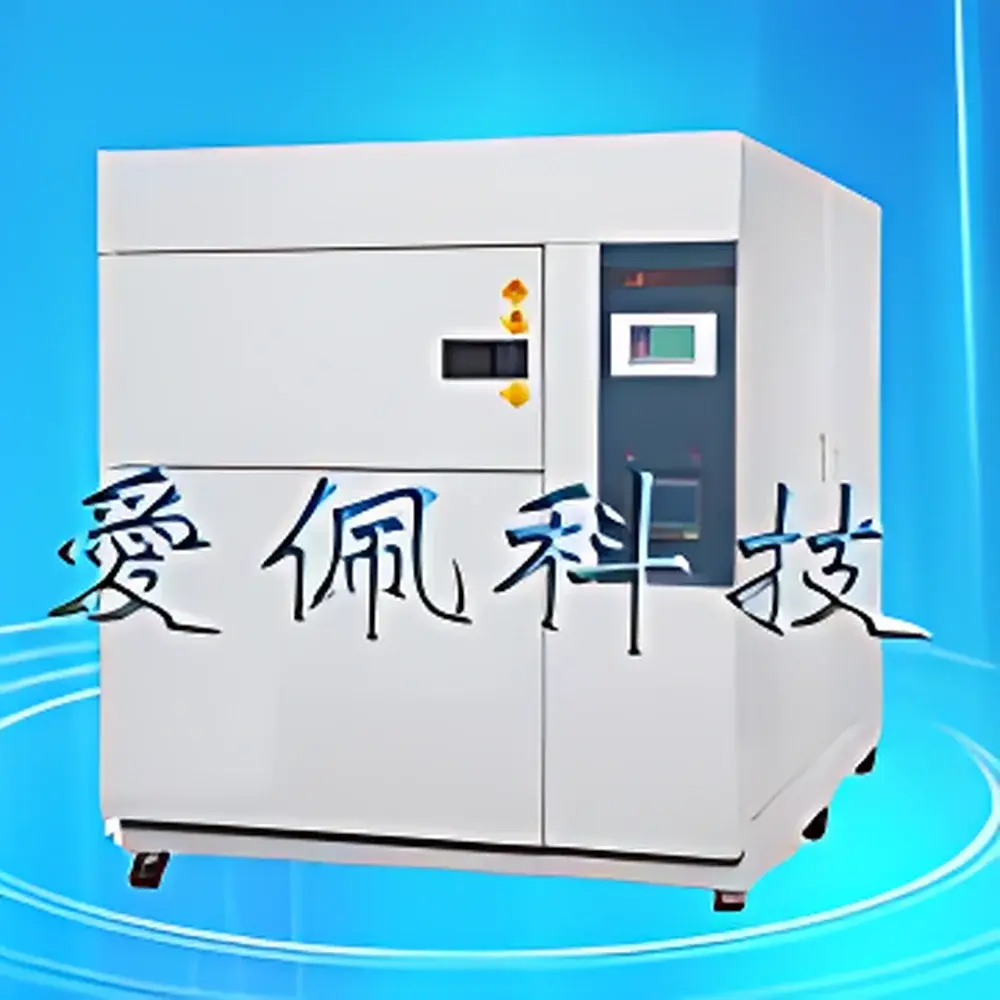
APKJ AP-CJ-150 Three-Zone Thermal Shock Test Chamber
| Brand | APKJ |
|---|---|
| Origin | Guangdong, China |
| Manufacturer Type | Direct Manufacturer |
| Model | AP-CJ-150 |
| Internal Dimensions (W×H×D) | 60×50×50 cm |
| External Dimensions (W×H×D) | 180×190×154 cm |
| Preheat Temperature Range | RT to +200 °C |
| Precool Temperature Range | –70 °C |
| Test Temperature Range Options | +150 °C to –40 °C / –55 °C / –65 °C |
| Temperature Stability | ±2 °C |
| Transfer Time (Test Zone ↔ Hot/Cold Zone) | ≤10 s |
| Recovery Time (–40 °C → +150 °C) | ≤5 min |
| Heating Rate (to +150 °C) | 30–40 min |
| Cooling Rate (to –55/–65/–75 °C) | 70–120 min |
| Construction | SUS304 Stainless Steel Interior & Exterior |
| Insulation | Rigid Polyurethane Foam + Glass Wool |
| Refrigeration System | Cascade Type |
| Low-Temp Stage Refrigerant | R23 or R508B |
| High-Temp Stage Refrigerant | R404A or R507 |
| Compressor Options | Tecumseh (hermetic) / Bitzer or Copeland (semi-hermetic) |
| Controller | TEMI (Korea) or OYO (Japan), optional |
| Power Supply | 3φ5w AC 380 V ±10%, 50/60 Hz |
| Total Power Consumption | 28–35–45 kW |
| Approx. Weight | 1300 kg |
| Safety Protections | Overtemperature, overpressure, overcurrent, phase sequence, oil pressure, low-voltage, water flow, and pressure relief protection |
| Compliance | GB/T 2423.1–2008, GB/T 2423.2–2008, GB/T 2423.22–2012, GJB 150.5–1986, GJB 360.7–1987, GJB 367.2–1987, QC/T 17–1992, EIA-364-32, IEC 60068-2-14 |
Overview
The APKJ AP-CJ-150 Three-Zone Thermal Shock Test Chamber is an engineered environmental simulation system designed for rapid, high-fidelity thermal shock testing of materials and electronic components under controlled, repeatable conditions. It operates on the principle of mechanical thermal inertia transfer—utilizing physically isolated high-temperature, low-temperature, and test zones—to subject specimens to abrupt, discontinuous temperature transitions without mechanical movement of the sample. This architecture eliminates positioning errors and thermal lag associated with single-chamber or two-zone shuttle mechanisms, ensuring superior measurement repeatability and traceability in accelerated reliability assessment. The chamber supports standardized thermal shock profiles per international test standards—including extreme step changes from –65 °C to +150 °C within ≤10 seconds—and is widely deployed in qualification testing for aerospace avionics, automotive ECUs, semiconductor packaging, and high-reliability PCB assemblies.
Key Features
- Three-zone independent thermal reservoir design: dedicated high-temp zone (RT to +200 °C), low-temp zone (down to –70 °C), and static test zone—eliminating specimen motion and minimizing thermal mass interference.
- Cascade refrigeration system with dual-stage compressors and environmentally compliant refrigerants (R23/R508B + R404A/R507), enabling stable sub-zero operation while meeting U.S. EPA and EU F-Gas Regulation Phase-down timelines.
- High-speed pneumatic damper actuation ensures ≤10-second thermal transfer between zones; recovery time from –40 °C to +150 °C is ≤5 minutes—validated per IEC 60068-2-14 Annex A.
- Controller options include TEMI 990 (Korea) or OYO 7110 (Japan), both supporting programmable multi-step profiles, real-time data logging, USB export, and audit-trail-enabled user authentication—compatible with GLP/GMP documentation requirements.
- SUS304 stainless steel construction (interior and exterior), reinforced with rigid polyurethane foam (≥100 mm thickness) and glass wool backing, achieves thermal leakage <0.8 K/h under steady-state operation.
- Comprehensive safety architecture includes dual independent overtemperature cutouts (mechanical + controller-based), compressor oil pressure monitoring, phase-sequence detection, water-cooling flow interlock, and pressure-relief valves compliant with ASME BPVC Section VIII.
Sample Compatibility & Compliance
The AP-CJ-150 accommodates test specimens up to 60 × 50 × 50 cm (W×H×D) and supports non-standard configurations via custom internal fixtures, cable ports (φ50 mm, optional), viewing windows, and adjustable stainless steel shelves. Its thermal uniformity—verified per GB/T 2423.22–2012 Clause 6.3—maintains ±2 °C deviation across 90% of the working volume at any setpoint. The system is validated for conformance to multiple national and industry-specific thermal shock protocols, including MIL-STD-810H Method 503.5, JEDEC JESD22-A106C, and AEC-Q200 stress categories. All control firmware and calibration records are structured to support FDA 21 CFR Part 11 compliance when paired with appropriate electronic signature modules and networked audit logging.
Software & Data Management
The integrated controller provides native CSV export of time-stamped temperature traces (sampled at 1 Hz), alarm history with timestamped event codes, and profile versioning with user-defined metadata tags. Optional Ethernet/IP or RS-485 Modbus RTU connectivity enables integration into centralized MES or LIMS platforms. Data integrity safeguards include write-protected memory partitions, cyclic redundancy checks (CRC-32) on all logged files, and automatic backup to external USB storage. For regulated environments, optional validation packages include IQ/OQ documentation templates aligned with ISO/IEC 17025 and ASTM E2500 guidelines.
Applications
This chamber is routinely employed in failure mode acceleration studies for solder joint fatigue (IPC-9701), polymer embrittlement analysis (ASTM D790), conformal coating adhesion verification (IPC-CC-830), and die-attach delamination screening in power modules. It serves as a critical tool in Design Verification Testing (DVT) for automotive ADAS sensors operating across –40 °C to +125 °C ambient envelopes, and in qualification of space-grade connectors per ECSS-Q-ST-70-08C. Universities and national metrology institutes use it for reference material stability assessment and inter-laboratory round-robin studies requiring NIST-traceable thermal transient characterization.
FAQ
What distinguishes a three-zone thermal shock chamber from a two-zone shuttle-type system?
The three-zone architecture isolates thermal mass completely: samples remain stationary in the test zone while hot/cold air is pneumatically directed into that zone. This avoids mechanical wear, vibration-induced failures, and thermal overshoot common in moving-basket designs—critical for fragile MEMS devices and wafer-level packages.
Can the AP-CJ-150 perform ramp-and-soak profiles, or is it limited to step-change shocks?
It supports both modes: standard thermal shock cycles (e.g., –55 °C ↔ +150 °C), as well as hybrid profiles combining dwell periods, linear ramps (0.5–10 °C/min), and hold steps—programmable via the TEMI or OYO interface.
Is calibration certification included with shipment?
Yes—each unit ships with a factory calibration report traceable to CNAS-accredited standards (equivalent to ISO/IEC 17025), covering temperature uniformity, transition speed, and controller accuracy across the full operational range.
How is refrigerant maintenance handled under evolving environmental regulations?
R23 and R508B are currently exempt from phase-out under EPA SNAP Rule 27 and EU Regulation (EU) No 517/2014, with no mandated end-of-life date. APKJ provides sealed-system service kits and OEM-certified technician training for field replacement.
What electrical infrastructure is required for installation?
A dedicated 3-phase, 5-wire 380 V ±10% supply with minimum 63 A circuit breaker per phase is required; cooling water must be supplied at 15–30 °C, ≥3 bar pressure, and ≥1.2 m³/h flow rate for condenser heat rejection.



