
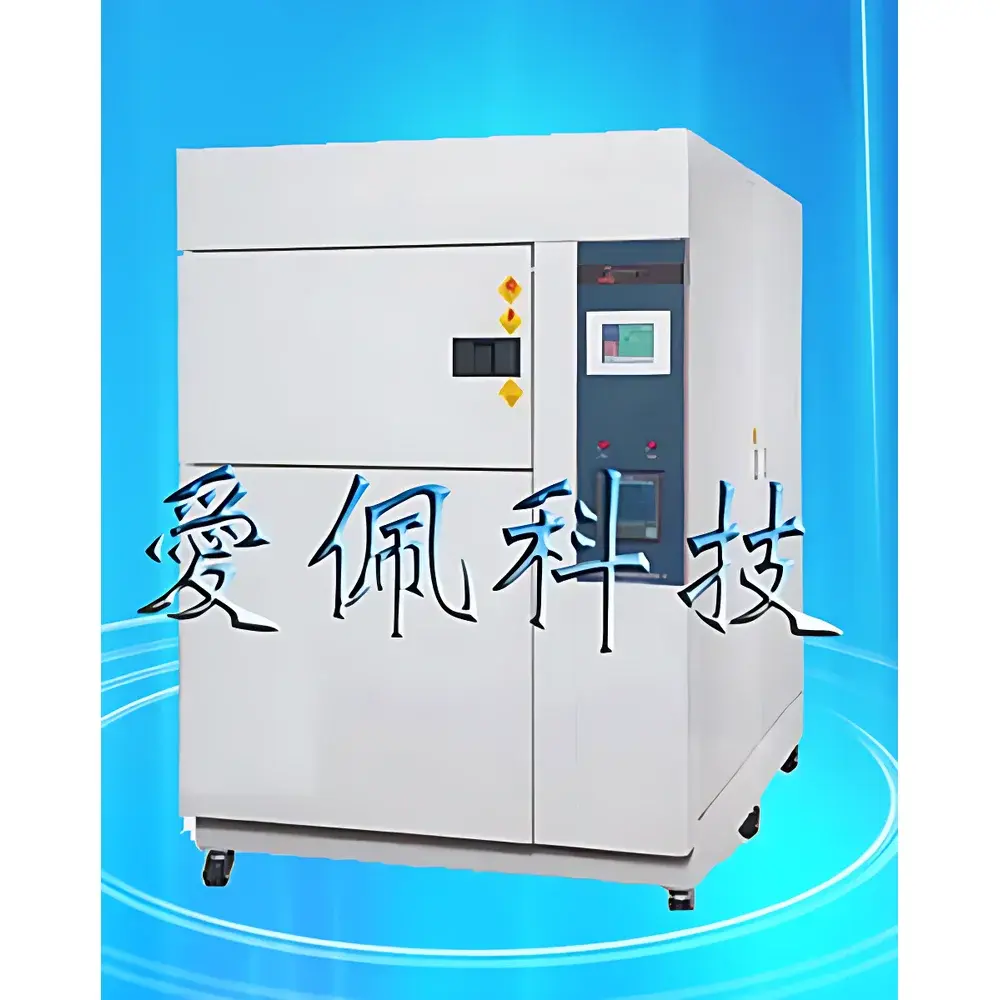
APKJ AP-CJ-225 Three-Zone Thermal Shock Test Chamber
| Brand | APKJ |
|---|---|
| Model | AP-CJ-225 |
| Type | Three-Zone (Hot/Cold/Test) Thermal Shock Test Chamber |
| Origin | Guangdong, China |
| Manufacturer | APKJ Technology Co., Ltd. |
| Refrigeration System | Cascade-type with dual-stage compressors (TECUMSEH or Bitzer optional) |
| Refrigerants | R404A/R23 or R507/R508B |
| Preheat Range | RT to +200 °C |
| Precool Range | RT to −70 °C |
| Test Temp Range | +150 °C to −40 °C / −55 °C / −65 °C (configurable) |
| Temperature Uniformity | ±2 °C |
| Transfer Time | ≤10 s |
| Recovery Time | 3–5 min |
| Interior Material | SUS304 Stainless Steel |
| Insulation | Rigid Polyurethane Foam + Glass Wool |
| Controller | TEMI (Korea) or OYO (Japan), programmable |
| Compliance | Designed for ASTM D5229, ISO 11359, IEC 60068-2-14, MIL-STD-810G thermal shock protocols |
Overview
The APKJ AP-CJ-225 Three-Zone Thermal Shock Test Chamber is an engineered environmental test system designed to evaluate material resilience under rapid, extreme temperature transitions. Unlike two-zone (hot/cold) configurations, this three-chamber architecture—comprising independent high-temperature, low-temperature, and test zones—enables precise, static-sample thermal shock testing without mechanical movement of the specimen. The device operates on the principle of controlled thermal mass transfer: pre-conditioned air from either the hot or cold reservoir is pneumatically directed into the test zone via high-efficiency centrifugal blowers, achieving temperature transitions in ≤10 seconds. This methodology ensures reproducible thermal gradients and eliminates positional artifacts associated with basket-transfer mechanisms. The chamber supports standardized thermal shock profiles including high-to-low, high-to-ambient, and ambient-to-low sequences—critical for validating solder joint integrity, polymer dimensional stability, coating adhesion, and semiconductor packaging reliability in accordance with international test standards.
Key Features
- Three-zone segregated architecture: dedicated high-temp (RT to +200 °C), low-temp (RT to −70 °C), and static test chambers—eliminating sample displacement and enhancing measurement repeatability.
- Cascade refrigeration system with dual-stage compression: low-stage refrigerant (R23 or R508B) paired with high-stage (R404A or R507) enables stable sub−65 °C operation while complying with current U.S. EPA SNAP program guidelines for ozone-depleting substance alternatives.
- Selectable compressor options: TECUMSEH hermetic compressors for general-purpose reliability; Bitzer semi-hermetic units for extended duty cycles and enhanced low-temperature performance.
- Programmable controller interface: TEMI (South Korea) or OYO (Japan) touchscreen HMI with multi-segment ramp-soak profiles, real-time data logging, and user-defined alarm thresholds.
- Thermal insulation: 150 mm composite wall construction using rigid polyurethane foam (λ ≈ 0.022 W/m·K) and layered glass wool—minimizing parasitic heat gain and ensuring energy-efficient stabilization.
- Structural integrity: interior and exterior chambers fabricated from 1.2 mm SUS304 stainless steel with electropolished weld seams—resistant to corrosion from condensate, salt mist, and thermal cycling fatigue.
Sample Compatibility & Compliance
The AP-CJ-225 accommodates specimens up to 60 × 50 × 50 cm (W×H×D), supporting diverse sample geometries including PCB assemblies, automotive plastic housings, elastomeric seals, aerospace composites, and medical device enclosures. Its static-test design preserves mechanical alignment during exposure—essential for post-test metrology (e.g., CMM, optical profilometry). The chamber meets functional requirements of ASTM D5229/D5229M (low-temperature impact resistance of plastics), ISO 11359-2 (thermomechanical analysis of polymers), IEC 60068-2-14 (environmental testing—change of temperature), and MIL-STD-810G Method 503.5 (thermal shock). While not certified as GLP/GMP-compliant out-of-the-box, its audit-ready data logging (with time-stamped setpoints, actual temps, and alarm events), password-protected parameter modification, and exportable CSV/Excel reports support validation under FDA 21 CFR Part 11 when integrated with qualified IT infrastructure.
Software & Data Management
Both TEMI and OYO controllers provide embedded 16-channel data acquisition at 1 Hz resolution, recording chamber setpoints, sensor feedback (PT100 Class A), blower status, compressor discharge temperatures, and door interlock states. Data is stored internally (≥30 days at 1 Hz) and exportable via USB or Ethernet to third-party LIMS or MES platforms. Optional PC-based software (APKJ TestSuite v3.2) adds automated report generation compliant with ISO/IEC 17025 documentation requirements—including uncertainty budgeting per GUM (Guide to the Expression of Uncertainty in Measurement). All firmware updates are delivered via signed binary packages with SHA-256 verification to prevent unauthorized modification—a prerequisite for regulated laboratory environments.
Applications
- Electronics reliability: qualification of BGA solder joints, flex circuit delamination, and MEMS package hermeticity under repeated thermal cycling.
- Automotive components: validation of dashboard plastics, LED headlamp housings, and battery module gaskets across −40 °C to +150 °C extremes.
- Aerospace materials: assessment of carbon-fiber-reinforced polymer (CFRP) matrix cracking and adhesive bondline degradation after 500+ shock cycles.
- Medical device packaging: verification of sterile barrier integrity (ISO 11607) following accelerated aging simulations.
- Research & development: correlation of thermal expansion coefficients (CTE) between dissimilar materials (e.g., silicon die vs. organic substrate) using synchronized strain gauge inputs.
FAQ
What distinguishes a three-zone thermal shock chamber from a two-zone system?
A three-zone configuration maintains separate hot, cold, and test chambers—keeping the specimen stationary while transferring conditioned air. This eliminates mechanical wear from basket movement, improves temperature uniformity (±2 °C), and enables ambient-temperature shock phases not feasible in two-zone designs.
Can the AP-CJ-225 perform non-standard thermal profiles?
Yes. The TEMI/OYO controller supports up to 99 programmable segments with variable ramp rates, soak durations, and loop counts—allowing custom profiles such as dwell-at-−65 °C for 2 hours followed by 150 °C ramp in 3 minutes.
Is remote monitoring supported?
Standard Ethernet (TCP/IP) and optional RS-485 Modbus RTU interfaces enable integration with building management systems (BMS) or centralized lab monitoring platforms. No cloud connectivity is included by default to maintain data sovereignty.
What maintenance intervals are recommended for the cascade refrigeration system?
Compressor oil analysis every 2,000 operating hours; refrigerant leak checks annually; blower filter replacement quarterly; calibration of PT100 sensors biannually per ISO/IEC 17025 traceable procedures.
Does APKJ provide IQ/OQ documentation for GxP environments?
Factory-issued IQ templates and test protocols are supplied. OQ execution requires on-site witness by customer-qualified personnel; APKJ engineers may assist as consultants under separate service agreement.



