
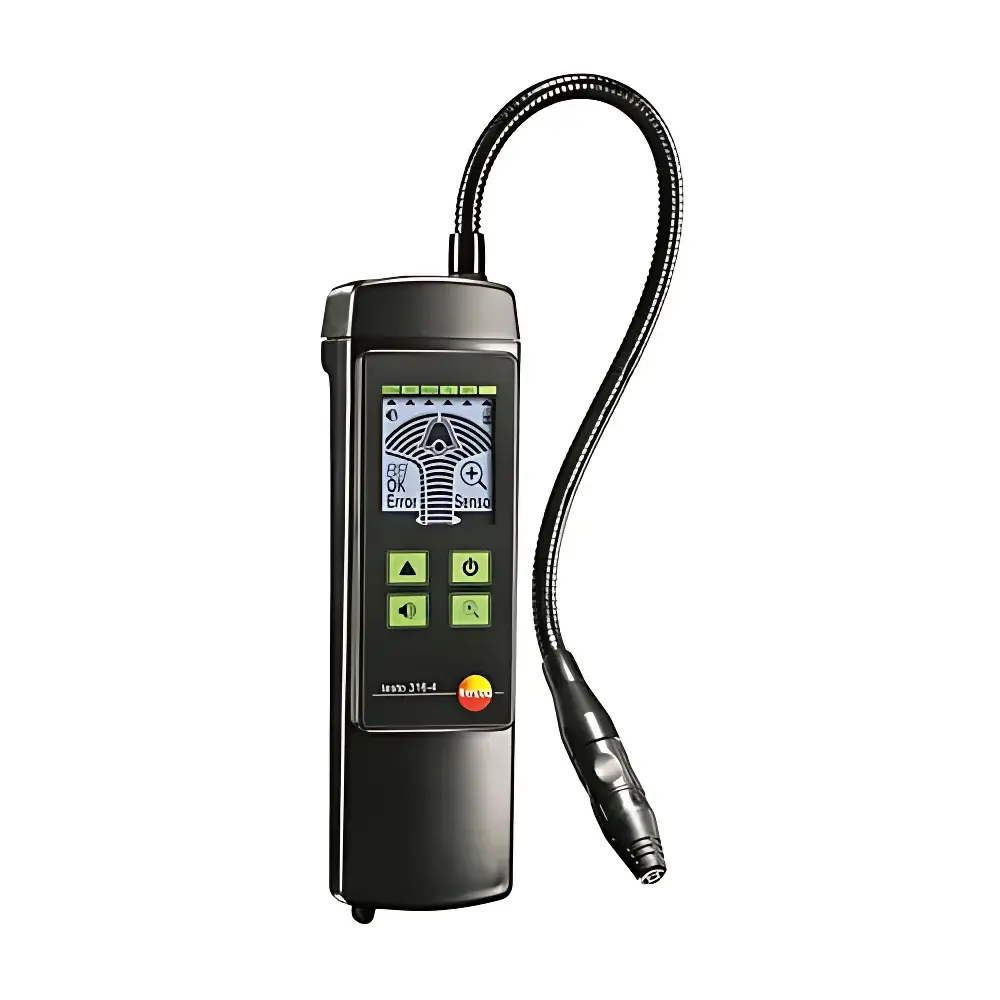
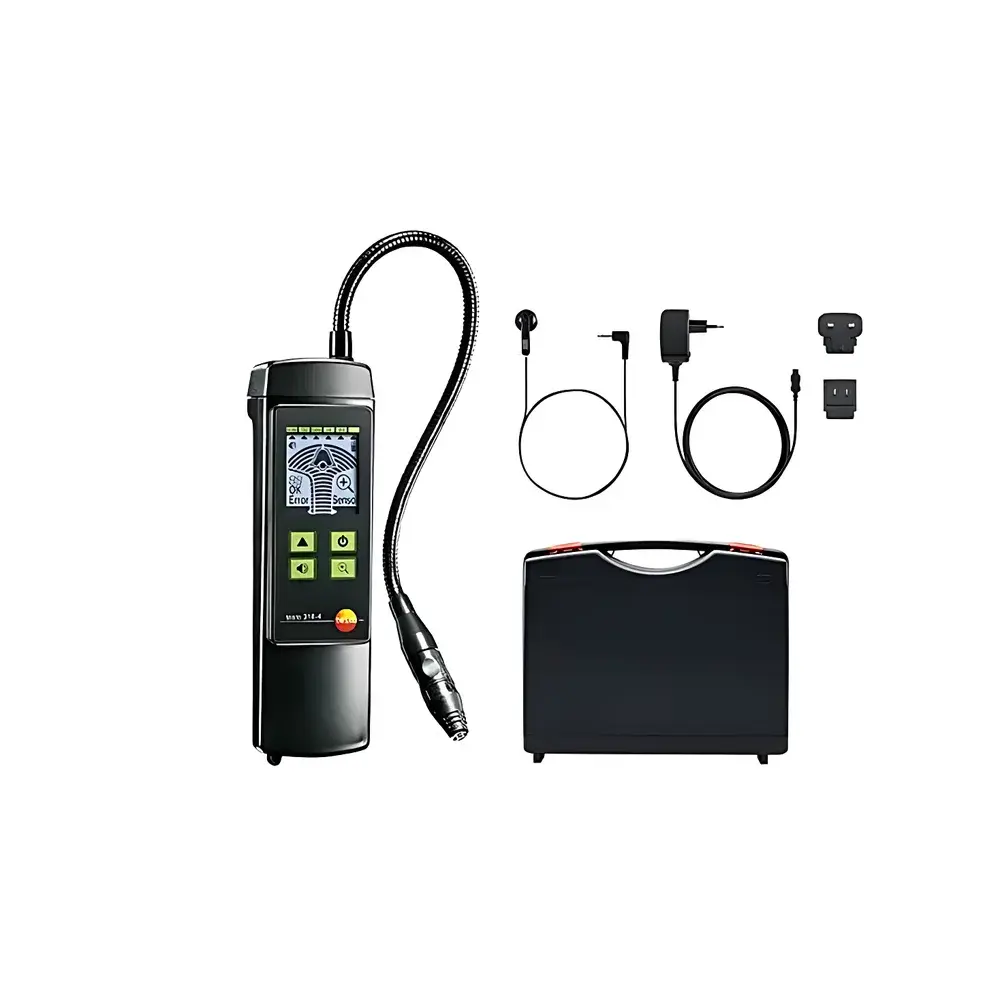
testo 316-4 Refrigerant Leak Detector Kit
| Brand | testo |
|---|---|
| Origin | Germany |
| Model | 0563 3164 |
| Detection Sensitivity | <3 g/year (per EN 14624:2012) |
| Detectable Refrigerants | R134a, R22, R404A, H₂, CFCs, HCFCs, HFCs (NH₃ requires optional probe) |
| Operating Temperature | -20 °C to +50 °C |
| Relative Humidity Range | 20–80 % RH |
| Response Time | <1 s |
| Warm-up Time | <50 s |
| Weight | 348 g |
| Dimensions (L×W×H) | 190 × 57 × 42 mm |
| Gooseneck Length | 370 mm |
| Battery | Integrated NiMH pack (6 cells), ~6 h continuous operation |
| Storage Temperature | -25 °C to +70 °C |
| Alarm Type | Visual (LED color shift: green → red) and audible (adjustable tone) |
| Compliance | EN 14624:2012 |
Overview
The testo 316-4 Refrigerant Leak Detector Kit is an engineered solution for precision leak detection in stationary and mobile refrigeration, air conditioning, and heat pump systems. Based on heated diode (HD) sensor technology, it delivers rapid, selective, and repeatable detection of halogenated and hydrogen-based refrigerants—including CFCs, HCFCs, HFCs, and molecular hydrogen (H₂)—with a certified sensitivity of less than 3 g/year per EN 14624:2012. Unlike catalytic or infrared-based detectors, the HD principle ensures high specificity to halocarbons while minimizing cross-sensitivity to common background gases such as alcohol vapors or solvents. The instrument operates across a wide environmental envelope (−20 °C to +50 °C), making it suitable for field use in industrial chillers, supermarket cold rooms, transport refrigeration units, and HVAC maintenance operations. Its compact, ergonomic design integrates a 370 mm flexible gooseneck probe that enables access to confined joints, flared connections, and evaporator coil bends—critical zones where micro-leaks commonly originate.
Key Features
- EN 14624-compliant sensitivity: Verified detection threshold <3 g/year for R134a, R22, and R404A—meeting the strictest European standard for refrigerant leak detection in professional service applications.
- Multi-refrigerant capability: Factory-calibrated for broad-spectrum detection of CFC, HCFC, HFC, and H₂ refrigerants; optional NH₃-specific probe available for ammonia-based industrial systems (e.g., food processing plants, cold storage facilities).
- Real-time visual and auditory feedback: Dual-mode alarm system: LED status indicator shifts from green (normal) to red (leak detected); simultaneous audible tone with adjustable volume. Includes noise-isolating earphones for reliable localization in compressor rooms or mechanical spaces exceeding 85 dB(A).
- User-serviceable sensor module: The heated diode sensor head is designed for on-site cleaning using isopropyl alcohol and lint-free swabs—no recalibration required post-cleaning. Sensor lifetime is extended through periodic decontamination, reducing long-term operational cost.
- Intuitive leak localization aid: Analog pointer display dynamically tracks signal amplitude; “peak-hold” function captures maximum concentration during scanning, enabling precise pinpointing of leak origin without requiring continuous operator attention.
- Rugged field-ready construction: IP54-rated housing, black matte finish for glare reduction, and integrated battery management ensure consistent performance under vibration, dust exposure, and thermal cycling typical in HVAC/R technician workflows.
Sample Compatibility & Compliance
The testo 316-4 is validated for direct sampling of vapor-phase refrigerant emissions at ambient pressure. It is not intended for liquid-phase or high-pressure injection point testing. Detection performance is maintained across the full specified humidity range (20–80 % RH), with no drift correction required under normal operating conditions. All factory calibrations are traceable to NIST-traceable reference standards. The device complies with EN 14624:2012 for refrigerant leak detection instrumentation and supports documented maintenance procedures aligned with ISO/IEC 17025 laboratory quality requirements. While not intrinsically safe, its low-power electronics (max. 3.6 V DC supply) and non-sparking sensor architecture meet general safety expectations for use in non-hazardous classified areas per IEC 60079-0.
Software & Data Management
The testo 316-4 operates as a standalone, real-time measurement tool without onboard data logging or Bluetooth/Wi-Fi connectivity. However, its analog output and consistent response behavior support integration into external documentation workflows. Technicians routinely pair the device with testo’s Smart Probes app (via compatible smartphone and optional IR interface) for time-stamped photo annotation of leak locations, or export results to CMMS platforms via manual entry. For regulated environments subject to EPA Section 608 or F-Gas Regulation (EU No. 517/2014), the instrument’s EN 14624 certification and stable calibration history satisfy audit requirements for leak detection methodology validation. Full traceability is maintained through user-maintained calibration logs, sensor cleaning records, and warm-up verification checks performed prior to each service call.
Applications
- Pre-commissioning and commissioning leak checks on new refrigeration circuits (per ASHRAE Standard 15 and EN 378)
- Routine preventive maintenance of commercial HVAC systems and industrial chillers
- Post-repair verification following component replacement (compressors, expansion valves, driers)
- Regulatory compliance audits for refrigerant containment (e.g., EU F-Gas Regulation, U.S. EPA SNAP program)
- Troubleshooting intermittent cooling failures linked to slow, chronic leakage
- Training and certification labs for HVAC/R apprenticeship programs requiring standardized leak detection methodology
FAQ
Does the testo 316-4 require annual recalibration?
No mandatory annual recalibration is stipulated by testo; however, users must perform functional verification before each day’s use per EN 14624:2012 Clause 6.3. A zero-check and span-check using certified R134a test gas (100 ppm) are recommended weekly in high-use environments.
Can the sensor detect ammonia (NH₃) out of the box?
No—the base configuration does not detect NH₃. An optional NH₃-specific probe (testo 0563 3164 11) must be installed and configured separately. This variant meets EN 14624 Annex B requirements for ammonia detection.
Is the device suitable for use in explosive atmospheres?
No—it is not ATEX or IECEx certified. Use only in non-classified areas where refrigerant concentrations remain below 25 % LEL.
How long does the battery last during continuous operation?
Approximately 6 hours at 25 °C ambient temperature with active sampling and backlight enabled. Battery runtime decreases by ~15 % per 10 °C drop below 20 °C.
What maintenance is required beyond sensor cleaning?
The instrument requires no routine internal servicing. Users should inspect the gooseneck for kinks or cracks, verify LED and buzzer functionality during startup, and store the unit in its protective case at temperatures between −25 °C and +70 °C when not in use.
Related Products







