
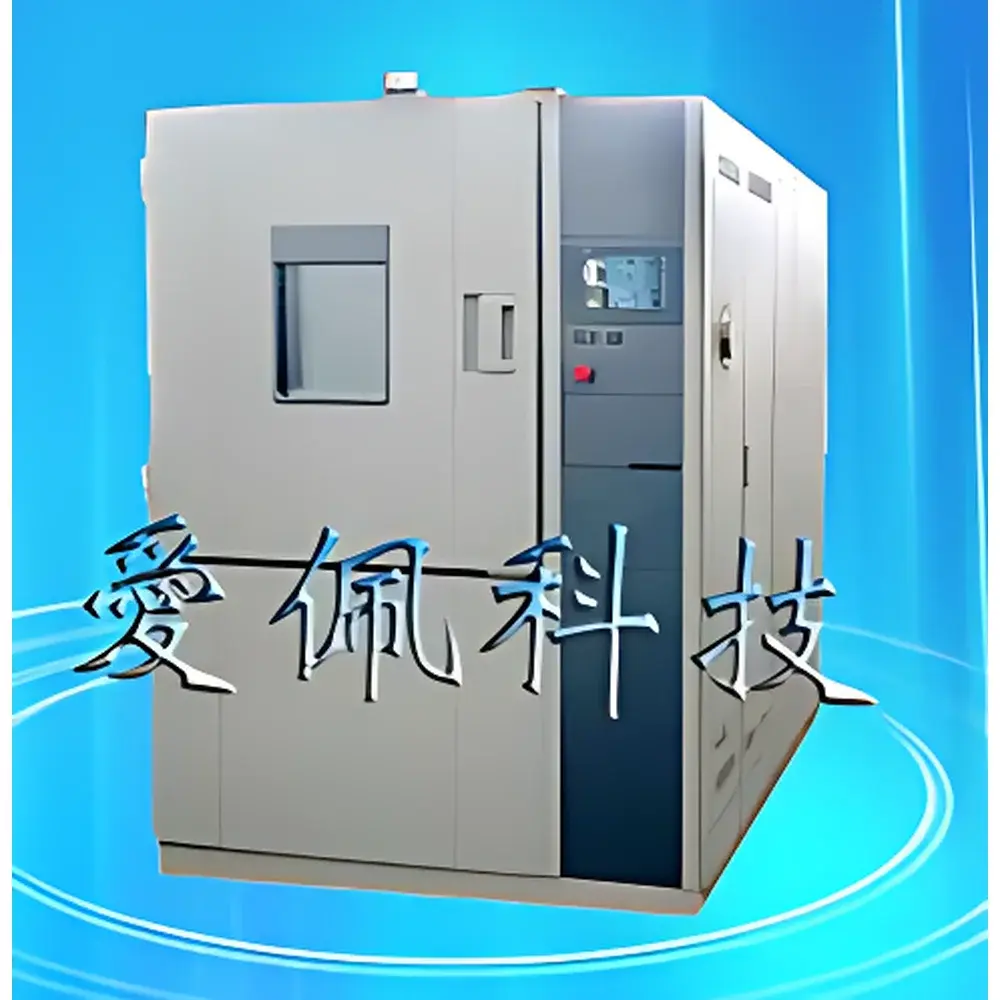
Apkji AP-KS-A1 Advanced Rapid Temperature Change Chamber for Electronic & Optoelectronic Components
| [Brand | Apkji (APKJ) |
|---|---|
| Origin | Guangdong, China |
| Manufacturer Type | Direct Manufacturer |
| Model | AP-KS-A1 |
| Temperature Range | −70 °C to +100 °C (optional +180 °C) |
| Ramp Rate | Up to 10 °C/min (LN₂ option), 5 °C/min (standard) |
| Temperature Uniformity | ±2 °C (−70 °C to +100 °C) |
| Control Accuracy | ±0.5 °C |
| Resolution | 0.1 °C (temperature), 0.01 °C (internal sensor) |
| Cooling System | Dual-stage air-cooled hermetic compressors (imported from Europe & USA) with finned-tube evaporator |
| Heating System | SUS#304 finned tubular heaters |
| Insulation | Polyurethane foam + glass wool |
| Interior Material | Mirror-finish SUS304 stainless steel |
| Exterior Material | Powder-coated special steel |
| Air Circulation | Aluminum multi-wing centrifugal blower |
| Control System | BTHC (Balance Temperature and Humidity Control) with PID + SSR |
| Compliance | MIL-STD-810, IEC 60068-2-14, JIS C 60068-2-14 |
| Interface | Touchscreen LCD, bilingual (English/Chinese) |
| Safety Protections | Over-temperature cut-off, compressor overheat/overcurrent/overpressure protection, heater dry-run prevention, fuseless overload protection] |
Overview
The Apkji AP-KS-A1 Advanced Rapid Temperature Change Chamber is an engineered environmental stress screening (ESS) system designed specifically for reliability validation of electronic assemblies, optoelectronic devices, semiconductor packages, PCBs, and high-performance materials. It operates on the principle of balanced temperature control (BTHC), dynamically modulating heating and cooling energy inputs to achieve precise, repeatable thermal transients—critical for identifying latent defects induced by thermal expansion mismatch, interfacial delamination, solder joint fatigue, or die attach degradation. Unlike conventional thermal chambers relying solely on fixed-rate ramping, the AP-KS-A1 employs real-time feedback-driven PID+SSR regulation coupled with a dual-circuit refrigeration architecture, enabling stable dwell accuracy and high-fidelity profile replication across extreme operating envelopes—from cryogenic −70 °C to elevated +180 °C (with LN₂ assist). Its mechanical design prioritizes thermal inertia minimization and uniform airflow distribution, ensuring compliance with rigorous qualification standards including MIL-STD-810H Method 503.5 (Temperature Shock), IEC 60068-2-14 (Change of Temperature), and JIS C 60068-2-14.
Key Features
- High-fidelity thermal profiling: Standard ramp rates up to 5 °C/min; optional liquid nitrogen (LN₂) injection enables programmable ramps of 10–17 °C/min for accelerated thermal shock testing.
- Bilingual touchscreen HMI: Intuitive English/Chinese interface with graphical trend display, real-time alarm logging, and parameter lockout functionality for operator-level security.
- Dual-stage refrigeration system: Air-cooled, hermetically sealed compressors (European and U.S.-sourced) paired with finned-tube evaporators ensure long-term stability and low maintenance overhead.
- Thermally optimized chamber construction: Mirror-polished SUS304 interior walls minimize contamination risk and enhance emissivity consistency; PU/glass wool composite insulation delivers ≤0.8 W/m²·K thermal conductivity.
- Robust safety architecture: Integrated triple-layer protection includes independent over-temperature cutoff, compressor thermal overload monitoring, heater dry-run detection, and non-fusible circuit breakers compliant with IEC 61000-4-5 surge immunity requirements.
- System integration readiness: RS-485 Modbus RTU and Ethernet (TCP/IP) ports support seamless connection to SCADA platforms, centralized data loggers, and LIMS environments.
Sample Compatibility & Compliance
The AP-KS-A1 accommodates a broad spectrum of test specimens—from miniature SMD components and bare dies to assembled modules up to 800 L volume (model-dependent). Its standardized 50 mm diameter test port (φ50 × 1), double-layer observation window (30 × 26 cm), and two-tier adjustable sample racks facilitate flexible fixture integration without compromising thermal integrity. All operational profiles adhere to internationally recognized environmental test protocols: MIL-STD-810H (Method 503.5), IEC 60068-2-14 Ed. 4.0 (2021), JIS C 60068-2-14, and ASTM E1545-22 (Standard Practice for Calibration of Thermal Shock Chambers). The chamber’s temperature uniformity (±2 °C across working volume) and stability (±0.5 °C at setpoint) meet GLP-compliant validation criteria per ISO/IEC 17025:2017 Annex A.2 for accredited calibration laboratories.
Software & Data Management
Equipped with Apkji’s proprietary TCS-Link™ control software (v4.2+), the AP-KS-A1 supports full-cycle test definition, execution, and post-processing via Windows-based workstations. Users can import custom thermal profiles (CSV/TXT), define multi-step cycles with dwell/ramp/handling phases, and configure audit-trail-enabled user permissions aligned with FDA 21 CFR Part 11 requirements—including electronic signatures, change history logs, and immutable data export (PDF/Excel). Raw sensor data (10 Hz sampling) is timestamped with NTP-synchronized precision and stored locally on embedded industrial SSDs with 12-month retention capacity. Optional cloud gateway integration enables remote diagnostics, predictive maintenance alerts, and automated report generation for internal QA audits or third-party certification submissions.
Applications
- Qualification testing of automotive ECUs, ADAS sensors, and LiDAR modules under extended thermal cycling conditions (e.g., −40 °C ↔ +125 °C, 1000 cycles).
- Process validation of reflow soldering profiles and underfill cure kinetics in advanced packaging lines.
- Failure analysis root cause determination for popcorning, wire bond lift-off, and mold compound cracking in plastic-encapsulated microcircuits (PEMs).
- Material compatibility assessment of optical adhesives, lens coatings, and fiber-optic ferrules subjected to rapid thermal excursions.
- Reliability screening of space-grade photodiodes, laser diodes, and CCD/CMOS image sensors per ECSS-Q-ST-70-08C guidelines.
FAQ
What is the standard temperature range, and how is the +180 °C option implemented?
The base configuration operates from −70 °C to +100 °C. The extended +180 °C capability requires upgraded high-temperature heaters, enhanced insulation, and recalibrated PID tuning—available as a factory-configured option.
Does the chamber support automated thermal shock testing per MIL-STD-810H Method 503.5?
Yes. With optional LN₂ assist and pre-validated profile templates, the AP-KS-A1 meets all procedural and performance requirements for Method 503.5, including transition time verification and dwell stabilization criteria.
Can the controller store multiple test programs with password-protected access levels?
Yes. Up to 100 user-defined programs may be saved internally, with three-tier permission roles (Operator, Engineer, Administrator) enforced via encrypted login.
Is calibration traceability provided with delivery?
Each unit ships with a NIST-traceable calibration certificate covering temperature sensors (PT100 Class A) and control loop verification, valid for 12 months from commissioning.
What maintenance intervals are recommended for the refrigeration system?
Compressor oil and filter replacement every 24 months; refrigerant charge verification and leak inspection annually—both documented in the included Preventive Maintenance Logbook.



