
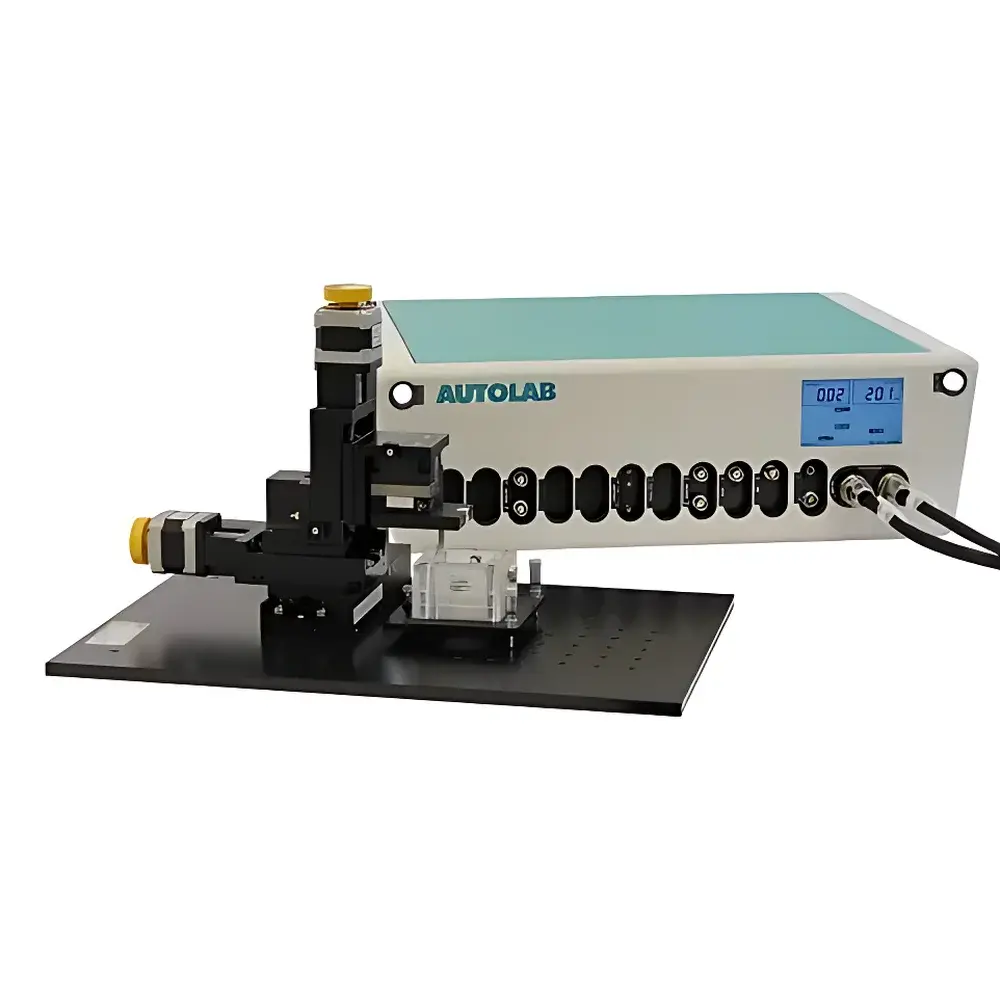
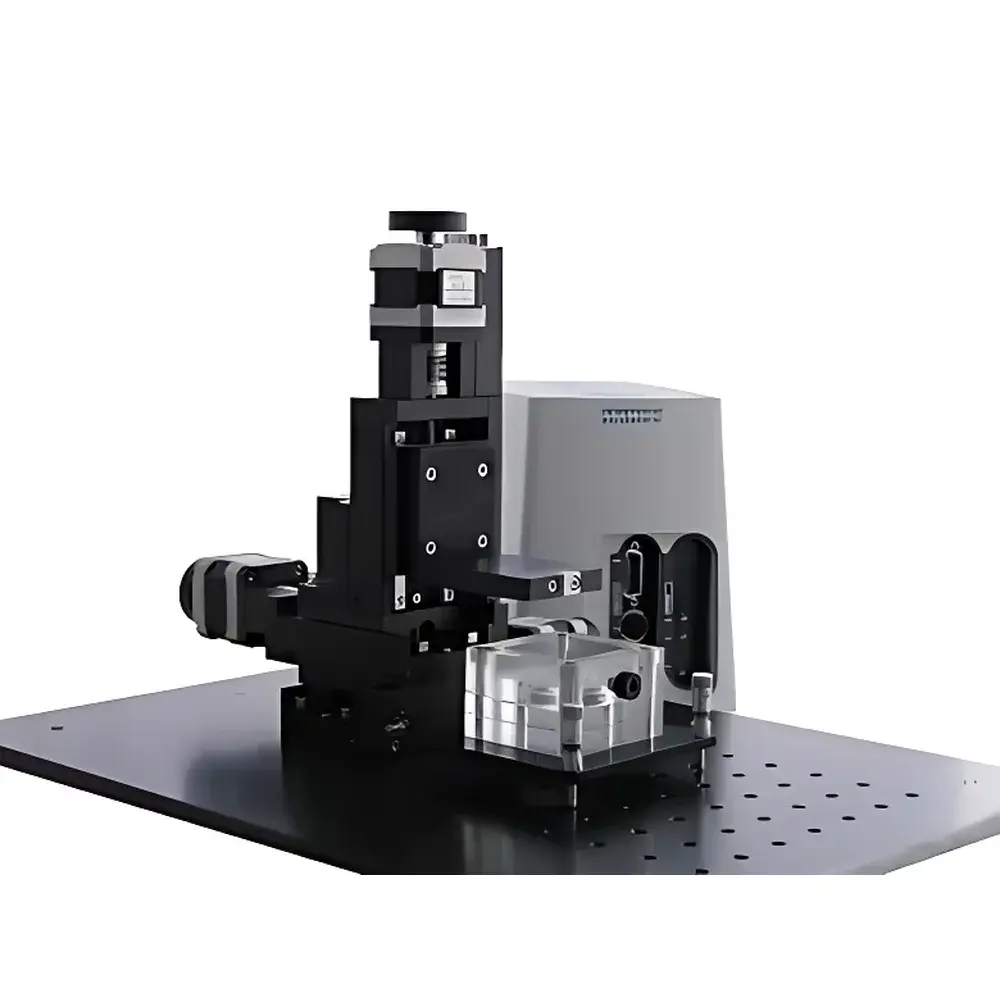
Metrohm SECM Series Scanning Electrochemical Microscope
| Brand | Metrohm |
|---|---|
| Origin | Switzerland |
| Manufacturer Type | Original Equipment Manufacturer (OEM) |
| Product Origin | Imported |
| Model | SECM |
| Instrument Type | Multichannel Electrochemical Workstation |
| Current Range | 10 pA – 100 pA |
| Current Resolution | 0.3 fA |
| Potential Accuracy | ±0.3 µV |
| Potentiostatic Range | ±30 V |
| EIS Frequency Range | 10 µHz – 1 MHz |
| Positioning System | XYZ Stepper Motor Control |
| Scan Volume (Standard) | 25 × 25 × 25 mm |
| Max Linear Scan Speed | 10 mm/s |
| Spatial Resolution | 20 nm |
| Operating Modes | Feedback Mode, Generation-Collection (GC) Mode, Direct Mode, AC-SECM (Local Impedance), 4D Mode, Shear-Force Mode |
| Scan Types | 2D, 3D, Equidistant, Fast Equidistant, User-Defined Electrochemical Protocol Scans |
Overview
The Metrohm SECM Series Scanning Electrochemical Microscope is a high-precision, multimodal electrochemical imaging platform engineered for quantitative nanoscale electrochemical characterization at solid/liquid, liquid/liquid, and biological interfaces. Based on the foundational methodology developed in Prof. Schuhmann’s group at Ruhr University Bochum, this instrument implements scanning probe electrochemistry using ultramicroelectrode (UME) tips positioned with sub-20 nm spatial resolution via closed-loop stepper motor control. Unlike conventional electrochemical cells, SECM operates in a feedback-based configuration where local faradaic current is modulated by tip–substrate distance and interfacial reactivity—enabling direct correlation between topography and electrochemical activity without physical contact. Its core architecture integrates a multichannel potentiostat/galvanostat with real-time digital signal processing, supporting simultaneous acquisition of current, potential, and position data across three orthogonal axes. Designed for rigorous academic and industrial R&D environments, the system meets fundamental requirements for traceable, reproducible measurements under controlled ambient or inert conditions.
Key Features
- Sub-20 nm spatial resolution enabled by high-stability XYZ stepper positioning system with 25 × 25 × 25 mm standard scan volume (custom ranges available)
- Multichannel electrochemical workstation with ultra-low current detection capability (10 pA–100 pA range, 0.3 fA resolution)
- High-fidelity potentiostatic control (±30 V range, ±0.3 µV accuracy) and wide-bandwidth electrochemical impedance spectroscopy (10 µHz–1 MHz)
- Seven operational modes: Feedback, Generation-Collection (GC), Direct, AC-SECM (local impedance mapping), 4D (time-resolved 3D imaging), Shear-Force (topography-coupled electrochemical imaging), and user-defined protocol scanning
- Support for both 2D planar and true 3D volumetric scans, including equidistant, fast equidistant, and programmable electrochemical step sequences
- Modular design allowing integration of optional modules: temperature-controlled electrochemical cells, microfluidic interface units, and optical coupling for correlative SECM–optical microscopy
Sample Compatibility & Compliance
The Metrohm SECM accommodates a broad spectrum of sample types—including conductive and insulating substrates, soft biological tissues, polymer films, catalytic nanoparticles, and liquid–liquid interfaces—without requiring conductive coatings or vacuum environments. All electrochemical measurements comply with ASTM E2792 (Standard Guide for Electrochemical Impedance Spectroscopy), ISO 16773 (Electrochemical corrosion testing), and USP (Analytical Instrument Qualification). Data integrity is ensured through audit-trail-enabled software compliant with FDA 21 CFR Part 11 requirements for electronic records and signatures. The system supports GLP/GMP-aligned workflows, including user access control, method versioning, and raw-data immutability verification.
Software & Data Management
Control and analysis are performed via Metrohm’s proprietary SECM Studio software, a Windows-based application built on a modular, object-oriented framework. It provides real-time visualization of current–distance curves, 2D/3D current maps, and time-resolved electrochemical series. All raw data—including tip coordinates (x, y, z), applied potential/current waveforms, and transient response traces—are stored in HDF5 format with embedded metadata (timestamp, calibration parameters, environmental conditions). Export options include CSV, MATLAB .mat, and standardized CDF formats for third-party analysis (e.g., Python-based SciPy/NumPy pipelines or COMSOL Multiphysics coupling). Software validation documentation, IQ/OQ protocols, and electronic signature templates are provided as part of the installation qualification package.
Applications
- Quantitative investigation of heterogeneous electron transfer kinetics at electrode surfaces and catalyst layers
- In situ monitoring of adsorption/desorption dynamics and dissolution processes at solid–electrolyte interfaces
- Imaging of localized corrosion initiation sites and passivation breakdown on metallic alloys
- Mapping of enzymatic activity and redox gradients across living biofilms and tissue sections
- Characterization of ion transport and interfacial charge transfer at liquid–liquid boundaries (e.g., water–ionic liquid systems)
- Localized electropolymerization and electrochemical deposition of conducting polymers or metal nanostructures with micrometer-scale spatial fidelity
- Microscale electrochemical etching and surface modification under potentiodynamic or galvanostatic control
FAQ
What distinguishes SECM from conventional cyclic voltammetry or EIS?
SECM provides spatially resolved electrochemical information by raster-scanning an ultramicroelectrode tip across a sample surface, whereas CV and EIS yield only bulk-averaged responses from macroscopic electrodes.
Can the system operate in non-aqueous electrolytes?
Yes—compatible with common organic solvents (acetonitrile, DMF, THF) and ionic liquids, provided appropriate reference electrodes and UME tip materials (e.g., Pt, Au, carbon) are selected.
Is shear-force feedback compatible with soft biological samples?
Yes—the non-contact shear-force mode enables stable topographic referencing on delicate, hydrated specimens such as hydrogels or cell monolayers without mechanical perturbation.
How is calibration performed for quantitative current mapping?
Calibration involves sequential measurement of tip approach curves over homogeneous redox mediators (e.g., ferrocene methanol), followed by finite-element modeling to relate current decay to tip–substrate separation and kinetic parameters.
Does the system support automated long-duration experiments?
Yes—integrated scheduler functionality allows unattended overnight or multi-day scans with configurable pause/resume logic, environmental logging, and automatic data backup to network storage.
Related Products




