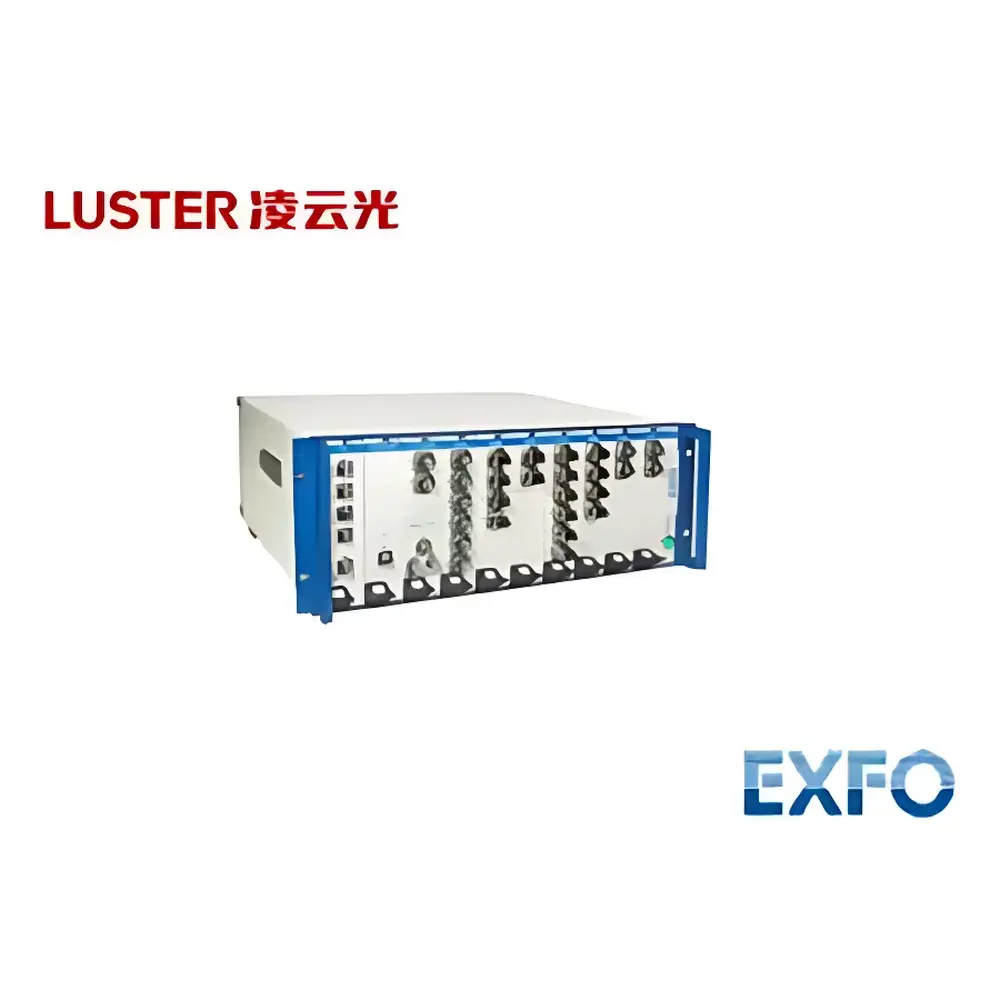
EXFO CTP10 Modular Passive Component Test Platform
| Brand | EXFO |
|---|---|
| Origin | Canada |
| Model | CTP10 |
| Dynamic Range | up to 80 dB |
| Wavelength Range | 1240–1680 nm |
| Scan Speed | up to 100 nm/s |
| Sampling Resolution | 1 pm |
| Detector Channels | up to 50 (expandable to >100 via daisy-chaining) |
| Polarization Control | SOP generation & Mueller matrix-based PDL calculation |
| OS | Dedicated real-time embedded OS |
| Remote Control | SCPI-compliant |
| Storage | High-capacity internal SSD |
| Compliance | Fully compatible with EXFO T100S-HP tunable laser series (O, ES, C, L, O+, CLU bands) |
| Optional Wavelength Reference | NIST-traceable gas cell (HCN for C-band, HF for O-band) |
| Calibration Support | SCAN SYNC module (±5 pm wavelength accuracy) |
Overview
The EXFO CTP10 is a high-performance, modular passive component test platform engineered for precision characterization of optical devices in R&D, qualification, and high-volume manufacturing environments. Built upon a deterministic real-time embedded operating system and proprietary high-speed data acquisition architecture, the CTP10 performs wavelength-swept insertion loss (IL), return loss (RL), and polarization-dependent loss (PDL) measurements using coherent, single-scan methodologies—eliminating post-processing artifacts such as trace stitching or bandwidth correction. Its core measurement principle relies on synchronized scanning of a tunable laser source (e.g., EXFO T100S-HP) coupled with calibrated photodetectors and integrated polarization state generation. This enables full-spectrum IL/RL/PDL acquisition across the entire telecom O-to-L band (1240–1680 nm) in a single pass, with no compromise in dynamic range, resolution, or repeatability—even for high-contrast spectral devices such as DWDM multiplexers, wavelength-selective switches (WSS), and photonic integrated circuits (PICs).
Key Features
- Single-scan IL measurement with up to 80 dB dynamic range and 1 pm sampling resolution—no averaging or curve reconstruction required
- Integrated SOP generation and Mueller matrix computation for accurate, traceable PDL quantification across full wavelength range
- Modular hot-swappable architecture supporting up to 10 modules per chassis, delivering up to 50 optical output ports; expandable to >100 ports via daisy-chained CTP10 units
- Full-band coverage (1240–1680 nm) achieved through automatic laser switching between T100S-HP variants (O, ES, C, L, O+, CLU), managed natively by the platform firmware
- Dedicated SCAN SYNC module with optional NIST-traceable gas-cell reference (HCN for C-band, HF for O-band) enabling ±5 pm absolute wavelength accuracy
- SCPI-compliant remote control interface with full command set for integration into automated test systems and factory-floor MES environments
- High-throughput data handling: onboard SSD storage, zero-latency acquisition pipeline, and deterministic real-time OS ensuring sub-millisecond trigger response and no data drop during 100 nm/s sweeps
Sample Compatibility & Compliance
The CTP10 is designed for rigorous compliance with international standards governing optical component testing. It supports measurement protocols aligned with ITU-T G.694.1 (DWDM grid), IEC 61300-3-4 (IL/RL), and Telcordia GR-1221-CORE (reliability and repeatability). When configured with the WLRM-NS270x gas-cell accessory and SCAN SYNC module, wavelength calibration meets NIST-traceable metrology requirements for GLP/GMP auditable environments. The platform’s uncertainty budget—including connector repeatability (FC/APC, SMF28), thermal drift (<±1 °C stabilized ambient), and detector linearity—is documented per ISO/IEC 17025 guidelines. All IL, RL, and PDL specifications are validated under defined conditions: 1-hour warm-up, 23 °C ±1 °C ambient, auto-averaging enabled, and power baseline established prior to measurement.
Software & Data Management
The CTP10 runs a purpose-built GUI application optimized for both engineering flexibility and production-line robustness. Configuration, calibration, and measurement workflows are fully scriptable and support hierarchical test plans with pass/fail thresholds, statistical process control (SPC) logging, and CSV/PDF report export. Built-in analysis tools include WDM filter shape evaluation (passband width, ripple, isolation), WSS channel crosstalk mapping, and PDL spectral profiling. All data—including raw spectra, Mueller matrices, and environmental metadata—is stored in a structured binary format on the internal SSD, with optional network backup to centralized servers. Audit trails comply with FDA 21 CFR Part 11 requirements when deployed with user authentication, electronic signatures, and immutable log archiving.
Applications
- Characterization of high-port-count passive components: DWDM MUX/DEMUX, arrayed waveguide gratings (AWG), optical splitters/combiners, and planar lightwave circuit (PLC) devices
- PDL validation of polarization-sensitive elements including isolators, circulators, and lithium niobate modulators
- End-of-line testing of photonic integrated circuits (PICs) requiring multi-channel IL/RL correlation and spectral uniformity assessment
- Process development and yield analysis in semiconductor photonics fabs, where scan-to-scan reproducibility <±0.005 dB and wavelength stability <±5 pm are critical
- Laser-sharing deployments across up to eight synchronized CTP10 test stations on a shared LAN—reducing CAPEX while maintaining per-station measurement autonomy
FAQ
What wavelength ranges does the CTP10 support, and how is full-band coverage achieved?
The CTP10 operates from 1240 nm to 1680 nm. Full-band coverage is realized through automatic, firmware-managed switching between multiple T100S-HP tunable lasers (O, ES, C, L, O+, CLU variants), with seamless spectral stitching handled internally.
Can the CTP10 measure PDL without external polarization controllers?
Yes. The platform integrates hardware-level SOP generation and real-time Mueller matrix computation—requiring no external polarization controllers or manual alignment.
Is the CTP10 suitable for GLP/GMP-regulated manufacturing environments?
Yes. With optional SCAN SYNC + NIST-traceable gas-cell calibration, audit-trail logging, SCPI-based automation, and documented uncertainty budgets, it meets key requirements for regulated optical component production.
How many detectors can be connected to a single CTP10 unit?
A single chassis supports up to 50 detector channels via 10 hot-swappable modules; daisy-chaining additional CTP10 units extends this to over 100 channels under unified GUI control.
Does the CTP10 require post-scan software correction for high-dynamic-range IL measurements?
No. Its architecture acquires full 80 dB dynamic range in one continuous sweep at 1 pm resolution—eliminating the need for trace stitching, gain switching, or digital post-processing.