
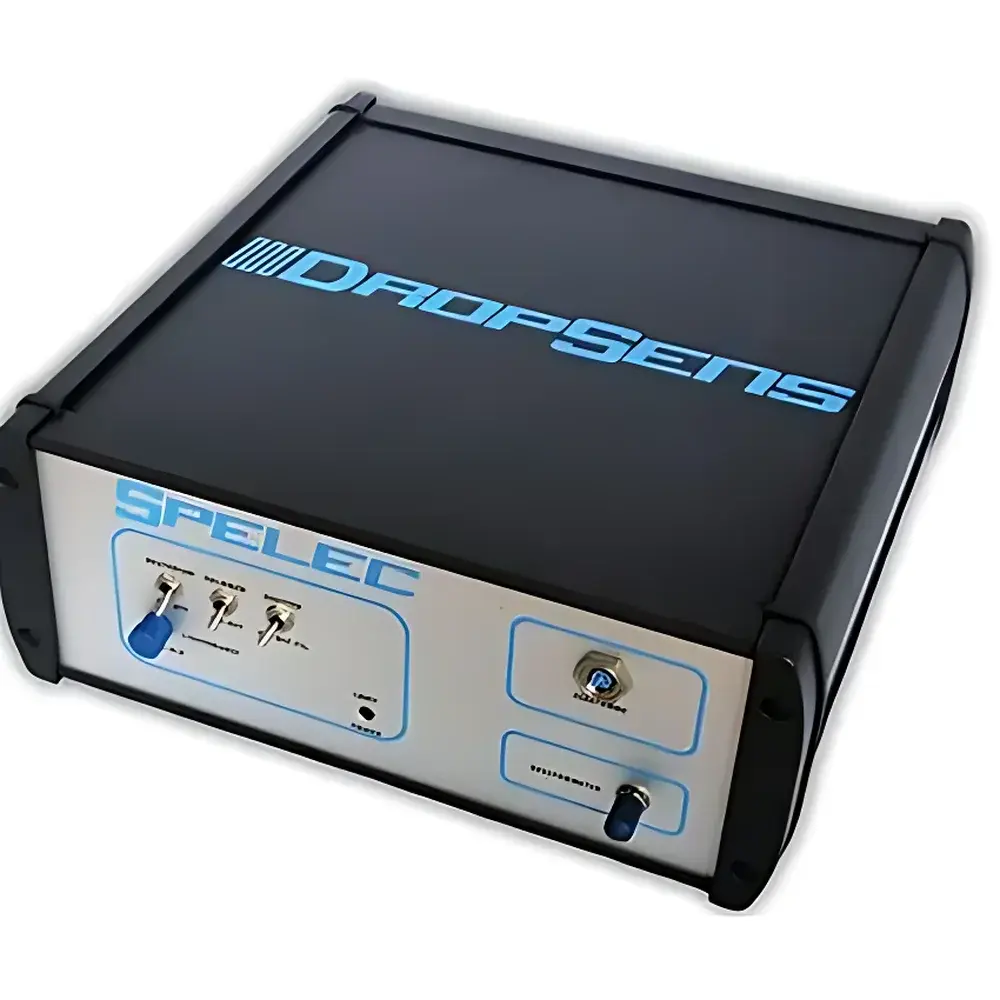
Metrohm SPELEC Spectroelectrochemical System
| Brand | Metrohm |
|---|---|
| Origin | Switzerland |
| Manufacturer | Metrohm AG |
| Import Status | Imported |
| Model | SPELEC |
| Instrument Type | Electrochemical Workstation |
| Channel Configuration | Single-Channel |
| Current Range | ±40 mA |
| Current Accuracy | ≤0.5% |
| Potential Accuracy | ±0.2% |
| Potentiostatic Range | ±4 V |
| EIS Frequency Range | 10 mHz – 1 MHz |
| Optical Detection Ranges | 200–900 nm or 350–1050 nm (user-selectable) |
Overview
The Metrohm SPELEC Spectroelectrochemical System is a fully integrated, benchtop platform engineered for simultaneous electrochemical and optical characterization of redox-active species in real time. It combines a high-precision bipotentiostat/galvanostat, a modular UV-Vis-NIR spectrometer, and a stable broadband light source into a single, synchronized measurement environment. Based on the fundamental principle of spectroelectrochemistry—where electrochemical perturbation (e.g., potential step, cyclic voltammetry, or chronoamperometry) is coupled with in situ or operando optical detection—the SPELEC system enables quantitative correlation between electron transfer events and spectral changes (e.g., absorbance, transmittance, reflectance, or photon counting). This dual-domain capability is essential for mechanistic studies of charge-transfer processes, identification of transient intermediates, and structure–property analysis in photoelectrochemical systems, molecular catalysts, battery electrode materials, and organic semiconductors.
Key Features
- Integrated bipotentiostat/galvanostat with ±40 mA current range, ≤0.5% current accuracy, and ±0.2% potential accuracy across a ±4 V control window
- Modular optical subsystem supporting two interchangeable spectral ranges: 200–900 nm (UV-Vis) or 350–1050 nm (Vis-NIR), each with thermoelectrically cooled CCD detection
- Real-time synchronization of electrochemical waveforms and spectral acquisition at user-defined temporal resolution (down to millisecond-level alignment)
- Hardware-triggered data acquisition ensuring sub-millisecond timing fidelity between potentiostat output and spectrometer exposure
- Optimized optical path design accommodating both transmission and reflection geometries, including flow cells and thin-layer configurations
- Robust mechanical architecture compliant with ISO/IEC 17025 laboratory environmental requirements for long-term stability and repeatability
Sample Compatibility & Compliance
The SPELEC system supports a wide range of sample formats—including conventional three-electrode electrochemical cells, optically transparent thin-layer electrodes (OTTLE), flow-through spectroelectrochemical cells, and disposable screen-printed electrodes (SPEs). Its modular cell interface allows rapid reconfiguration for aqueous, non-aqueous, and ionic liquid electrolytes. All hardware and software components are designed in accordance with GLP and GMP principles. Data integrity is maintained through audit-trail-enabled operation, electronic signatures, and secure user access controls aligned with FDA 21 CFR Part 11 requirements. The system supports traceable calibration protocols compliant with ASTM E2698 (standard practice for UV-Vis spectrophotometer qualification) and ISO 17025 clause 5.5.2 (equipment verification).
Software & Data Management
DropView SPELEC is the dedicated, Windows-based application for instrument control, acquisition, and advanced post-processing. It provides synchronized visualization of electrochemical curves (i.e., current vs. time/potential) alongside dynamic spectral maps (e.g., absorbance vs. wavelength vs. time). Real-time display modes include photon count rate, absorbance (A), transmittance (%T), and reflectance (%R). Data processing functions include baseline correction, peak integration (with Savitzky-Golay smoothing), spectral difference mapping, isosbestic point analysis, and 3D surface plotting (wavelength × time × intensity). All raw datasets are stored in vendor-neutral HDF5 format, enabling interoperability with MATLAB, Python (via h5py), and third-party chemometrics tools. Version-controlled software updates follow Metrohm’s formal change management process per ISO 9001.
Applications
- Identification and kinetic profiling of short-lived redox intermediates in catalytic cycles (e.g., metalloporphyrins, cobalt complexes)
- In situ monitoring of charge carrier generation and recombination in dye-sensitized solar cells (DSSCs) and perovskite photovoltaic layers
- Quantitative analysis of electrochromic switching dynamics in WO₃, NiO, and conducting polymer films
- Structure–activity correlation of battery cathode materials during lithiation/delithiation (e.g., LiFePO₄, NMC)
- Electrocatalytic CO₂ reduction mechanism studies via time-resolved IR-Vis coupling (when interfaced with external FTIR)
- Quality control of conductive inks and printed electronics using screen-printed electrode arrays
FAQ
What optical configurations does the SPELEC support?
It supports both transmission and reflection modes, compatible with commercially available OTTLE cells, flow cells, and custom-designed cuvettes with quartz or CaF₂ windows.
Can the SPELEC perform electrochemical impedance spectroscopy (EIS) while acquiring spectra?
Yes—EIS measurements (10 mHz to 1 MHz) can be triggered synchronously with spectral acquisition, enabling frequency-resolved analysis of interfacial capacitance and Faradaic processes.
Is DropView SPELEC compliant with regulatory data integrity standards?
Yes—it implements full 21 CFR Part 11 compliance features including electronic signatures, audit trails, role-based access control, and immutable raw data archiving.
How is calibration verified for combined electrochemical and optical measurements?
Electrochemical calibration uses certified reference resistors and standard redox couples (e.g., ferrocene/ferrocenium); optical calibration employs NIST-traceable holmium oxide and neutral density filters.
Does Metrohm provide application-specific accessories for SPELEC?
Yes—Metrohm offers a full suite of validated accessories including SPE-compatible flow cells, optically optimized screen-printed electrodes, fiber-optic couplers, and temperature-controlled cell holders.






