
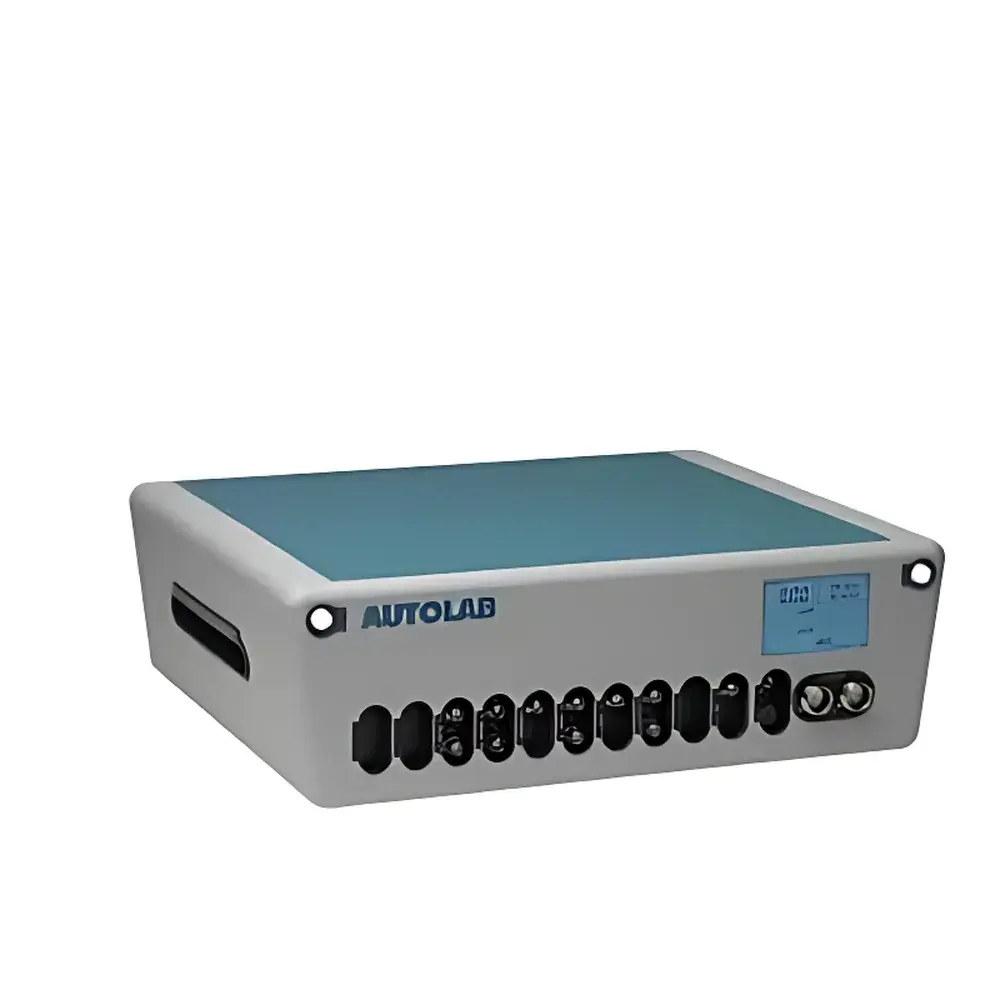
Metrohm PGSTAT128N Electrochemical Workstation
| Brand | Metrohm |
|---|---|
| Origin | Netherlands |
| Manufacturer Type | Original Equipment Manufacturer (OEM) |
| Product Category | Imported Instrument |
| Model | PGSTAT128N |
| Channel Configuration | Single-Channel Workstation |
| Current Range | 10 nA – 100 mA (7 decades) |
| Current Accuracy | ±0.2% of reading and range |
| Potential Range | ±10 V |
| Potential Accuracy | ±2 mV or ±0.2% of set value |
| Potentiostat Bandwidth | >500 kHz |
| Rise/Fall Time (1 V step, 10–90%) | <500 ns |
| Input Bias Current (25 °C) | <1 pA |
| Input Impedance | >100 GΩ |
| Coulometric Bandwidth | >4 MHz |
| EIS Frequency Range | 10 µHz – 1 MHz |
| Sampling Rate | Up to 50 kHz (standard), up to 750 kHz with ADC750 module |
| Potential Resolution | 150 µV (applied), 30/300 µV (measured) |
| Current Resolution | 0.0003% of range (e.g., 30 fA at 10 nA range) |
Overview
The Metrohm PGSTAT128N Electrochemical Workstation is a modular, high-fidelity potentiostat/galvanostat designed for precision electrochemical characterization across research and applied analytical domains. Engineered on the AUTOLAB platform, it operates on classical three-electrode (or two-/four-electrode) potentiostatic control principles, enabling accurate imposition of potential or current stimuli while resolving ultra-low faradaic and capacitive responses. Its architecture integrates low-noise analog front-end design, high-speed digital signal processing, and galvanically isolated analog I/O—making it particularly suited for applications demanding sub-picoampere current resolution, microsecond-level temporal fidelity, and stable baseline performance over extended acquisition windows. The instrument supports both DC and AC electrochemical techniques—including cyclic voltammetry, pulse methods, chronoamperometry, coulometry, and potentiometric stripping—and serves as a foundational platform for impedance spectroscopy when equipped with the optional FRA2 module.
Key Features
- Single-channel workstation with ±250 mA maximum output current and ±12 V compliance voltage, optimized for low-current (<100 nA) and high-dynamic-range measurements
- Current resolution down to 30 fA (at 10 nA range), achieved via 24-bit ADC and adaptive gain switching across seven programmable current ranges
- Potentiostat bandwidth exceeding 500 kHz and rise/fall time <500 ns ensure faithful reproduction of fast transient signals and sharp potential steps
- Dual analog I/O ports support synchronized external triggering, real-time feedback control, and integration with auxiliary instrumentation (e.g., flow cells, temperature controllers, or optical detectors)
- iR compensation capability from 0 to 200 MΩ with 0.025% resolution, critical for accurate kinetic analysis in resistive electrolytes
- Modular expandability: compatible with FRA2 (frequency response analyzer), BIPOT (bipotentiostat), SCANGEN (scan generator), MUXF120 (multiplexer), ADC750 (high-speed digitizer), and ECDE (electrochemical data encryption) modules
- Galvanically isolated analog inputs prevent ground-loop interference and enable safe operation in multi-instrument setups
Sample Compatibility & Compliance
The PGSTAT128N accommodates standard electrochemical cell configurations—including conventional three-electrode cells (working, reference, counter), rotating disk electrodes (RDE), thin-layer cells, and liquid–liquid interface cells—via configurable electrode connections and floating ground architecture. It meets essential electromagnetic compatibility (EMC) requirements per IEC 61326-1 and safety standards per IEC 61010-1. While not intrinsically certified for hazardous environments, its low-power design and isolation features support use in ISO 17025-accredited laboratories performing method validation under GLP/GMP frameworks. Data integrity is reinforced through hardware-level timestamping and optional ECDE module for encrypted logging compliant with FDA 21 CFR Part 11 audit trail requirements.
Software & Data Management
The system ships with GPES (General Purpose Electrochemical Software) and NOVA (for advanced EIS and modeling), both developed by Metrohm Autolab. GPES implements over 30 standardized electrochemical techniques—including CV, DPV, SWV, CA, CP, LSV, and pulse amperometric detection—with full parameter scripting, real-time visualization, and export to CSV, ASCII, or HDF5 formats. NOVA provides comprehensive EIS measurement protocols (single-potential sweep, potential-frequency mapping, time-frequency analysis), nonlinear least-squares fitting using equivalent circuit models (e.g., Randles, transmission line), and Kramers–Kronig validation. All software modules support automated calibration routines, metadata tagging (operator, sample ID, environmental conditions), and batch processing workflows suitable for QC/QA environments.
Applications
- Fundamental electrokinetic studies: electron transfer kinetics, diffusion-controlled processes, and surface-confined redox reactions
- Biosensor development: immobilized enzyme electrodes, DNA hybridization assays, and aptamer-based detection platforms
- Corrosion science: polarization resistance, electrochemical noise analysis, and localized corrosion monitoring
- Battery and fuel cell R&D: half-cell cycling stability, SEI formation analysis, and impedance evolution during aging
- Analytical electrochemistry: trace metal detection (e.g., Pb²⁺, Cd²⁺) via anodic stripping voltammetry, pharmaceutical assay validation
- Electrocatalysis: activity mapping of nanostructured catalysts under controlled mass transport (RDE, RRDE)
FAQ
What is the minimum detectable current with the PGSTAT128N?
At the 10 nA current range, the instrument achieves a current resolution of 30 fA, limited primarily by thermal noise and input bias current (<1 pA at 25 °C).
Can the PGSTAT128N perform simultaneous dual-potentiostat experiments?
Not natively—but adding the BIPOT module enables true bipotentiostatic control for rotating ring-disk electrode (RRDE) or split-cell configurations.
Is EIS data acquisition fully automated across the entire 10 µHz–1 MHz range?
Yes—the FRA2 module supports single-sweep broadband acquisition without manual range segmentation, with user-defined amplitude per frequency decade and multi-sine excitation options.
How is data traceability ensured for regulated environments?
With the optional ECDE module, all raw data, method parameters, and operator actions are cryptographically signed and stored with immutable timestamps, satisfying ALCOA+ and 21 CFR Part 11 electronic record requirements.
What sampling rate is achievable for transient techniques like chronoamperometry?
Standard configuration supports 50 kHz sampling (20 µs interval); installing the ADC750 module extends this to 750 kHz (1.33 µs interval), enabling resolution of rapid nucleation events or fast adsorption kinetics.




