
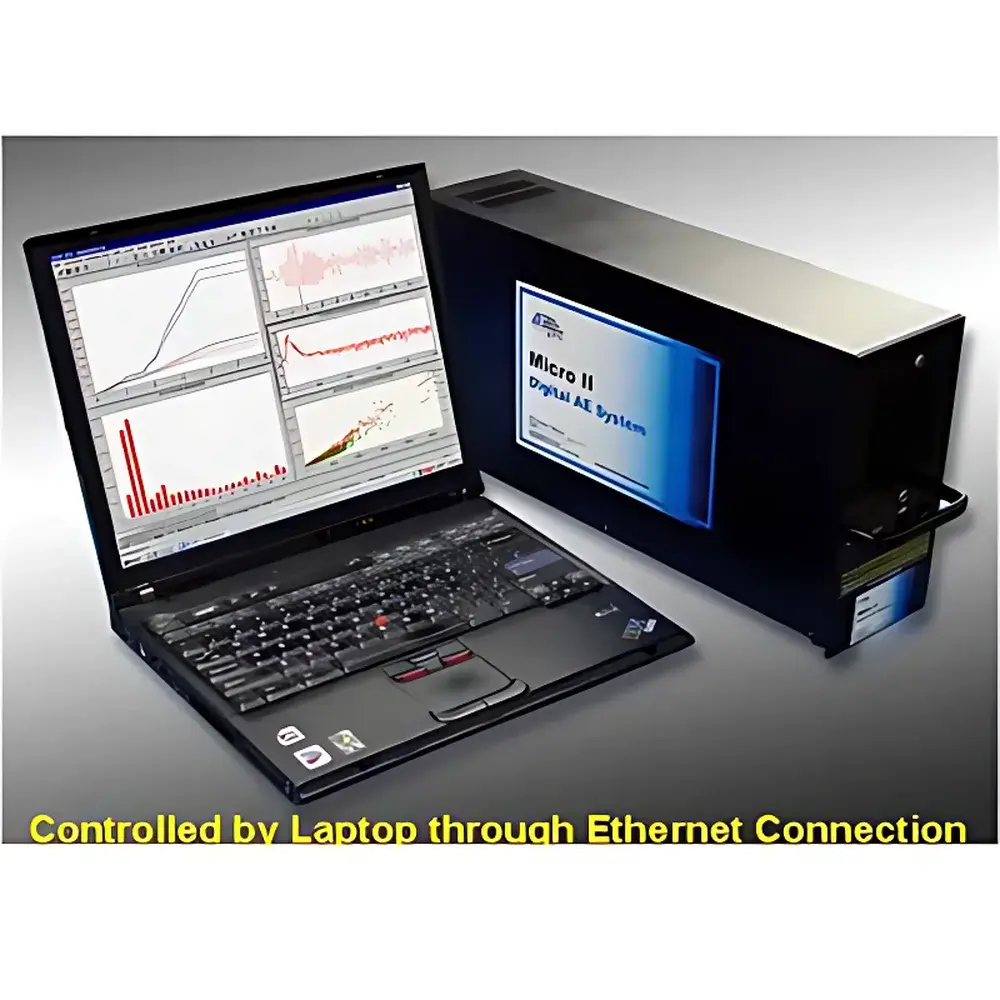
Acoustic Emission System Mainframe
| Origin | USA |
|---|---|
| Manufacturer Type | Authorized Distributor |
| Import Status | Imported |
| Form Factor | PCI Slot-Based Mainframe |
| Channel Capacity | Up to 112 Channels (Configurable via PCI-8 or PCI-2 AE Acquisition Cards) |
| Compliance | Designed for ASTM E1316, ISO 12713, and EN 1330-9 Conformance |
| Interface | PCI Express Backplane with Synchronized Sampling Architecture |
| Power Supply | Industrial-grade 100–240 VAC, 50/60 Hz |
| Operating Temperature | 0–50 °C |
| Storage Temperature | –20–70 °C |
| Dimensions (W×D×H) | 483 × 500 × 177 mm (Standard 4U Rack-Mount Chassis) |
| Weight | ≤18 kg |
Overview
The Acoustic Emission System Mainframe is a high-density, modular signal acquisition platform engineered for real-time structural health monitoring (SHM), in-service defect localization, and dynamic failure analysis in critical infrastructure and industrial assets. Based on a synchronized PCI Express backplane architecture, the mainframe serves as the central processing and synchronization hub for distributed acoustic emission (AE) sensor networks. It operates on the fundamental principle of transient elastic wave detection—capturing high-frequency stress-wave emissions (typically 100 kHz–1 MHz) generated by microstructural events such as crack propagation, fiber breakage, delamination, or friction-induced surface deformation. Unlike conventional ultrasonic pulse-echo methods, AE is a passive, non-intrusive technique requiring no external excitation; instead, it relies on intrinsic energy release from active damage mechanisms. This makes the system uniquely suited for continuous, unattended monitoring of pressure vessels, wind turbine blades, composite airframes, nuclear piping systems, and civil engineering structures under operational loading.
Key Features
- Modular PCI-based expansion architecture supporting up to 14 acquisition cards per chassis, enabling scalable channel counts (8–112 channels) without sacrificing timing coherence.
- Hardware-level time-synchronization across all channels (<±10 ns inter-channel skew), essential for accurate source location via time-difference-of-arrival (TDOA) algorithms.
- Dual card compatibility: PCI-8 cards deliver 8-channel simultaneous sampling at 10 MS/s (12-bit resolution); PCI-2 cards provide 2-channel sampling at 20 MS/s (14-bit resolution), optimized for high-fidelity waveform capture.
- Industrial-grade 4U rack-mount chassis with redundant cooling, EMI-shielded compartments, and conformal-coated PCBs for long-term deployment in harsh environments (e.g., power plants, offshore platforms).
- Embedded FPGA-based real-time feature extraction—including amplitude, duration, energy, rise time, and counts—reducing host CPU load and enabling edge-level decision logic.
- Support for mixed-sensor configurations: integrates seamlessly with piezoelectric AE sensors (e.g., PAC R15, PICO, or MISTRAS models), accelerometers, and auxiliary analog inputs (temperature, strain, load) for multi-parameter correlation.
Sample Compatibility & Compliance
The mainframe is designed for broad material and component compatibility, including metallic alloys (carbon steel, stainless steel, titanium), fiber-reinforced polymers (CFRP, GFRP), concrete, ceramics, and welded joints. Its signal conditioning and thresholding parameters are configurable to accommodate varying acoustic impedances and attenuation characteristics across substrates. The system complies with internationally recognized standards for acoustic emission testing: ASTM E1316 (Standard Terminology for Nondestructive Examinations), ISO 12713 (Acoustic emission—General principles), and EN 1330-9 (Non-destructive testing—Terminology—Part 9: Acoustic emission testing). For regulated industries, firmware supports audit-trail logging and user-access controls aligned with GLP/GMP documentation requirements. Optional configuration packages meet specific nuclear sector requirements (e.g., LPMS cabinet variant conforms to IEEE 344 seismic qualification guidelines for Class 1E applications).
Software & Data Management
Bundled with AEwin™ v6.x professional software suite, the mainframe enables full waveform streaming, parametric mapping, 3D source localization (using spherical or planar triangulation), and statistical trend analysis (Kurtosis, RA value, b-value). Data export formats include ASCII, HDF5, and MAT for post-processing in MATLAB, Python (SciPy/NumPy), or custom ML pipelines. The software architecture supports 21 CFR Part 11-compliant electronic signatures, role-based permissions, and immutable data archiving—critical for FDA-regulated manufacturing or NRC-licensed nuclear facilities. Remote monitoring is enabled via secure TLS-encrypted HTTP API, allowing integration into enterprise SCADA or CMMS platforms (e.g., Siemens Desigo, Honeywell Experion) for predictive maintenance workflows.
Applications
- Continuous online monitoring of steam generator tubes and reactor coolant system piping in nuclear power plants.
- Pre-service and in-service inspection of aerospace composite components during static and fatigue testing.
- Real-time delamination tracking in wind turbine blade root joints during field operation.
- Corrosion-under-insulation (CUI) detection in petrochemical refinery piping networks.
- Fracture mechanics studies in laboratory-scale fracture toughness (KIC) and fatigue crack growth (da/dN) experiments.
- Condition-based assessment of prestressed concrete bridges and tunnel linings using permanent AE sensor arrays.
FAQ
What is the maximum number of channels supported in a single mainframe chassis?
The mainframe supports up to 112 channels when fully populated with 14 PCI-8 acquisition cards.
Does the system support wireless sensor integration?
Yes—the mainframe interfaces with certified 4-channel wireless AE nodes (e.g., SH-II SHM modules) via Ethernet gateway, enabling hybrid wired/wireless network topologies.
Is calibration traceable to NIST standards?
All acquisition cards ship with factory calibration certificates traceable to NIST through accredited third-party laboratories; on-site recalibration services are available.
Can the mainframe operate unattended for extended periods?
Yes—it is rated for continuous 24/7 operation with watchdog timer, automatic error recovery, and non-volatile event logging to internal SSD or network storage.
Are OEM integration options available for embedding into proprietary test systems?
Yes—API libraries (C/C++, .NET, LabVIEW) and hardware trigger I/O are provided for seamless integration into automated test equipment (ATE) or digital twin frameworks.



