
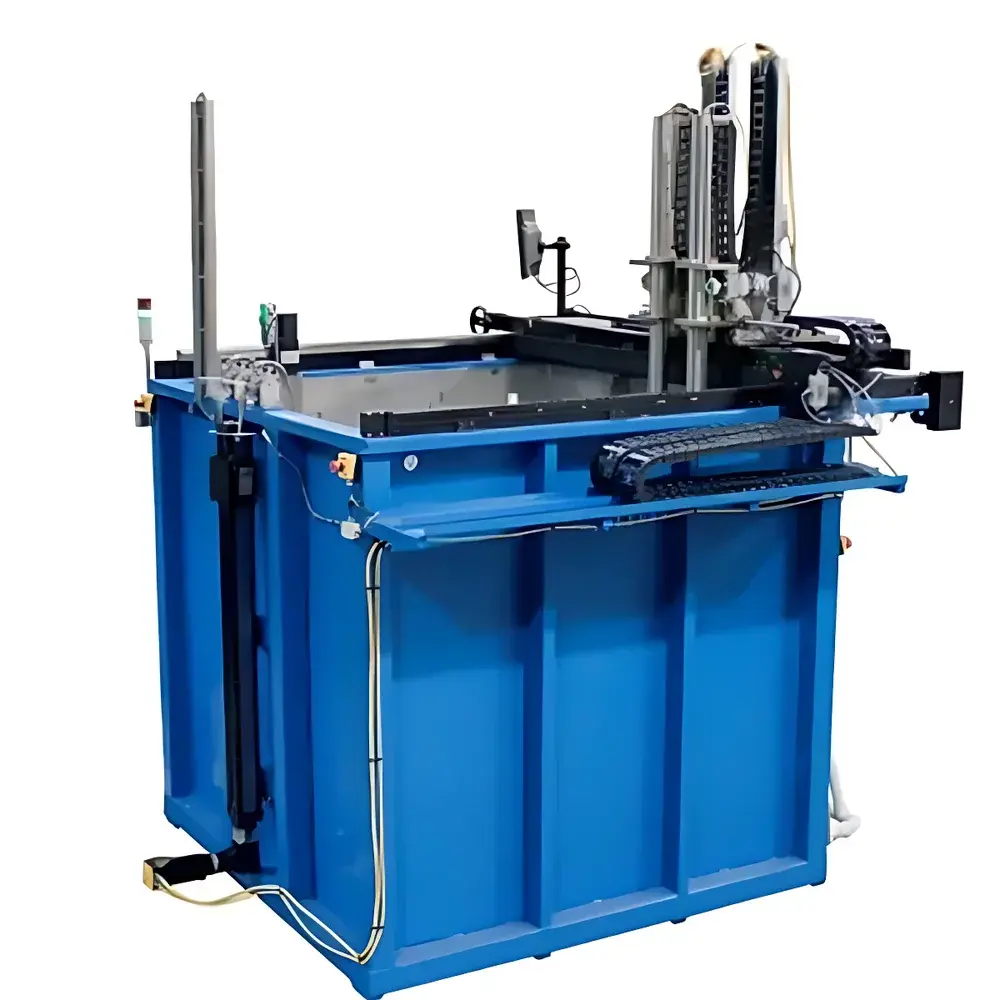
Ansys Custom C-Scan Ultrasonic Inspection System for Aircraft Engine Disks, Rings, and Shafts
| Brand | Ansys |
|---|---|
| Origin | USA |
| Manufacturer | Ansys, Inc. |
| Product Type | Imported |
| Model | Custom |
| Instrument Type | Digital Ultrasonic Flaw Detector |
| Inspection Method | Pulse-Echo & Through-Transmission |
| Waveform Type | Pulsed Ultrasonic |
| Scan Envelope | 1800 mm × 1800 mm × 1200 mm |
| Transducer Configuration | Single-Crystal Probes (Pulse-Echo and Through-Transmission Modes) |
| Compliance | GE Aviation Approved Design |
Overview
The Ansys Custom C-Scan Ultrasonic Inspection System is a high-precision, fully automated non-destructive testing (NDT) platform engineered specifically for the dimensional and volumetric evaluation of critical rotating components in aerospace propulsion systems—including turbine disks, compressor rings, and drive shafts. Built upon pulse-echo and through-transmission ultrasonic principles, the system delivers quantitative, spatially resolved C-scan image data by synchronizing transducer motion with real-time A-scan acquisition across three orthogonal axes (X, Y, Z). Unlike conventional manual or semi-automated setups, this system integrates rigid mechanical architecture with programmable motion control to maintain consistent coupling, beam alignment, and standoff distance—even over complex curved geometries. Its design adheres to the stringent repeatability, traceability, and documentation requirements mandated for Tier 1 aerospace suppliers under AS9100 Rev D and NADCAP AC7114/1.
Key Features
- Full 3D scanning envelope of 1800 mm × 1800 mm × 1200 mm, accommodating large-diameter engine disks (up to 1200 mm OD) and extended-length shafts (up to 1200 mm length)
- Motorized vertical lift rotary table with ±180° continuous rotation and precise angular indexing (0.01° resolution), enabling full circumferential coverage without repositioning
- Heavy-duty gantry structure fabricated from stress-relieved aluminum alloy and stainless steel linear guides—designed for long-term dimensional stability under repeated thermal and mechanical loading
- Dual-mode probe support: configurable single-crystal transducers operating in both pulse-echo (for near-surface flaw detection and thickness mapping) and through-transmission (for volumetric attenuation analysis and porosity assessment)
- GE Aviation–certified mechanical and software architecture—validated against GE’s internal NDT specification GEK 32675 and compatible with GE’s legacy inspection procedure documentation (IPDs)
- Multi-axis coordinated motion control (up to 6 DOF optional) with real-time surface-following algorithms that dynamically adjust Z-axis position based on laser triangulation feedback—ensuring constant water-path coupling during contour scanning
Sample Compatibility & Compliance
The system accommodates nickel-based superalloys (e.g., Inconel 718, Waspaloy), titanium alloys (Ti-6Al-4V), and maraging steels commonly used in hot-section and cold-section engine components. Fixture interfaces comply with MIL-STD-130 marking requirements and integrate with standard aerospace part carriers (e.g., ISO 10303-21 STEP AP242 geometry exchange). All hardware and firmware are designed to meet electromagnetic compatibility per EN 61326-1 and safety standards per IEC 61010-1. Data acquisition workflows support audit-ready compliance with FAA Order 8900.1, EASA Part-21G, and ISO 17025:2017 accredited laboratory practices.
Software & Data Management
The proprietary Ansys NDT Suite v4.2 provides integrated control, acquisition, and post-processing functionality. It supports raw RF data export in HDF5 format for third-party analysis (e.g., MATLAB, Python SciPy), and generates compliant reports in PDF/A-2b format with embedded digital signatures, timestamps, and full audit trails. Software architecture conforms to FDA 21 CFR Part 11 requirements for electronic records and signatures—including role-based access control, session logging, and immutable change history. Calibration verification logs, probe characterization files, and scan parameter sets are stored in a relational database with automatic versioning and backup synchronization to network-attached storage (NAS) infrastructure.
Applications
- Automated volumetric inspection of forged and powder metallurgy turbine disks for subsurface voids, inclusions, and forging laps
- Layer-by-layer thickness mapping of diffusion-bonded ring assemblies to verify interfacial integrity
- Longitudinal and circumferential flaw screening of hollow fan shafts with variable wall thickness profiles
- Quantitative porosity assessment in investment-cast nozzles and vanes using through-transmission attenuation gradients
- Baseline reference scanning for fleet-wide health monitoring programs—enabling time-of-flight diffraction (TOFD) and synthetic aperture focusing technique (SAFT) reprocessing as new defect models emerge
FAQ
Is this system qualified for use in FAA-certified repair stations?
Yes—the mechanical design, calibration procedures, and software validation protocols are aligned with FAA Advisory Circular AC 65-15A and have been accepted by multiple Part 145 repair stations under documented equivalency agreements.
Can existing UT equipment be retrofitted into this C-scan architecture?
Limited retrofitting is supported for select OEM ultrasonic pulser-receivers meeting IEEE 1850-2018 interface specifications; however, full C-scan performance requires native integration with the Ansys motion controller and timing module.
What level of operator training is required for certification?
Operators must hold ASNT Level II UT certification and complete a 40-hour Ansys-specific system operation and data interpretation course, followed by supervised qualification per SNT-TC-1A Appendix A.
Does the system support automated report generation for customer-facing deliverables?
Yes—customizable report templates conform to customer-specific formats (e.g., Rolls-Royce RRES 90060, Pratt & Whitney PW-1000G IPC-NDT-001), including embedded C-scan thumbnails, A-scan overlays, and pass/fail decision logic traceability.



