
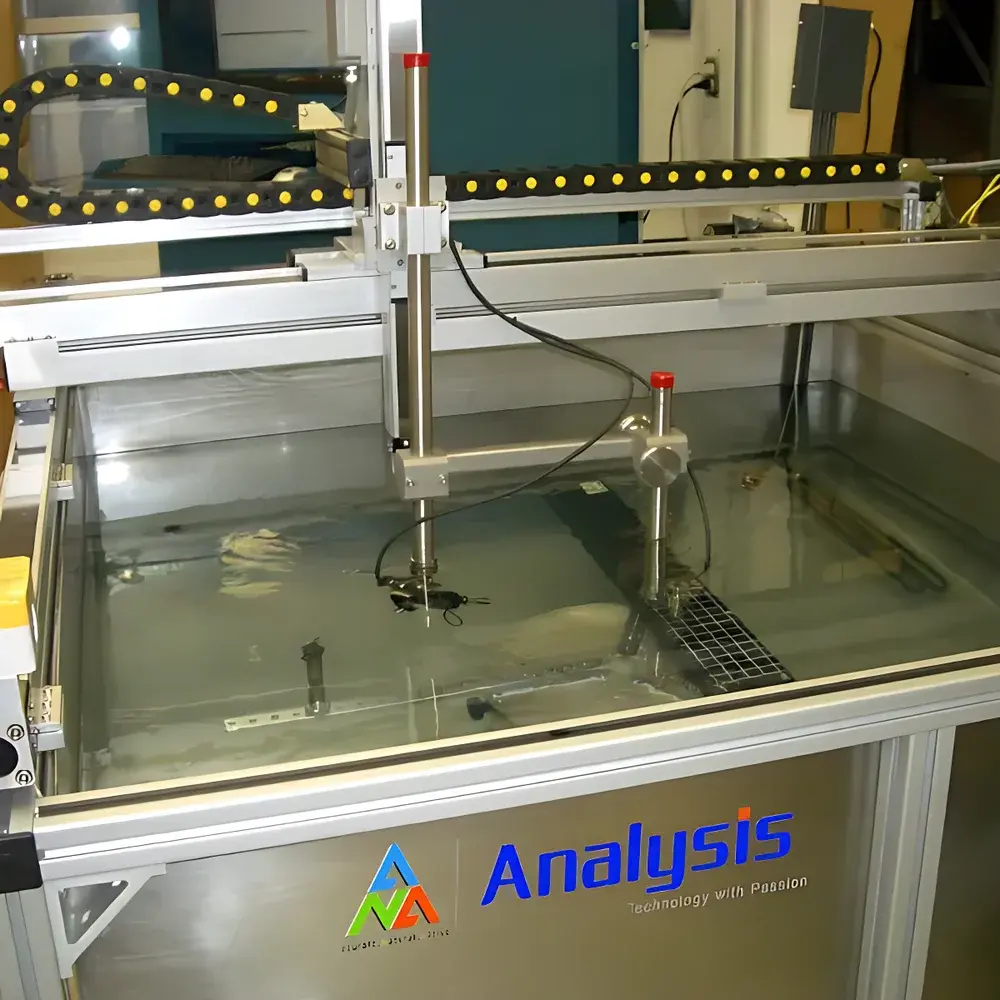
Analysis UPK-T48 Immersion Ultrasonic C-Scan System
| Brand | Analysis |
|---|---|
| Origin | Beijing, China |
| Manufacturer Type | Authorized Distributor |
| Origin Category | Domestic (China-made) |
| Model | UPK-T48 |
| Instrument Type | Digital |
| Inspection Method | Pulse-Echo |
| Waveform Type | Pulsed Ultrasonic |
| Scan Envelope | 1200 × 900 × 600 mm |
| Gain Range | 0–110 dB |
| Vertical Linearity | ≤2% |
| Horizontal Linearity | ≤2% |
| Dynamic Range | ≥95 dB |
| Transducer Configuration | Single-Crystal or Through-Transmission |
Overview
The Analysis UPK-T48 Immersion Ultrasonic C-Scan System is a precision-engineered, computer-controlled ultrasonic non-destructive testing (NDT) platform designed for high-resolution volumetric defect mapping in solid and laminated materials. Operating on the pulse-echo and through-transmission principles, the system immerses test specimens in a temperature-stabilized water bath to enable consistent acoustic coupling and eliminate air-gap interference. It generates two-dimensional C-scan images by synchronizing ultrasonic A-scan data acquisition with high-fidelity positional feedback from multi-axis motion encoders. The core architecture integrates a 30 MHz bandwidth, 12-bit digitization pulser-receiver card with real-time data streaming capabilities—enabling detection of sub-millimeter discontinuities such as delaminations, disbonds, inclusions, porosity, and voids in structural composites and polymer matrices. Engineered for both laboratory-based material characterization and production-line quality assurance, the UPK-T48 conforms to fundamental NDT physics requirements defined in ASTM E1158, ASTM E2700, and ISO 16810 for immersion ultrasonic testing methodology.
Key Features
- Modular digital acquisition architecture featuring a high-speed pulser-receiver card with 30 MHz analog bandwidth and 12-bit vertical resolution for optimized signal fidelity and SNR.
- Multi-axis motion control system (4–8 axes configurable) with servo-driven linear stages, integrated optical encoders, and ±0.025 mm positional repeatability across the full 1200 × 900 × 600 mm scan envelope.
- Programmable scanning velocity up to 500 mm/s, supporting both raster and contour-following trajectories for complex geometries including curved CFRP panels and molded thermoplastic components.
- Dual transducer support: compatible with single-element focused or unfocused transducers (pulse-echo mode) and paired transmitter/receiver configurations (through-transmission mode) for differential attenuation analysis.
- Real-time gain compensation algorithms and automatic time-gain compensation (TGC) profiles to maintain consistent sensitivity across varying material thicknesses and acoustic path lengths.
- Ruggedized industrial PC integration with dual-monitor support, PCIe-based hardware synchronization, and low-latency data buffering to sustain continuous acquisition at >10 kHz A-scan rate.
Sample Compatibility & Compliance
The UPK-T48 accommodates flat, slightly curved, and contoured specimens up to 600 mm in height and 900 mm in width, including carbon fiber reinforced polymer (CFRP) laminates, glass-fiber composites, adhesive-bonded assemblies, ceramic matrix composites (CMCs), and engineering thermoplastics (e.g., PEEK, PEI). Specimen mounting fixtures are customizable for vacuum-chuck, edge-clamp, or submerged cradle configurations. System-level compliance includes adherence to electromagnetic compatibility (EMC) per IEC 61326-1, safety standards per IEC 61010-1, and software traceability features aligned with GLP and GMP documentation practices. While not FDA-cleared, the system supports audit-ready data export formats (e.g., .csv, .tif, .udf) suitable for internal QA/QC workflows under ISO 9001 and AS9100 frameworks.
Software & Data Management
The proprietary Windows-based C-Scan Suite provides a unified interface for scanner calibration, scan planning, real-time imaging, post-processing, and report generation. Key modules include: (i) Geometry-aware scan path generator with CAD import (STEP/IGES) for automated feature-aligned rastering; (ii) Multi-parameter thresholding engine for amplitude-, time-of-flight-, and attenuation-based defect classification; (iii) Cross-sectional B-scan and depth-encoded C-scan overlays with user-defined color maps and logarithmic dB scaling; (iv) Measurement tools for defect area, max amplitude, depth-to-surface distance, and through-thickness extent quantification; (v) Export options compliant with ASTM E2375 Annex A1 for C-scan metadata embedding and long-term archival. All session logs—including instrument settings, motion parameters, and operator ID—are timestamped and stored with cryptographic hashing to satisfy basic 21 CFR Part 11 electronic record integrity requirements.
Applications
- Delamination and interlaminar bond integrity assessment in aerospace CFRP wing skins, fuselage panels, and empennage structures.
- Void and porosity mapping in injection-molded polymer components used in medical device housings and automotive sensor enclosures.
- Adhesive layer inspection in bonded aluminum-lithium assemblies and hybrid metal-composite joints.
- Quality gate verification of additively manufactured titanium and Inconel parts for subsurface lack-of-fusion defects.
- Research-grade evaluation of thermal aging effects on polymer matrix degradation using longitudinal C-scan time-series analysis.
- Calibration validation of reference standards per ASTM E2491, including flat-bottom hole (FBH) and side-drilled hole (SDH) blocks in aluminum and composite simulants.
FAQ
What ultrasonic inspection standards does the UPK-T48 support?
The system enables implementation of ASTM E1158 (standard practice for immersion ultrasonic testing), ASTM E2700 (C-scan data presentation), and ISO 16810 (general principles of ultrasonic testing) through configurable acquisition parameters and reporting templates.
Can the UPK-T48 perform through-transmission scanning?
Yes—it supports both pulse-echo and through-transmission modes via independent transmitter and receiver channel configuration, enabling differential attenuation analysis for highly attenuative or layered materials.
Is custom fixture design available for non-planar parts?
Yes—Analysis provides mechanical integration support for bespoke immersion fixtures, including rotary indexers and 5-axis contour-following tooling, subject to dimensional and weight constraints.
Does the software support automated defect sizing per ASTM E2375?
The C-Scan Suite includes measurement tools aligned with ASTM E2375 Annex A2 for planar defect area, maximum amplitude, and depth estimation, though final acceptance criteria must be defined per customer-specific procedure qualification.
What is the minimum detectable defect size under typical operating conditions?
Detection sensitivity is application-dependent; with a 10 MHz focused transducer and 2 mm water path, planar defects ≥0.3 mm in lateral dimension and ≥0.1 mm in thickness can be reliably resolved in quasi-isotropic CFRP at depths up to 25 mm.



