
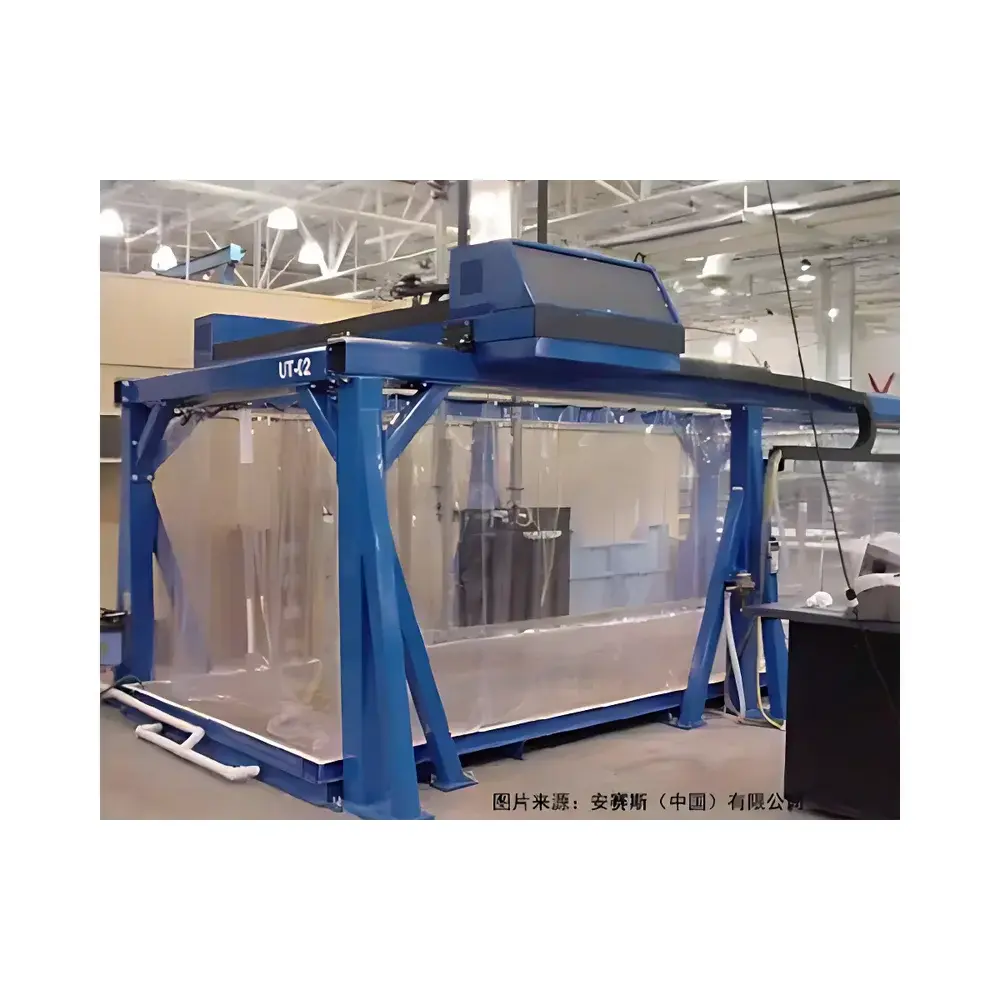
Analysis GN1500HS Spray-Water Immersion Ultrasonic C-Scan System
| Brand | Analysis |
|---|---|
| Origin | USA |
| Manufacturer | Analysis Instruments, Inc. |
| Type | Imported |
| Model | GN1500HS |
| Pricing | Available upon Request |
Overview
The Analysis GN1500HS Spray-Water Immersion Ultrasonic C-Scan System is an industrial-grade, multi-axis automated ultrasonic testing (AUT) platform engineered for high-fidelity volumetric inspection of large-scale composite and metallic structures. It operates on the pulse-echo and through-transmission ultrasonic principles, utilizing focused immersion transducers coupled via a precisely regulated water spray couplant to ensure consistent acoustic impedance matching across complex geometries. Designed for aerospace, wind energy, and defense applications, the system delivers repeatable, traceable, and quantifiable defect characterization—including delaminations, disbonds, porosity, impact damage, cracks, and voids—in carbon fiber reinforced polymer (CFRP), glass fiber laminates, aluminum honeycomb, and hybrid assemblies. Its architecture integrates real-time A-scan waveform acquisition, B-scan cross-sectional reconstruction, and C-scan planar imaging synchronized with precision motion control—enabling full-field, non-contact, and non-destructive evaluation compliant with ASTM E1316, ISO 16810, and EN 1330-4 standards.
Key Features
- 8-axis coordinated motion system: X (linear traverse), Y1/Y2 (dual parallel scanning axes), Z1/Z2 (vertical lift & tilt compensation), G1/G2 (probe rotation for angular beam steering), and S1 (swivel axis for probe orientation adjustment)
- Spray-water coupling mechanism ensuring uniform acoustic transmission without immersion tank constraints—ideal for oversized or irregularly shaped components up to 15 m × 4 m
- Real-time simultaneous acquisition and display of A-scan waveforms, B-scan depth profiles, and C-scan amplitude/TOF maps during scanning
- Automated surface-following capability for 2D and 2.5D curved geometries using dynamic Z-axis servo feedback and adaptive path planning
- Full-waveform data capture (RF data) enabling post-scan parameter reprocessing: gain, gate position, threshold, PRF, and filtering—without rescanning the part
- Dual alarm logic: entry-gate (front-surface echo) and exit-gate (back-wall echo) monitoring with four independent, user-configurable thresholds per channel
- Automatic PRF optimization and scan resolution synchronization based on probe velocity, material sound velocity, and required spatial sampling density
Sample Compatibility & Compliance
The GN1500HS accommodates structural components ranging from flat panels to doubly curved airframe skins, rotor blades, pressure vessels, and bonded assemblies. It supports both single-element and phased-array probes (5–15 MHz frequency range), with compatibility for focused immersion transducers (10–25 mm focal length). The system meets requirements for AS9100-certified NDT workflows and supports audit-ready documentation per FAA AC 150/5370-10, EASA Part-21G, and ISO 9712 Level 3 operator protocols. All raw data files are stored in industry-standard .uf, .udf, or HDF5 formats, ensuring long-term archival integrity and third-party software interoperability.
Software & Data Management
The proprietary ScanView™ control and analysis suite provides intuitive GUI-driven operation, including CAD-based scan path import (IGES, STEP, DXF), geometric correction mapping, and automated report generation with embedded C-scan thumbnails, statistical defect summaries, and pass/fail flagging per user-defined acceptance criteria. Software features include GLP-compliant electronic signatures, 21 CFR Part 11–ready audit trails, and role-based access control. All acquisitions retain full RF waveform metadata (time-zero reference, calibration settings, motion encoder timestamps), enabling retrospective analysis and regulatory review without data loss.
Applications
- Aerospace: Inspection of CFRP fuselage sections, wing skins, empennage components, and bonded repairs for manufacturing defects and in-service damage
- Renewable Energy: Thickness mapping and delamination detection in wind turbine blade spar caps and shear webs
- Defense: Certification of ballistic armor plates, naval composite hull segments, and radar-absorbing structure integrity
- Automotive: Validation of adhesive bond quality in EV battery enclosures and structural carbon fiber chassis modules
- R&D Laboratories: Quantitative microstructural analysis of porosity distribution, fiber misalignment, and interlaminar shear strength correlation
FAQ
What is the minimum detectable defect size for delaminations in CFRP?
The system achieves reliable detection of Ø3 mm delaminations in standard 10-ply carbon fiber laminates at 5 MHz with water-coupled focused transducers under optimized scan parameters.
Does the system support phased-array ultrasonic testing (PAUT)?
Yes—GN1500HS is compatible with commercial PAUT modules; hardware I/O interfaces support external beamformer synchronization and encoded wedge positioning.
Can scan paths be imported from CAD models?
Yes—ScanView™ accepts IGES, STEP, and DXF files for automatic trajectory generation, including curvature compensation and probe incidence angle optimization.
Is full waveform data export supported for third-party analysis?
Yes—raw RF data is saved in open-format HDF5 containers with complete metadata, supporting MATLAB, Python (h5py), and commercial NDT analytics platforms.
What motion accuracy specifications apply to the X-Y-Z axes?
Linear axes achieve ±5 µm repeatability over full travel (±15 m X, ±4 m Y, ±0.5 m Z), calibrated per ISO 230-2 using laser interferometry.



