
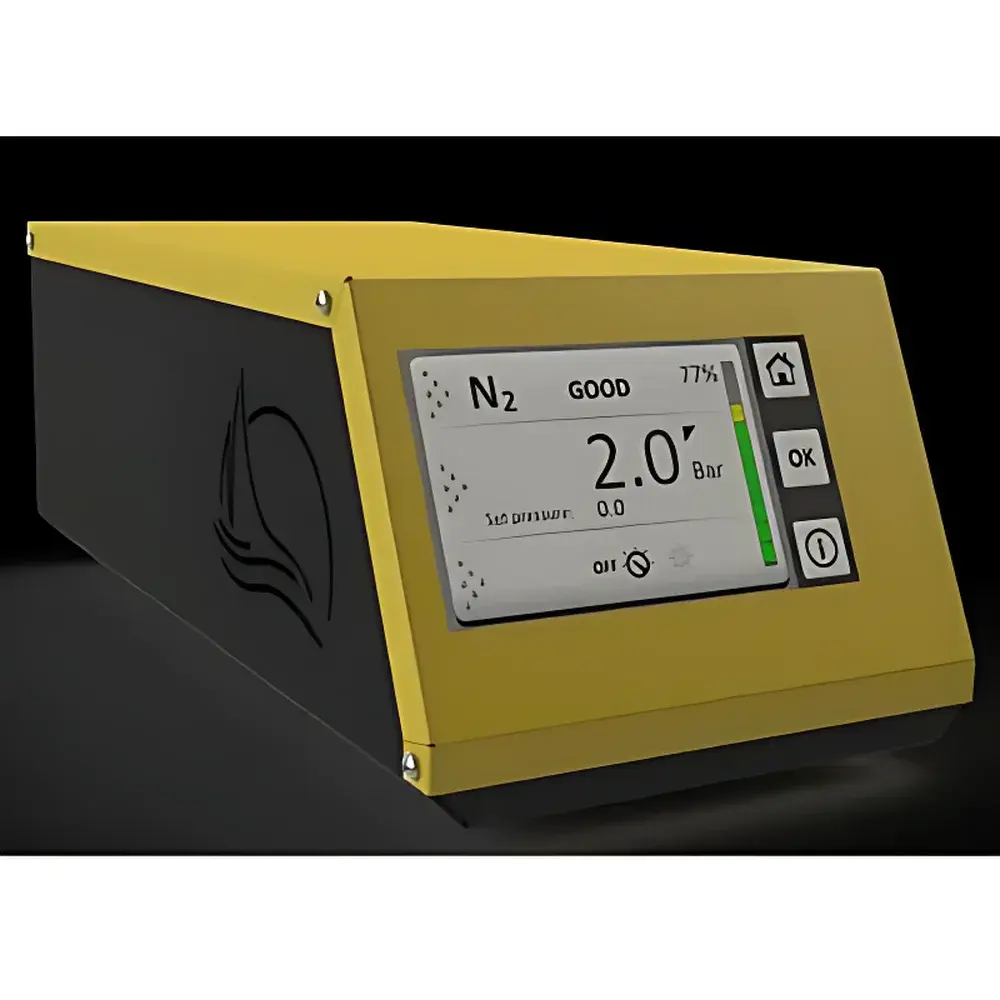
Leman Instruments LISAS N2 High-Purity Nitrogen Generator
| Brand | Leman Instruments |
|---|---|
| Origin | France |
| Model | LISAS N2 |
| Nitrogen Generation Principle | Pressure Swing Adsorption (PSA) |
| Output Flow | 250 mL/min or 500 mL/min (NTP) |
| Output Pressure | 0.5–5 bar (adjustable) |
| Nitrogen Purity | ≥99.999% |
| Dew Point | −40 °C |
| Filtration | 0.1 µm final particulate filter |
| Power Supply | 90–260 V AC, 47–63 Hz |
| Max. Power Consumption | 300 W |
| Dimensions (W×H×D) | 210 × 160 × 430 mm |
| Weight | 15 kg |
| Noise Level | <50 dB(A) at 1 m |
| Certifications | CE |
| Connectivity | Ethernet 10/100 & Wi-Fi |
| Display | 4.3″ TFT-LCD touchscreen |
| Compressed Air Requirement | Oil-free, dry air per ISO 8573-1 Class 3 |
Overview
The Leman Instruments LISAS N2 is a compact, laboratory-grade nitrogen generator engineered for continuous, on-demand production of ultra-high-purity nitrogen gas (≥99.999%) using proven Pressure Swing Adsorption (PSA) technology. Designed and manufactured in France, the system integrates carbon molecular sieve (CMS) beds with precision electronic pressure regulation and multi-stage filtration to deliver stable, contamination-free nitrogen under controlled conditions. Unlike cryogenic or membrane-based alternatives, PSA enables selective separation of nitrogen from compressed air by exploiting differential adsorption kinetics—oxygen, water vapor, and CO₂ are retained on CMS while high-purity N₂ passes through. This principle ensures consistent purity across variable flow rates and ambient conditions, making the LISAS N2 particularly suited for sensitive analytical applications where trace hydrocarbon or moisture interference must be eliminated—such as GC carrier gas, ICP-MS auxiliary gas, ELSD and CAD detector operation, and inert atmosphere incubation.
Key Features
- Stable output purity ≥99.999% (O₂ ≤1 ppmv, H₂O ≤1 ppmv, hydrocarbons ≤0.1 ppmv), validated per ISO 8573-1:2010 Class 1 for particles and Class 2 for moisture
- Two flow variants: LISAS N2-250 (250 mL/min NTP) and LISAS N2-500 (500 mL/min NTP), both scalable via software-defined pressure setpoints (0.5–5 bar)
- Integrated 0.1 µm final particulate filter and catalytic deoxygenation stage to eliminate residual O₂ and volatile organic compounds
- Intuitive 4.3″ TFT-LCD touchscreen interface with real-time monitoring of pressure, flow, purity status, CMS bed cycle timing, and alarm history
- Dual communication architecture: Ethernet 10/100 and IEEE 802.11 b/g/n Wi-Fi for seamless integration into centralized lab gas management systems
- Low acoustic signature (<50 dB(A) at 1 m) and passive thermal design enable benchtop deployment without dedicated ventilation or external cooling
- CE-compliant architecture with built-in safety interlocks—including overpressure relief, CMS saturation detection, and automatic shutdown on air supply failure
Sample Compatibility & Compliance
The LISAS N2 meets stringent requirements for analytical-grade gas supply across regulated and research environments. Its nitrogen output complies with ASTM D6349–18 (for GC carrier gas), USP (for pharmaceutical gas quality), and ISO 8573-1:2010 Class 1 (solid particles), Class 2 (water), and Class 2 (oil aerosol). The absence of cylinder-derived contaminants—such as lubricant carryover, valve leaching, or batch-to-batch variability—ensures reproducibility in GC retention time, MS signal stability, and detector baseline noise. The system supports direct connection to Agilent, Thermo Fisher Scientific, and Bruker GC-MS and LC-MS platforms without additional purification modules. All firmware and control logic adhere to IEC 62443-3-3 cybersecurity guidelines for industrial automation devices.
Software & Data Management
The embedded firmware supports remote configuration, diagnostics, and audit logging via a secure web interface accessible over local network or VLAN. Each unit maintains a tamper-resistant event log compliant with FDA 21 CFR Part 11 requirements—including user authentication, electronic signatures, and immutable timestamped records of all operational changes, alarms, and maintenance triggers. Optional integration with LabVantage or STARLIMS LIMS enables automated gas usage tracking, predictive CMS replacement scheduling, and GLP/GMP-aligned reporting. No proprietary drivers or client software are required; standard HTTP/HTTPS and SNMP v3 protocols ensure interoperability with enterprise IT infrastructure.
Applications
- GC carrier and make-up gas for flame ionization (FID), thermal conductivity (TCD), electron capture (ECD), and mass spectrometric (MS) detectors
- Auxiliary gas for inductively coupled plasma optical emission spectroscopy (ICP-OES) and mass spectrometry (ICP-MS)
- Nebulizer and drying gas for evaporative light scattering (ELSD), charged aerosol (CAD), and corona discharge detectors
- Inert purge and blanketing gas for glove boxes, anaerobic chambers, and cell culture incubators
- LC-MS mobile phase sparging and instrument purge lines requiring sub-ppmv oxygen and hydrocarbon levels
- Calibration gas dilution systems and reference standard preparation workflows
FAQ
What compressed air specifications are required for optimal operation?
The LISAS N2 requires oil-free, desiccated compressed air meeting ISO 8573-1 Class 3 (≤0.1 µm particles, ≤−20 °C pressure dew point, ≤0.1 mg/m³ oil content). Inlet pressure must exceed desired N₂ output pressure by 2–9 bar.
Can multiple LISAS N2 units be daisy-chained or centrally managed?
Yes—via standard Ethernet or Wi-Fi, up to 32 units can be monitored and controlled from a single dashboard using Leman’s GasNet Manager software.
Is routine maintenance required beyond CMS cartridge replacement?
CMS cartridges require replacement every 24–36 months depending on daily runtime and inlet air quality; no other consumables or scheduled servicing are needed.
Does the system support 21 CFR Part 11-compliant electronic records?
Yes—the internal audit trail includes user ID, action timestamp, parameter change values, and digital signature verification, exportable as CSV or PDF.
What is the maximum ambient temperature for continuous operation?
The unit is rated for uninterrupted use within +10 °C to +35 °C ambient temperature, with derated flow above 30 °C per manufacturer’s thermal management curve.



