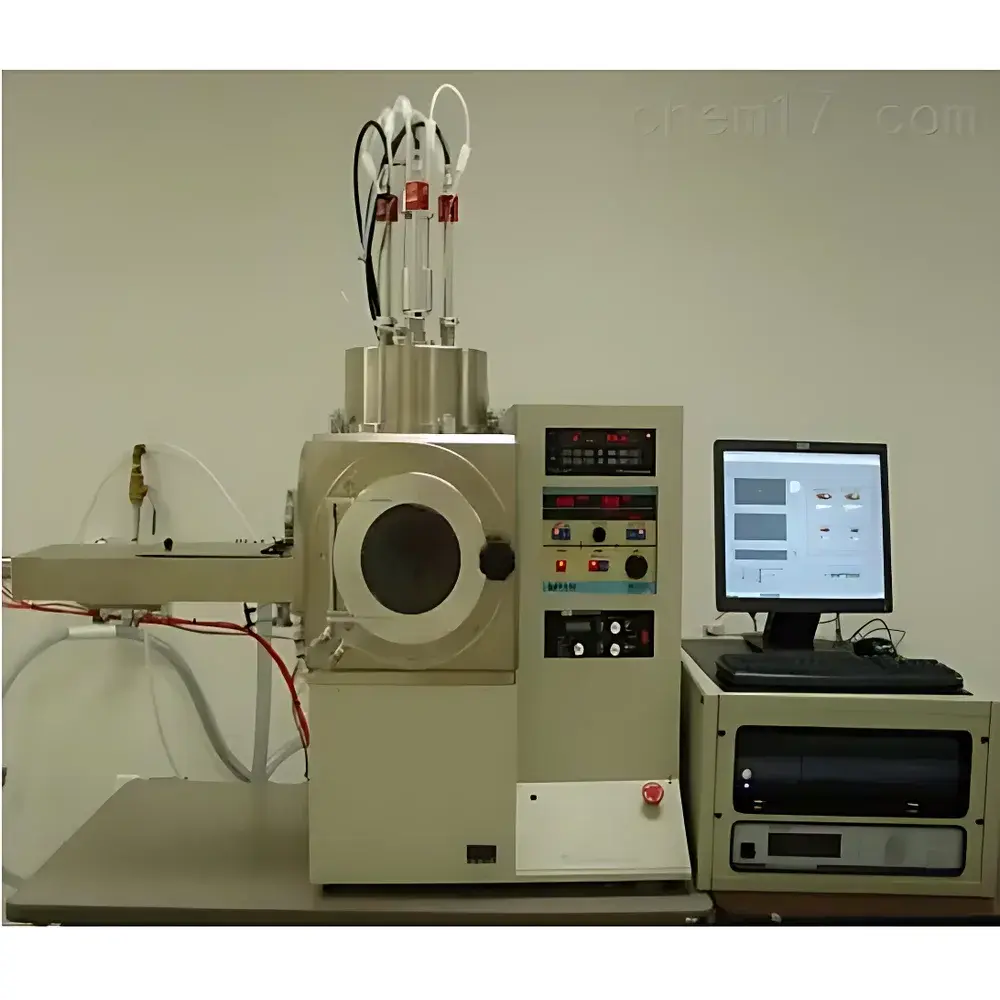
Nano-Master NSC-3000 (A) Fully Automated Magnetron Sputtering System
| Brand | Nano-Master |
|---|---|
| Origin | USA |
| Manufacturer | Nano-Master, Inc. |
| Type | Magnetron Sputter Deposition System |
| Substrate Size | 6-inch (152 mm) |
| Maximum Substrate Temperature | 700 °C |
| Thickness Uniformity | <1% (1σ, across 6″ wafer) |
| Base Pressure | ≤1 × 10⁻⁷ Torr |
| Pumping Speed | 260 L/s Turbo Molecular Pump (optional) |
| Power Supplies | 1 kW DC + 300–600 W RF (13.56 MHz) |
| Magnetron Configuration | Up to 3 off-axis planar magnetrons |
| Chamber | 14″ cubic aluminum vacuum chamber with viewport |
| Control Interface | LabVIEW-based PC control with multi-level password protection and full interlock safety architecture |
Overview
The Nano-Master NSC-3000 (A) Fully Automated Magnetron Sputtering System is an engineered thin-film deposition platform designed for research, process development, and pilot-scale fabrication in semiconductor, MEMS, photonics, and advanced materials laboratories. Based on the principle of magnetron sputtering—a physical vapor deposition (PVD) technique that utilizes a plasma-generated ion beam to eject atoms from a solid target material—the NSC-3000 (A) enables precise, repeatable, and contamination-controlled film growth on substrates up to 6 inches (152 mm) in diameter. Its modular architecture integrates high-vacuum performance, thermal management, and programmable process control to support both DC and RF sputtering modes—including reactive sputtering, bias-assisted deposition, and in-situ plasma cleaning—making it suitable for metallic, dielectric, and compound thin-film synthesis (e.g., Al, Ti, Cr, SiO₂, Al₂O₃, ITO, and nitrides).
Key Features
- 14-inch cubic aluminum vacuum chamber with integrated quartz viewport and pneumatically actuated front door for rapid sample loading/unloading
- Triple-magnetron configuration: three 2-inch planar magnetrons mounted in off-axis geometry for enhanced uniformity and reduced arcing risk
- High-temperature substrate stage with active water cooling and resistive heating up to 700 °C, enabling epitaxial-like growth and stress engineering
- Ultra-high vacuum capability: base pressure ≤1 × 10⁻⁷ Torr achieved using a 260 L/s turbo molecular pump backed by a dry scroll pump; 10⁻⁶ Torr reached within 15 minutes
- Dual-power supply system: 1 kW DC power supply for conductive targets and 300–600 W RF (13.56 MHz) generator for insulating or semi-insulating materials
- Quartz crystal microbalance (QCM) thickness monitor with sub-angstrom resolution (<1 Å) and real-time rate feedback
- Full LabVIEW-based automation: programmable recipes, step-by-step process sequencing, data logging, and remote monitoring via Ethernet
- Multi-tier security architecture: role-based access control with password-protected operator, engineer, and administrator levels
- Comprehensive hardware interlocks: chamber pressure, door position, cooling flow, power supply status, and emergency stop integration per SEMI S2/S8 guidelines
- Integrated load-lock option with pre-vacuum lock for high-throughput wafer handling without breaking main chamber vacuum
Sample Compatibility & Compliance
The NSC-3000 (A) accommodates standard 6-inch silicon wafers, fused silica, alumina, sapphire, glass substrates, and magnetic recording heads. Its robust chamber design supports both flat and slightly warped substrates through precision-ground rotation stages with ±0.02° angular repeatability. The system complies with ISO 14644-1 Class 5 cleanroom-compatible construction standards and meets electrical safety requirements per UL 61010-1 and IEC 61000-6-2/6-4. For regulated environments, optional audit-trail-enabled software modules support 21 CFR Part 11 compliance when paired with validated electronic signatures and change-control protocols.
Software & Data Management
Control is executed via a Windows-based LabVIEW application featuring intuitive GUI navigation, scriptable process templates, and synchronized timestamped acquisition of pressure, power, temperature, deposition rate, and film thickness. All operational parameters are stored in encrypted binary logs with SHA-256 hash integrity verification. Export formats include CSV, XML, and HDF5 for seamless integration with MATLAB, Python (via PyVISA), or enterprise MES systems. Optional add-ons include real-time spectral endpoint detection (for reactive sputtering) and automated calibration traceability linked to NIST-traceable QCM sensors.
Applications
- Deposition of ohmic and barrier metal stacks (Ti/TiN, Ta/TaN) for CMOS backend-of-line integration
- Growth of transparent conductive oxides (ITO, AZO) for display and photovoltaic R&D
- Hard coating synthesis (CrN, TiAlN) using pulsed DC and substrate bias (up to –1000 V)
- In-situ RF plasma pre-cleaning of substrates prior to metallization to remove native oxides and hydrocarbons
- Low-stress dielectric films (SiO₂, Si₃N₄) for MEMS encapsulation and optical waveguide fabrication
- Research-grade multilayer heterostructures requiring atomic-layer precision and thermal stability up to 700 °C
FAQ
What vacuum level is required for high-purity metallic film deposition?
For low-defect metallic films (e.g., Cu, Al), a base pressure ≤5 × 10⁻⁷ Torr is recommended to minimize residual gas incorporation (O₂, H₂O, N₂). The NSC-3000 (A) achieves ≤1 × 10⁻⁷ Torr with its standard 260 L/s turbo pump configuration.
Can the system perform reactive sputtering of oxides or nitrides?
Yes—when equipped with mass flow controllers (MFCs) for O₂ or N₂, RF power, and optional endpoint detection, the NSC-3000 (A) supports stable reactive sputtering of stoichiometric oxides and nitrides.
Is remote operation and monitoring supported?
Yes—the LabVIEW interface supports secure remote desktop access over LAN/WAN with TLS-encrypted command transmission and live parameter dashboards.
How is film thickness uniformity validated across a 6-inch wafer?
Uniformity is verified using calibrated ellipsometry and profilometry on witness wafers; typical results show <1% 1σ variation across the full diameter under optimized magnetron-to-substrate distance and rotation speed.
Does the system meet GLP/GMP documentation requirements?
With optional 21 CFR Part 11-compliant software, electronic signature validation, and audit-trail generation, the NSC-3000 (A) can be qualified for GxP environments subject to site-specific IQ/OQ/PQ protocols.