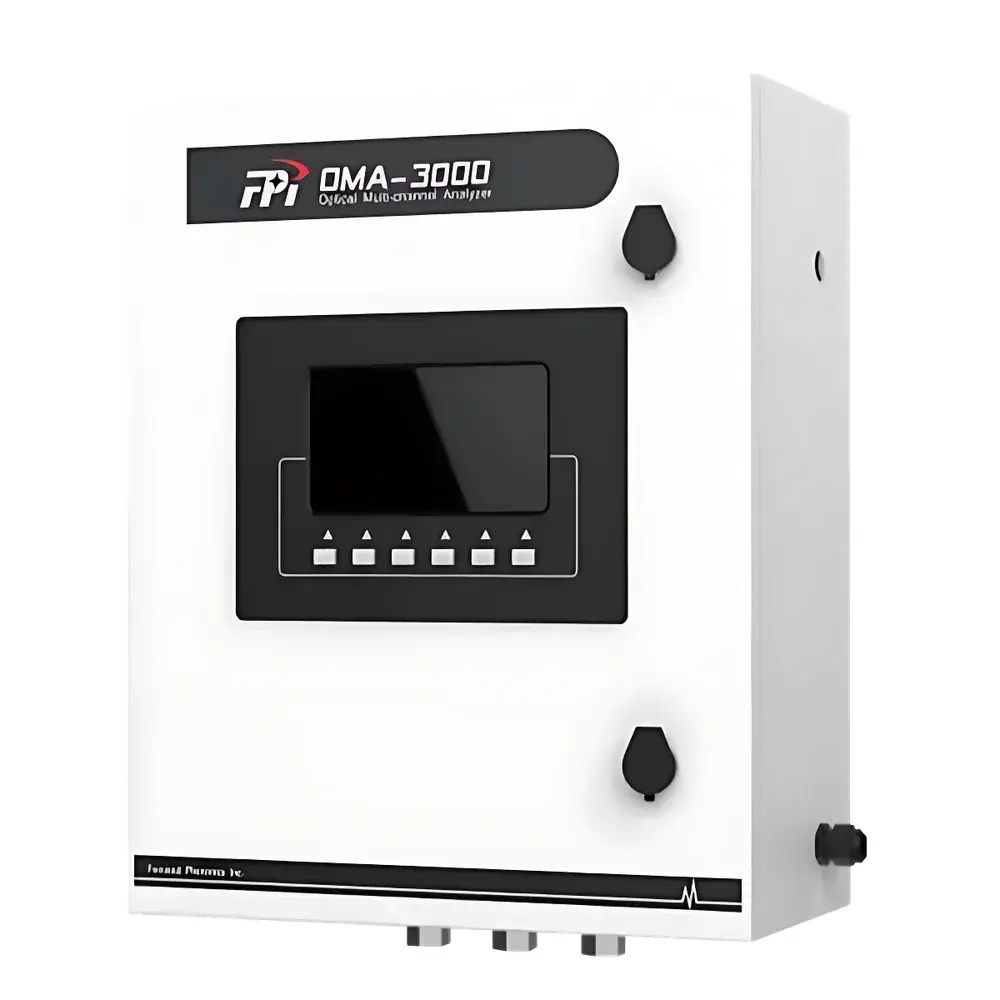
FPI OMA-3000 Online UV Fiber-Optic Spectrophotometer
| Brand | FPI |
|---|---|
| Origin | Zhejiang, China |
| Manufacturer Type | Original Equipment Manufacturer (OEM) |
| Country of Origin | China |
| Model | OMA-3000 |
| Pricing | Available Upon Request |
Overview
The FPI OMA-3000 Online UV Fiber-Optic Spectrophotometer is an industrial-grade, real-time gas concentration analyzer engineered for continuous in-situ monitoring in demanding process environments. It operates on the principle of ultraviolet absorption spectroscopy (UV-Vis), leveraging high-stability deuterium and/or tungsten-halogen light sources, a Czerny-Turner monochromator or concave holographic grating optical path, and a 2048-pixel linear silicon photodiode array (PDA) detector. Light is delivered to and collected from the measurement cell via robust, low-OH silica optical fibers—typically 200–600 µm core diameter, with UV-grade transmission down to 190 nm. The system measures broadband absorption spectra across the 190–400 nm range, enabling simultaneous quantification of multiple gas species (e.g., Cl₂, SO₂, NO, NO₂, O₃, H₂S, NH₃) based on their unique electronic transition fingerprints. Designed for integration into distributed control systems (DCS) or programmable logic controllers (PLC), the OMA-3000 delivers millisecond-scale spectral acquisition and sub-second concentration updates under steady-state conditions.
Key Features
- Multi-component analysis capability: Simultaneous quantification of up to eight gas species using full-spectrum chemometric modeling (e.g., partial least squares regression, PLS-R; or classical least squares, CLS)
- Wide dynamic concentration range: Supports auto-ranging via programmable integration time and digital gain adjustment—enabling detection from low-ppb to high-% vol levels without hardware reconfiguration
- Fiber-coupled modular architecture: Separation of optical engine (light source + spectrometer) from heated measurement cell (up to 200 °C with PID-controlled trace heating) minimizes thermal drift and simplifies hazardous-area installation
- High-speed spectral acquisition: Full 2048-channel spectrum captured in ≤10 ms; typical cycle time for calibrated concentration output: 0.5–2 s
- Robust environmental rating: Enclosure rated IP66/NEMA 4X; optional ATEX/IECEx Zone 1 or Class I Div 1 certification for explosive atmospheres; corrosion-resistant wetted materials (e.g., 316L SS, Hastelloy C-276, quartz, PTFE)
- Zero-drift optical design: Thermally stabilized optical bench and reference channel compensation mitigate baseline drift over extended unattended operation
Sample Compatibility & Compliance
The OMA-3000 is validated for use with corrosive, condensable, and particulate-laden process streams common in chlor-alkali electrolysis, sulfuric acid production, ethylene oxide synthesis, and flue gas desulfurization (FGD) units. Measurement cells are available in extractive (hot/wet or dilution-probe configurations) and in-situ (cross-stack or open-path) variants. All optical path components comply with ISO 17025 traceability requirements for calibration verification. System validation adheres to ASTM D6348–22 (standard test method for determining gaseous compounds by UV absorption) and supports IQ/OQ/PQ documentation per GMP/GLP guidelines. Data integrity features include audit-trail-enabled configuration logs and timestamped raw spectral archives compliant with FDA 21 CFR Part 11 requirements when deployed with certified software modules.
Software & Data Management
The instrument is operated via FPI’s proprietary OMA Control Suite—a Windows-based application supporting real-time spectral visualization, multi-point calibration management, interference correction setup, and alarm/event logging. Raw spectra and concentration time-series data are stored in HDF5 format with embedded metadata (wavelength calibration, temperature/pressure compensation parameters, lamp intensity history). OPC UA and Modbus TCP interfaces enable seamless integration into enterprise MES/SCADA platforms. Optional cloud connectivity allows remote diagnostics, firmware updates, and spectral model retraining using federated learning frameworks—subject to customer-defined cybersecurity protocols (TLS 1.2+, role-based access control).
Applications
- Chlor-alkali plants: Real-time monitoring of Cl₂ purity (>99.5%), O₂, and moisture in liquefaction and compression loops
- Petrochemical refining: Detection of sulfur compounds (H₂S, COS, mercaptans) in amine regenerator overheads and hydrotreater recycle gas
- Chemical synthesis: In-line stoichiometric control of nitration, chlorination, and ozonation reactions
- Environmental compliance: Continuous emission monitoring (CEMS) of NOₓ, SO₂, and VOCs in stack gases per EU BREF and US EPA PS-15 specifications
- Pharmaceutical manufacturing: Solvent vapor monitoring in reactor headspaces and dryer exhausts per ICH Q7 and Annex 11
FAQ
What is the typical optical path length for the OMA-3000 measurement cell?
Standard extractive cells offer 0.1–2.0 m path lengths; custom in-situ cross-stack configurations support up to 10 m. Path length selection is optimized for target analyte sensitivity and matrix interference.
Does the system require periodic lamp replacement?
Deuterium lamps have a rated lifetime of ≥1,500 hours; tungsten-halogen lamps exceed 2,000 hours. Integrated lamp intensity monitoring triggers maintenance alerts prior to performance degradation.
Can the OMA-3000 be calibrated against NIST-traceable gas standards?
Yes—calibration protocols support multi-point span gas validation using certified mixtures from NIST-accredited suppliers (e.g., Air Liquide, Linde, or Scott-Marrin), with documented uncertainty budgets.
Is third-party software integration supported?
Full API documentation and SDKs (C/C++, Python) are provided for custom integration with LIMS, DCS, or advanced process control (APC) platforms.
How is temperature and pressure compensation handled?
Integrated Pt100 RTD and piezoresistive transducers feed real-time T&P data to the chemometric engine, applying Beer-Lambert law corrections for density-dependent absorbance scaling.
Related Products