
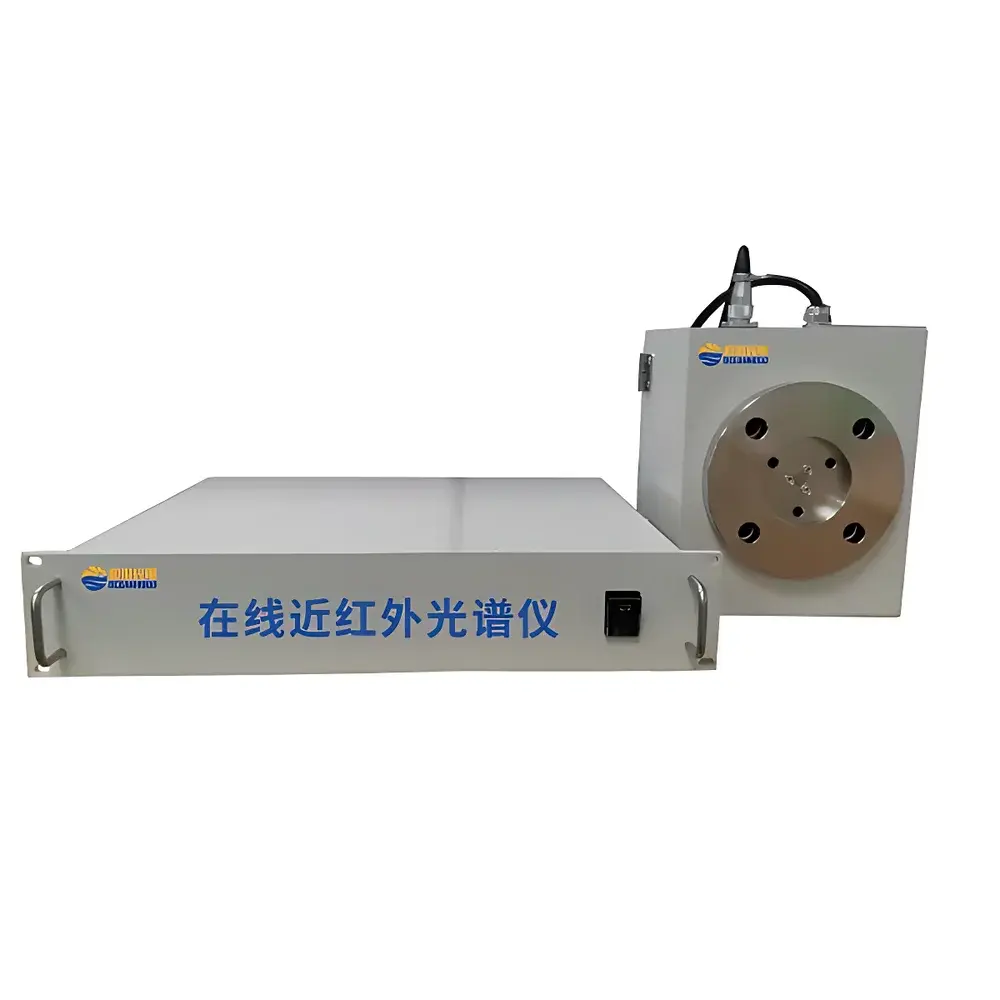
Oceanhood NirIn Online Near-Infrared Process Spectrometer
| Brand | Oceanhood |
|---|---|
| Origin | Shanghai, China |
| Manufacturer Type | OEM Manufacturer |
| Region of Origin | Domestic (China) |
| Model | NirIn |
| Instrument Type | Online Process Spectrometer |
| Wavelength Range | 900–1700 nm |
| Optical Resolution | 5 nm |
| Spectral Stability | <2% peak-to-peak deviation over 72 h continuous operation |
| Frame Rate | >1000 spectra/s |
| Integration Time | 100 µs – 30 s |
| Host Dimensions | 430 × 328 × 88.1 mm |
| Probe Head Dimensions | 250 × 200 × 250 mm |
| Spot Diameter | Up to 10 cm |
| Fiber Optic Cable Compatibility | Customizable fused-silica patch cables (1–100 m) |
| Data Interfaces | USB 2.0, RS-232 serial |
| Output Formats | JDX, SPC, CSV, TXT, PDF, JPEG |
| Operating Temperature | −10 to +50 °C |
| Operating Humidity | 5–80% RH (non-condensing) |
| Power Supply | 220 V AC, 50/60 Hz |
| Compliance | CE-marked |
Overview
The Oceanhood NirIn Online Near-Infrared Process Spectrometer is an industrial-grade, fiber-coupled NIR spectrometer engineered for real-time, non-destructive chemical and physical property monitoring in continuous manufacturing environments. It operates on the principle of diffuse reflectance and transmission spectroscopy in the 900–1700 nm spectral region—where overtones and combination bands of C–H, O–H, and N–H bonds exhibit characteristic absorption features. Unlike benchtop or portable NIR systems, the NirIn is purpose-built for permanent integration into production lines, reactor vessels, fluidized beds, or conveyor-based systems. Its optical architecture supports robust signal acquisition under variable ambient lighting, vibration, and thermal drift—enabling quantitative analysis without sample preparation or offline lab intervention. The system complies with foundational principles of Process Analytical Technology (PAT) as defined by FDA Guidance for Industry (2004), supporting Quality-by-Design (QbD) frameworks in regulated industries.
Key Features
- Fiber-optic remote sensing capability: Supports standard SMA-905 or FC/PC connectors with customizable silica-core optical fibers up to 100 m in length—enabling safe deployment in hazardous, high-temperature, or inaccessible zones.
- High-speed spectral acquisition: Capable of >1000 full-spectrum captures per second at minimum integration time (100 µs), facilitating dynamic process event capture (e.g., crystallization onset, mixing homogeneity, drying endpoint).
- Stable optical path design: Thermally compensated optical bench with fixed grating and InGaAs linear array detector ensures <2% spectral intensity drift over 72 h—critical for multiday unattended operation in GMP facilities.
- Large-area illumination geometry: Engineered probe head delivers uniform illumination with adjustable spot diameter up to 10 cm—optimized for heterogeneous bulk materials including granules, powders, pellets, and slurries.
- Rugged mechanical construction: IP54-rated enclosure for host unit; stainless-steel and anodized aluminum probe housing; operating range certified from −10 °C to +50 °C and 5–80% RH (non-condensing).
Sample Compatibility & Compliance
The NirIn accommodates solid, semi-solid, and liquid samples in situ—without contact or dilution—via reflection, transflectance, or transmission configurations. It is validated for use with pharmaceutical blends (API + excipients), agricultural grains, food powders (e.g., flour, starch), polymer resins, petrochemical intermediates, and aqueous process streams. The instrument’s spectral response adheres to ASTM E1655–22 (Standard Practices for Infrared Multivariate Quantitative Analysis) and ISO 12099:2017 (Animal feeding stuffs, cereals and milled cereal products — Guidelines on the application of near infrared spectroscopy). Data integrity meets ALCOA+ principles; raw spectral logs include embedded timestamps, instrument ID, calibration checksums, and environmental metadata—supporting audit readiness under FDA 21 CFR Part 11 and EU Annex 11 requirements.
Software & Data Management
The NirIn is supplied with Oceanhood SpectraSuite™ Process Edition—a modular, Windows/Linux-compatible software platform supporting method development, chemometric modeling (PLS, PCA, SVM), real-time spectral visualization, and automated alarm triggering. All acquired spectra are stored in vendor-neutral JDX and SPC formats compliant with ASTM E131 and ASTM E1421 standards. Batch export functions generate CSV/TXT tables for LIMS integration; PDF/JPEG reports include spectral overlays, prediction confidence intervals, and trend charts. Software architecture includes role-based access control, electronic signature support, and full audit trail logging—including user actions, model versioning, and calibration history—for GLP/GMP traceability.
Applications
- API and residual solvent quantification: Real-time tracking of active pharmaceutical ingredient concentration and solvent clearance during crystallization, drying, and blending—enabling endpoint determination per ICH Q5C and USP <1119>.
- In-line particle size distribution monitoring: Correlation of NIR spectral slope and second-derivative features with laser diffraction or sieve analysis data—validated for resin granules, milled APIs, and tablet granulations.
- Moisture content surveillance: Calibration against Karl Fischer titration or loss-on-drying reference methods for continuous moisture profiling in fluid bed dryers, roller compactors, and grain silos—aligned with ISO 712 and AOAC 985.15.
- Blend uniformity assessment: Multivariate statistical process control (SPC) of NIR spectral residuals across mixer discharge cycles—reducing sampling frequency while maintaining ≥95% confidence in content uniformity (USP <905>).
FAQ
Is the NirIn compatible with existing PLC or DCS systems?
Yes—via Modbus TCP or OPC UA protocol bridges; optional analog 4–20 mA output modules are available for direct integration with legacy control infrastructure.
Can the system be recalibrated remotely?
Yes—spectral calibration files (wavelength and intensity) can be uploaded via secure FTP or local network; built-in validation routines verify calibration integrity before deployment.
What chemometric tools are supported?
PLS regression, PCA, cluster analysis, and outlier detection are natively implemented; models trained in Unscrambler®, MATLAB®, or Python (scikit-learn) can be imported via PMML or .csv coefficient tables.
Does the probe require purging or cooling in high-temperature processes?
Standard probe heads operate up to 80 °C ambient; for >80 °C applications, optional air-purge collars or water-jacketed housings are available to maintain detector stability.
How is data security ensured during transmission?
All network communications use TLS 1.2 encryption; local storage employs AES-256 encryption for raw spectral archives, configurable per site-specific IT policies.
Related Products





