
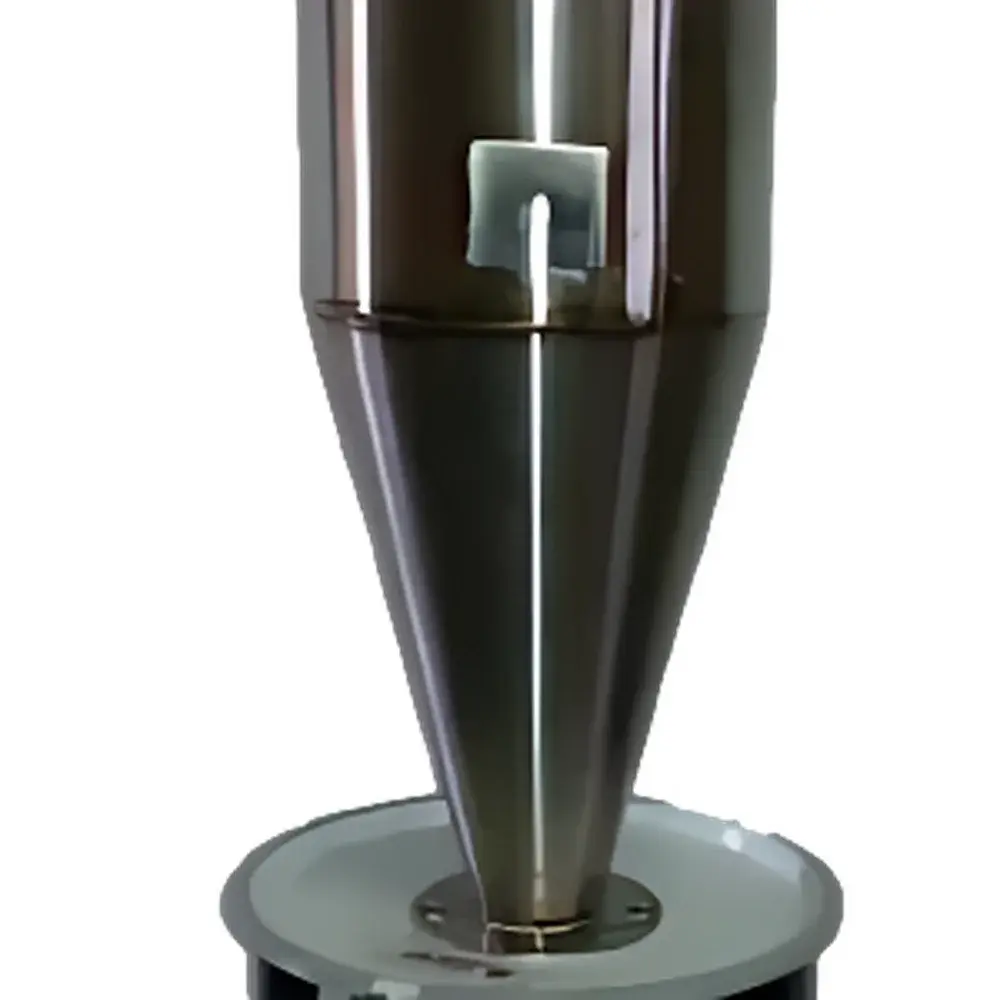
Accurate Thermal Systems ATS1032 Cyclonic Separator for Fluidized Sand Bath Systems
| Brand | Accurate Thermal Systems |
|---|---|
| Origin | USA |
| Manufacturer Type | Authorized Distributor |
| Origin Category | Imported |
| Model | ATS1032 |
| Price | Upon Request |
| Height | 23 in (57.5 cm) |
| Diameter | 19.5 in (49 cm) |
| Width | 18 in (45 cm) |
| Weight | 20 lb (9 kg) |
| Inlet OD | 5 in (12.5 cm) |
| Outlet OD | 6 in (15 cm) |
| Operating Temperature | up to 250°F (121°C) |
| Collection Efficiency | 90–95% for 120-mesh Al₂O₃ |
| Recommended Airflow | 250–350 CFM |
| Drum Dimensions | Ø19 in × 18 in (Ø47.5 cm × 45 cm) |
| Finish | Powder-Coated Steel |
Overview
The Accurate Thermal Systems ATS1032 Cyclonic Separator is an engineered component designed specifically for integration with fluidized sand bath systems used in thermal testing, material conditioning, and high-temperature process simulation laboratories. It operates on the principle of inertial separation—utilizing centrifugal force generated by tangential airflow to remove particulate matter from exhaust streams. As exhaust gas enters the cyclone tangentially at high velocity, heavier particles (primarily 120-mesh aluminum oxide, Al₂O₃) are forced outward against the conical wall, spiral downward under gravity, and collect in the removable drum. The cleaned air exits axially through the top outlet. This device is not a standalone air purifier but a process-integrated particulate recovery unit—critical for maintaining bed integrity, minimizing abrasive media loss, and reducing downstream filter loading in closed-loop or semi-closed thermal test environments.
Key Features
- Optimized geometry for high-efficiency separation of 120-mesh Al₂O₃ particles (90–95% collection efficiency at 250–350 CFM airflow)
- Powder-coated carbon steel construction rated for continuous operation up to 250°F (121°C), compatible with standard fluidized sand bath operating temperatures
- Modular design with integrated mounting kit for direct coupling to ATS-series fluidized beds and exhaust ducting
- Removable collection drum (Ø19 in × 18 in) enabling rapid media recovery—collected Al₂O₃ can be returned directly to the fluidized bed without sieving or reconditioning
- Tangential inlet (5 in OD) and axial outlet (6 in OD) configured to minimize pressure drop and maintain stable flow dynamics across the recommended 250–350 CFM range
- No moving parts or consumables—designed for long-term reliability and low-maintenance operation in industrial laboratory settings
Sample Compatibility & Compliance
The ATS1032 is validated for use with aluminum oxide (Al₂O₃) media commonly employed in fluidized sand baths—including ASTM F1290-compliant 120-mesh (125 µm nominal) granules. Its performance envelope aligns with typical exhaust requirements of benchtop and pilot-scale fluidized bed systems. While it achieves >90% capture for coarse-to-medium particles, it is not intended for submicron or ultrafine aerosol control; particles finer than 325 mesh (<44 µm) exhibit significantly reduced collection efficiency (~25%), necessitating downstream HEPA filtration if regulatory or occupational exposure limits (e.g., OSHA PEL for respirable Al₂O₃: 10 mg/m³ total dust; 5 mg/m³ respirable fraction) must be met. The unit complies with general mechanical safety standards for laboratory exhaust components (ANSI Z9.2, ASHRAE 110) and supports GLP-aligned documentation when paired with calibrated airflow measurement and maintenance logs.
Software & Data Management
The ATS1032 is a passive mechanical device and does not incorporate embedded electronics, sensors, or firmware. Its operational parameters are governed entirely by upstream airflow control—requiring integration with externally monitored ventilation systems. For traceability and audit readiness, users are advised to record airflow setpoints (via calibrated anemometer or pitot tube), damper positions, drum emptying intervals, and visual inspection logs as part of routine equipment maintenance per ISO/IEC 17025 Clause 6.4.1. When deployed in regulated environments (e.g., aerospace qualification labs following SAE AMS2750 or automotive thermal validation per ISO 16750-4), the separator’s performance data may be included in system-level validation protocols documenting particulate management efficacy.
Applications
- Particulate recovery in fluidized sand bath thermal cycling tests for electronic components, PCB assemblies, and aerospace composites
- Minimizing Al₂O₃ media attrition during extended-duration temperature soak studies (e.g., MIL-STD-810H Method 502.7)
- Pre-filtration stage ahead of HEPA or activated carbon scrubbers in recirculating or hybrid exhaust configurations
- Process optimization in R&D labs developing sand-based thermal interface materials or phase-change simulators
- Compliance support for lab-wide particulate emission controls under local environmental health and safety (EHS) policies
FAQ
What particle size range is the ATS1032 optimized for?
It is engineered for efficient separation of 120-mesh (≈125 µm) aluminum oxide particles. Collection efficiency drops markedly below 44 µm (325 mesh), where only ~25% capture is expected.
Can the collected Al₂O₃ be reused directly in the fluidized bed?
Yes—the drum design allows full recovery of non-agglomerated, non-contaminated media suitable for immediate reintroduction into the bed without sieving.
Is the ATS1032 compatible with non-Al₂O₃ media?
Performance varies significantly with particle density, shape, and moisture content. Validation testing is required for silica sand, ceramic beads, or polymer granules.
Does the unit require periodic calibration?
No—however, airflow verification using a traceable anemometer is recommended before each test campaign to ensure operation within the 250–350 CFM window.
What maintenance is required?
Routine inspection of powder coating integrity, drum seal condition, and inlet/outlet duct connections every 100 operational hours—or after any thermal shock event exceeding 250°F.



