
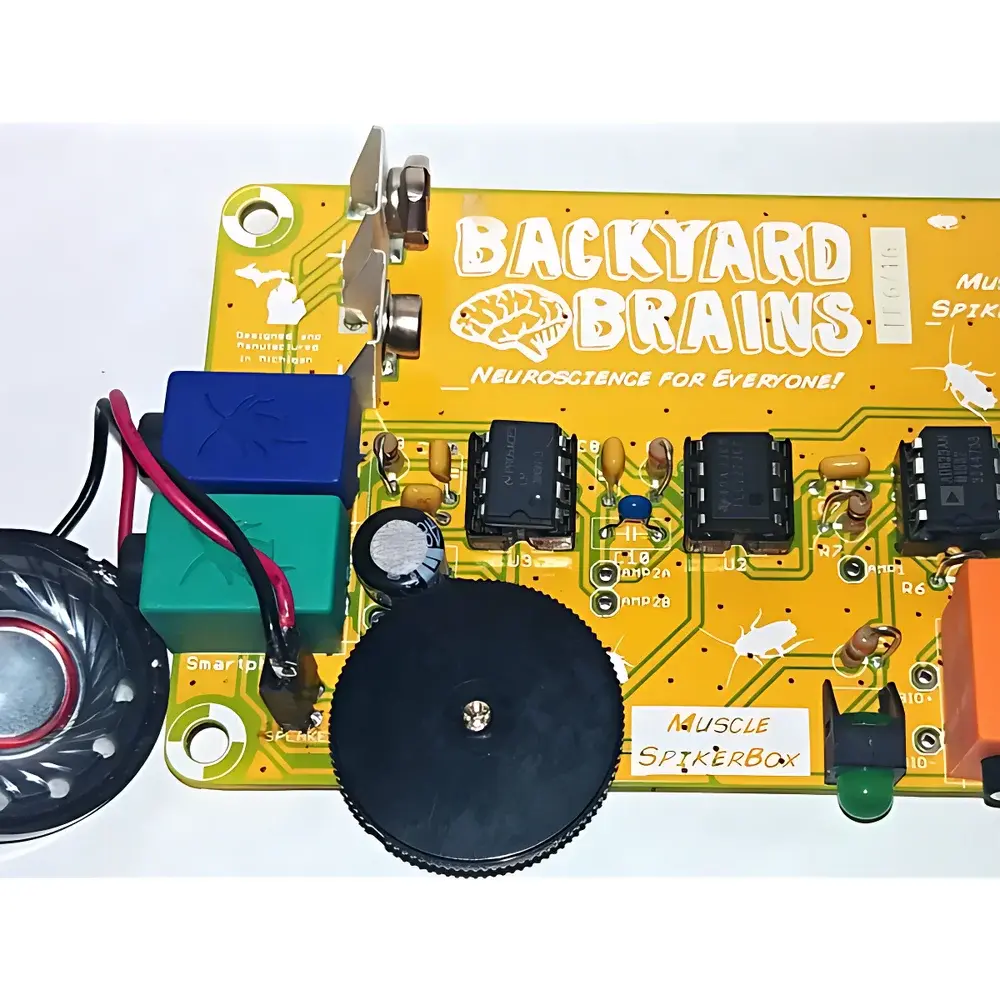
SpikerShield DIY Muscle Electrophysiology Shield for Arduino
| Brand | Backyard Brains |
|---|---|
| Origin | USA |
| Model | DIY Muscle SpikerShield |
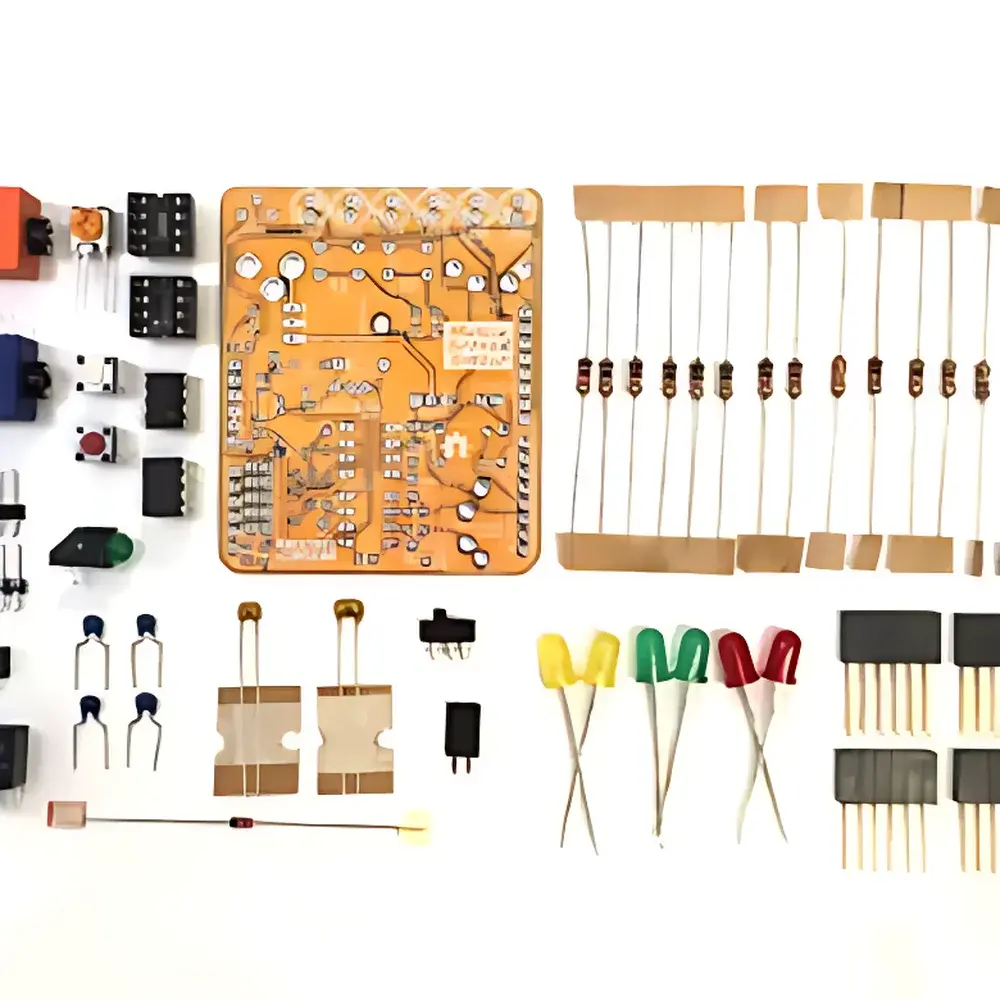
| Kit Type | Unassembled PCB with Components |
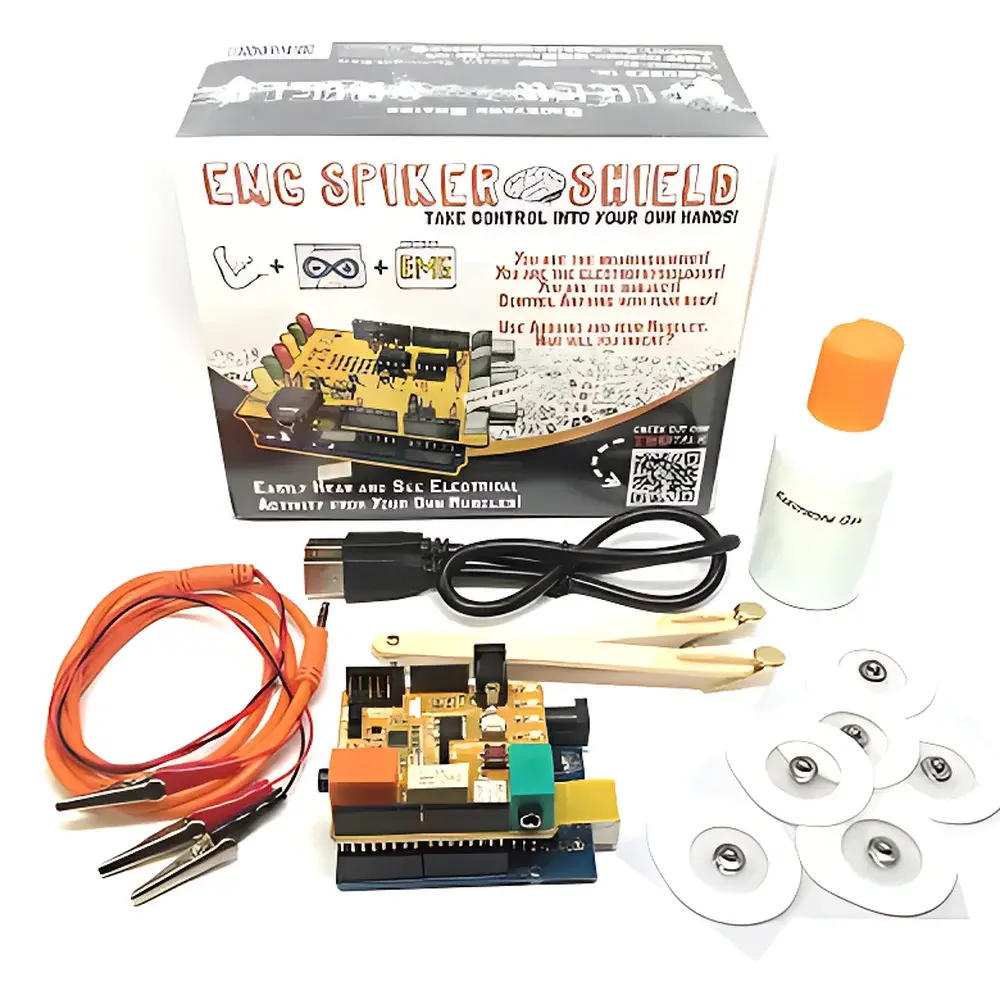
| Includes | 1× 3-lead EMG electrode cable (orange, red, red, black), 6× large-surface dry EMG electrodes, full component set for hand-soldering |
Overview
The SpikerShield DIY Muscle Electrophysiology Shield is an open-source, education-grade hardware platform designed to interface electromyographic (EMG) signals from human skeletal muscle with the Arduino ecosystem. Engineered for transparency and pedagogical rigor, it implements a classic analog signal chain: differential amplification (gain ≈ 1,000×), 50/60 Hz notch filtering, bandpass conditioning (10–500 Hz), and rail-to-rail output scaling compatible with Arduino’s 0–5 V analog input range. Unlike closed commercial EMG systems, this shield reveals every stage of signal acquisition—enabling students and researchers to trace noise sources, validate gain staging, and understand the physiological origins of motor unit action potentials (MUAPs). It operates on standard Arduino Uno or Mega platforms and requires no proprietary firmware or drivers.
Key Features
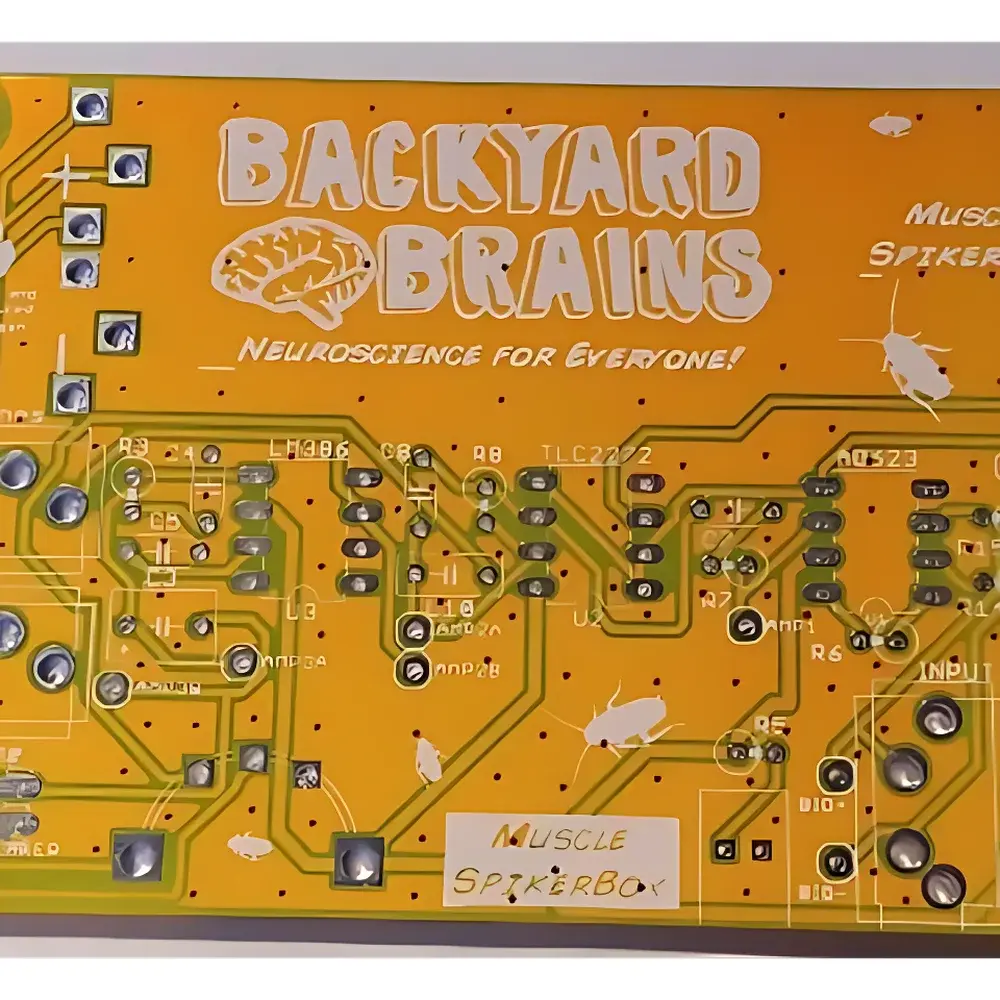
- Open-hardware design with fully published schematics, PCB layout files (Eagle format), and BOM—compliant with IEEE and IET educational instrumentation standards
- Differential input architecture with high common-mode rejection ratio (CMRR > 80 dB at 60 Hz) to suppress environmental interference during surface EMG recording
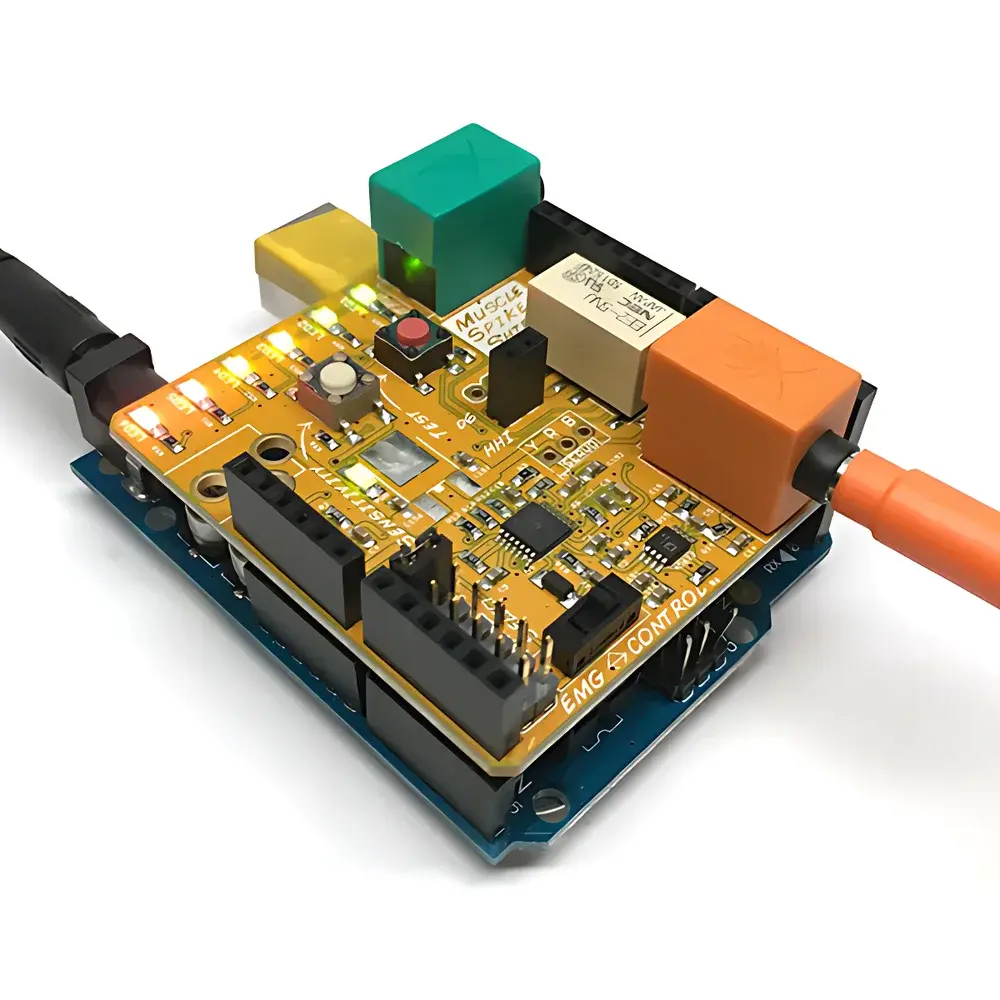
- Onboard LED indicators for power status, signal clipping, and active detection—supporting real-time troubleshooting without oscilloscope dependency
- Manual soldering kit format: includes all passive components (precision metal-film resistors, low-leakage ceramic capacitors), op-amps (TL074), and IC sockets—optimized for student assembly and failure analysis
- Integrated 3-lead electrode interface supporting standard bipolar surface EMG configuration (active, reference, ground) with color-coded wiring per IEC 60601-2-58 clinical conventions
- No embedded microcontroller: raw analog output ensures full compatibility with Arduino IDE, MATLAB Simulink Hardware Support Packages, and Python-based data acquisition via serial ADC interfaces
Sample Compatibility & Compliance
The SpikerShield is validated for non-invasive, surface-level EMG acquisition from voluntary skeletal muscles—including biceps brachii, flexor digitorum superficialis, and tibialis anterior—under controlled classroom or low-risk research conditions. Electrode placement follows SENIAM (Surface Electromyography for the Non-Invasive Assessment of Muscles) guidelines. As a Class I educational device under FDA 21 CFR §892.1000 and EU Directive 2017/745 (MDR), it carries no therapeutic claim and is not intended for diagnostic use, patient monitoring, or regulatory submission. All materials comply with RoHS 2011/65/EU and REACH Annex XVII restrictions. The included dry Ag/AgCl electrodes meet ISO 10993-5 biocompatibility requirements for short-term skin contact (< 8 hours).
Software & Data Management
Signal acquisition is implemented through standard Arduino analogRead() functions with configurable sampling intervals (default: 1 kHz). Backyard Brains provides open-source Arduino libraries (e.g., SpikerShield.h) and Processing-based visualization tools for real-time waveform rendering, RMS envelope calculation, and spike-triggered actuation logic. Data export supports CSV and MAT formats for downstream analysis in MATLAB, Python (NumPy/Pandas), or EEGLAB. While the shield itself does not implement audit trails or electronic signatures, its deterministic analog behavior and reproducible firmware enable GLP-aligned experimental documentation when paired with timestamped SD card logging or LabVIEW DAQ modules.
Applications
- Undergraduate neuroscience labs: Demonstrating motor unit recruitment, force–EMG amplitude correlation, and fatigue-induced spectral shifts (e.g., median frequency decline)
- Biofeedback prototyping: Mapping integrated EMG amplitude to servo position, LED brightness, or PWM-controlled actuators
- Human–machine interface (HMI) education: Building gesture-controlled robots, adaptive prosthetic simulators, or assistive switch interfaces
- Comparative physiology: Recording EMG during isometric vs. isotonic contractions across subject cohorts
- Hardware literacy training: Teaching soldering, circuit debugging, op-amp stability analysis, and noise mitigation techniques
FAQ
Is this device FDA-cleared or CE-marked for clinical use?
No. It is classified as an educational demonstration tool and is not certified for medical diagnosis, treatment, or regulatory submission.
What Arduino boards are officially supported?
Arduino Uno R3, Arduino Mega 2560, and Arduino Nano (with ATmega328P) are fully tested; compatibility with newer SAMD-based boards (e.g., MKR series) requires custom ADC configuration.
Can I use third-party EMG electrodes?
Yes—any reusable or disposable Ag/AgCl surface electrodes with 2 mm pin connectors and impedance < 10 kΩ at 100 Hz are mechanically and electrically compatible.
Does the kit include soldering instructions and troubleshooting guidance?
Yes: comprehensive step-by-step assembly guide (PDF), annotated schematic walkthrough, and video tutorials covering cold joint identification, op-amp offset nulling, and baseline drift correction are available on the manufacturer’s public GitHub repository.
Is firmware update capability built into the shield?
No—the shield contains no programmable memory; all signal processing occurs in the host Arduino microcontroller, allowing full user control over sampling rate, filtering, and output logic.




