
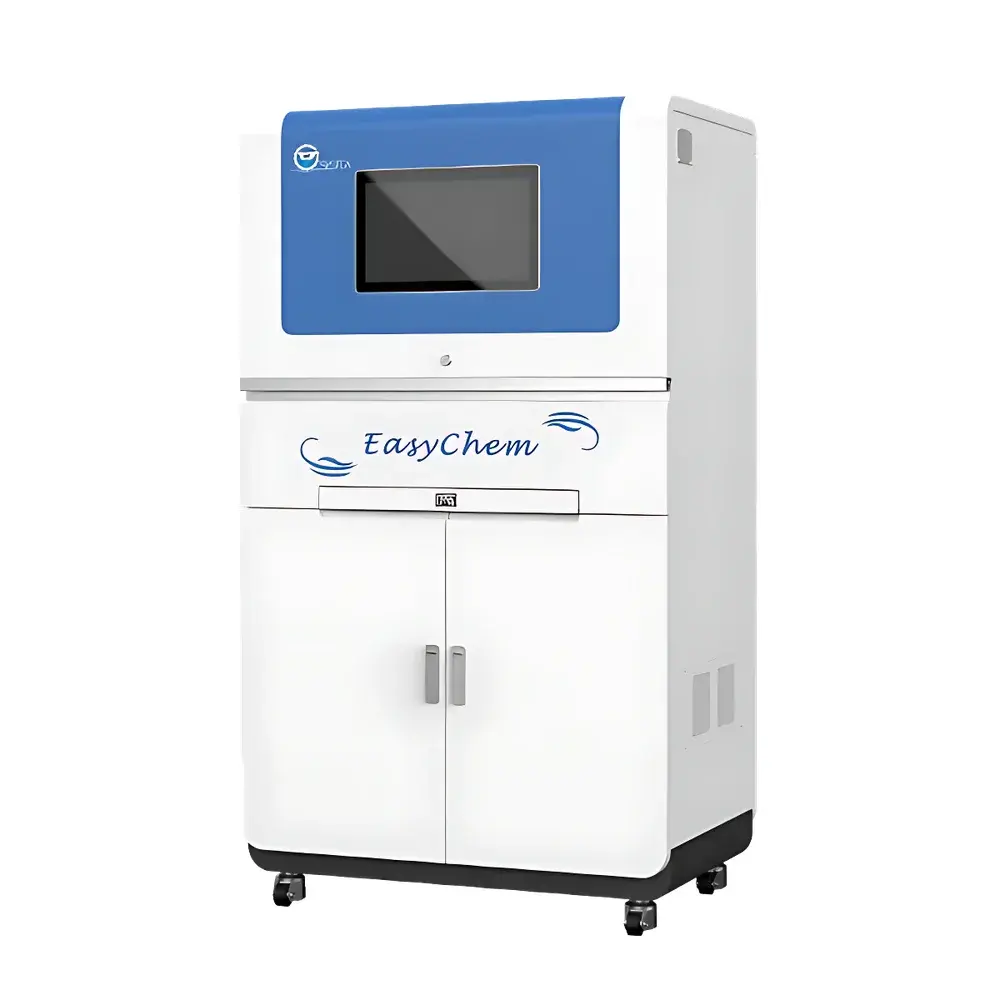
SYSTEA EasyChem Coli MPN Online Total and Fecal Coliform & E. coli Analyzer
| Brand | SYSTEA |
|---|---|
| Origin | Zhejiang, China |
| Manufacturer Type | Authorized Distributor |
| Country of Origin | China |
| Model | EasyChem |
| Pricing | Available Upon Request |
| Technology | Discrete Batch Analysis with MPN, P/A, and TTD Detection Methods |
| Compliance | ISO 9308-2:2012 (Colilert-based), ASTM D6501, US EPA Method 1604 (adapted) |
| Sample Throughput | Up to 28 MPN tests or 56 P/A–TTD tests per unattended cycle |
| Reagent Compatibility | Colilert®-18/Colilert®-EC, Enterolert®, and other ISO-validated media |
| Sample Independence | Fully isolated incubation wells per sample |
| Integrated Cleaning Station | Automated reagent/sample line flushing and well decontamination |
| Control Interface | 7-inch industrial touchscreen with programmable assay sequences |
Overview
The SYSTEA EasyChem Coli MPN Online Analyzer is a fully automated, discrete batch analysis system engineered for regulatory-grade enumeration of total coliforms, fecal coliforms, Escherichia coli, and optionally enterococci or heterotrophic plate count (HPC) in water matrices. It implements the Most Probable Number (MPN) method—recognized under ISO 9308-2:2012 and adapted for compliance with US EPA Method 1604 and ASTM D6501—alongside parallel Presence/Absence (P/A) and Time-to-Detection (TTD) protocols. Unlike continuous-flow or membrane filtration systems, the EasyChem employs micro-well-based discrete analysis: each sample is processed in physically isolated reaction vessels, eliminating carryover risk and enabling true statistical confidence in MPN estimation. The instrument integrates precise liquid handling, temperature-controlled incubation (35 ± 0.5 °C for total coliforms; 44.5 ± 0.2 °C for E. coli), optical density and fluorescence detection, and automated data interpretation—all within a single compact footprint suitable for on-site deployment or central laboratory integration.
Key Features
- Triple-method flexibility: Simultaneous support for MPN (full 3-dilution series), P/A, and TTD assays—enabling method selection based on regulatory requirement, matrix complexity, or reporting sensitivity needs.
- Extended quantification range: Full MPN mode covers 1–23,000 MPN/100 mL with statistically validated confidence intervals; P/A mode delivers qualitative results in ≤24 h; TTD provides quantitative kinetics for E. coli enumeration down to 1 CFU/100 mL.
- Multi-analyte capability: Pre-configured methods for total coliforms, thermotolerant coliforms, E. coli, and optional add-ons for enterococci (Enterolert®) and HPC (R2A-based media).
- Autonomous operation: Up to 28 MPN assays or 56 P/A–TTD tests executed without manual intervention; onboard reagent cooling (4–8 °C), waste containment, and power-fail recovery ensure continuity during extended monitoring campaigns.
- Cross-contamination mitigation: Dedicated fluidic paths per sample, UV-sterilized air purge between cycles, and an integrated cleaning station performing multi-stage flushes with deionized water and sodium hypochlorite solution.
- Regulatory-ready interface: Touchscreen HMI supports audit-trail-enabled method programming, user role management (admin/operator/auditor), and timestamped event logging compliant with GLP and GMP principles.
Sample Compatibility & Compliance
The EasyChem accepts raw and treated water samples across a broad physicochemical spectrum—including potable water, surface water, wastewater effluent, seawater (with salinity compensation), recreational bathing water, hospital wastewater, and municipal sewage. Sample turbidity up to 100 NTU and residual chlorine ≤2 mg/L are accommodated without pretreatment; higher interferents require inline filtration or quenching per ISO 9308-2 Annex B. All default methods align with ISO 9308-2:2012 using Colilert®-18 and Colilert®-EC substrates. Validation packages—including method transfer documentation, precision/recovery studies per ISO 5725, and interlaboratory comparison reports—are available upon request to support accreditation under ISO/IEC 17025:2017.
Software & Data Management
The embedded EasyChem Control Software (v4.x) provides real-time assay monitoring, dynamic curve fitting for TTD kinetics, and automatic MPN table lookup per APHA Standard Methods 9221. Data export is supported via CSV, PDF report generation, and OPC UA server integration for SCADA or LIMS connectivity. Audit trails record all user actions, parameter changes, calibration events, and error logs—with immutable timestamps and digital signatures meeting FDA 21 CFR Part 11 requirements when deployed with network authentication and electronic signature modules. Remote diagnostics and firmware updates are enabled via secure TLS 1.2–encrypted Ethernet or optional 4G LTE modem.
Applications
This analyzer serves as a primary tool for drinking water utilities validating treatment barrier efficacy (e.g., post-chlorination verification), environmental agencies conducting ambient water quality surveillance, wastewater plants demonstrating discharge compliance (e.g., NPDES permits), and public health departments monitoring recreational waters for beach closure decisions. Its robustness in high-particulate matrices also supports industrial applications such as pharmaceutical process water QC, food & beverage rinse water validation, and aquaculture intake screening—where rapid, culture-based confirmation remains legally mandated over rapid molecular alternatives.
FAQ
What regulatory standards does the EasyChem satisfy for E. coli detection?
It complies with ISO 9308-2:2012 for total and fecal coliforms and E. coli using Colilert® substrates, and its operational parameters align with adaptations of US EPA Method 1604 and ASTM D6501.
Can the system be integrated into an existing SCADA network?
Yes—via OPC UA server mode or Modbus TCP, supporting real-time status polling, alarm forwarding, and remote start/stop commands.
Is method validation assistance provided for laboratory accreditation?
SYSTEA supplies comprehensive validation kits including reference strains, repeatability datasets, LOD/LOQ studies, and ISO/IEC 17025 gap analysis templates.
How frequently does the system require maintenance?
Preventive maintenance is recommended every 6 months; consumables (filters, tubing, reagent packs) are tracked automatically and trigger alerts at 10% remaining capacity.
Does the instrument support alternative substrates beyond Colilert®?
Yes—any ISO 9308-2–validated chromogenic or fluorogenic medium may be configured, subject to optical filter and incubation profile adjustments verified during commissioning.
Related Products







