
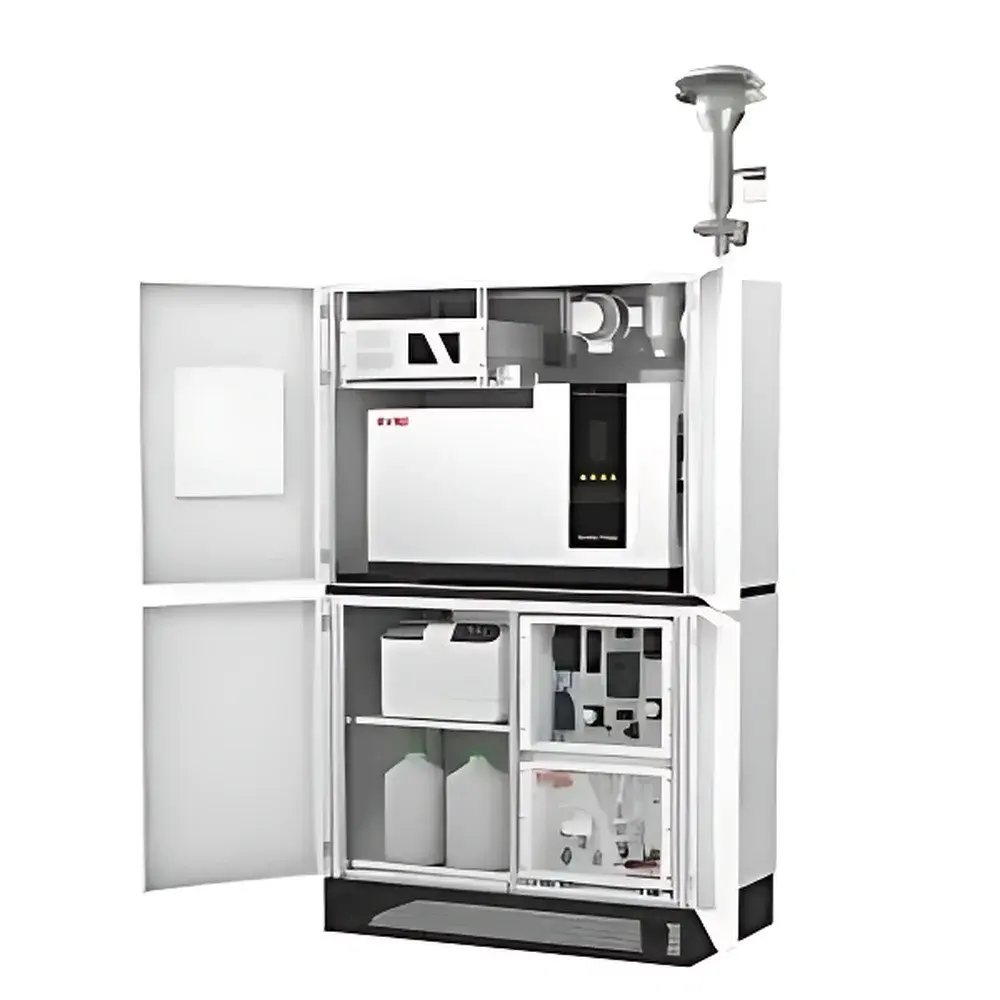
SUPEC 7030 Atmospheric Heavy Metal Online Monitoring System (ICP-MS)
| Brand | EXPEC |
|---|---|
| Origin | Zhejiang, China |
| Manufacturer Type | Authorized Distributor |
| Product Category | Domestic |
| Model | SUPEC 7030 |
| Instrument Type | Quadrupole ICP-MS |
| Application Environment | Laboratory & Continuous Ambient Air Monitoring |
| Detection Mode | Online Automated ICP-MS Analysis with Integrated Sample Preparation |
Overview
The SUPEC 7030 Atmospheric Heavy Metal Online Monitoring System is an integrated, fully automated analytical platform engineered for unattended, real-time quantification of trace and ultra-trace metallic elements in ambient airborne particulate matter (PM2.5/PM10). Unlike conventional filter-based sampling followed by offline digestion and analysis, the SUPEC 7030 implements a continuous, end-to-end workflow grounded in inductively coupled plasma mass spectrometry (ICP-MS) coupled with proprietary online sample conditioning. Its core architecture integrates three synchronized modules: (1) Steam Injection Particle Sampling (SIPS) for selective aerosol capture and hygroscopic growth; (2) Dual-Channel Microwave Digestion System (DMWS) operating at 170 °C and 1.5 MPa for complete mineralization of refractory species; and (3) a dedicated quadrupole ICP-MS unit (SUPEC 7000 series) optimized for high-sensitivity, low-interference elemental detection in complex acid matrices. The system operates under strict process control to deliver laboratory-grade accuracy (RSD < 5% for repeated analysis) with sub-hour temporal resolution—enabling robust time-series monitoring of atmospheric metal speciation without manual intervention.
Key Features
- Steam Injection Particle Sampling (SIPS): A physics-based, membrane-free aerosol enrichment technology leveraging homogeneous nucleation and controlled hygroscopic growth within parallel expansion chambers. Combined with an inertial cutoff head, SIPS achieves >90% collection efficiency for PM2.5 while minimizing memory effects and particle bounce—critical for long-term stability in unattended operation.
- Dual-Channel Microwave Digestion (DMWS): Two independent microwave cavities operate asynchronously, enabling continuous digestion cycles without downtime. Each cycle completes full decomposition of ≥4 m³ of sampled air within ≤10 minutes under rigorously controlled temperature (170 °C) and pressure (1.5 MPa), followed by rapid water-cooling to preserve volatile analytes including Si, As, and Hg.
- Hybrid Acid Digestion Chemistry: A proprietary mixed-acid formulation (HNO₃–HF–H₂O₂) ensures complete dissolution of silicate, oxide, and carbonaceous matrices without post-digestion dilution—preserving detection sensitivity and eliminating dilution-induced errors in low-concentration ambient measurements.
- Dedicated Online ICP-MS Unit (SUPEC 7000): Equipped with PFA-based sample introduction components resistant to HF-containing digests; collision/reaction cell (CRC) technology for polyatomic interference removal (e.g., 40Ar16O⁺ on 56Fe⁺); auto-tuning, mass calibration, detector linearity verification, and semi-quantitative screening capability for unknown inorganic contaminants.
- Automated Quality Assurance Protocol: Implements A-S-B-S (Analyte–Standard–Blank–Standard) sequence logic for every analytical cycle, delivering concurrent blank correction, drift compensation (zero and span), and certified reference material (CRM)-based recovery validation—all embedded in raw data output.
Sample Compatibility & Compliance
The SUPEC 7030 is validated for direct analysis of aqueous digests derived from ambient PM collected on-site. It accommodates variable matrix loads typical of urban, industrial, and background air environments. All hardware and software workflows comply with ISO/IEC 17025:2017 requirements for testing laboratories, support GLP-compliant audit trails, and generate metadata-rich output files compatible with EPA Method 200.8 and ISO 17294-2:2016 frameworks. Full traceability—including instrument parameters, digestion logs, calibration history, and QC flagging—is maintained per analysis batch.
Software & Data Management
The system runs on EXPEC’s proprietary SUPEC Control Suite v4.x, a Windows-based application supporting remote configuration, real-time diagnostics, and event-driven alerts. Data acquisition adheres to ASTM D7876-21 standards for automated environmental instrumentation. All measurement records include timestamped raw spectra, integrated peak areas, internal standard ratios, detection limits (calculated per element using 3σ of method blanks), and QA/QC flags. Export formats include CSV, NetCDF, and XML compliant with national air quality data platforms (e.g., CNEMC, EEA AQ e-Reporting). Audit logs meet FDA 21 CFR Part 11 requirements for electronic records and signatures when configured with user authentication and digital signing modules.
Applications
- Continuous ambient air monitoring of regulated toxic metals (Pb, Cd, As, Ni, Cr, Mn, V, Co, Tl, Sb) at regulatory monitoring stations and supersites.
- Source apportionment modeling: High-temporal-resolution elemental fingerprints serve as input vectors for positive matrix factorization (PMF) and chemical mass balance (CMB) receptor models.
- Episodic pollution event characterization: Tracking transient spikes in crustal (Al, Fe, Si), traffic-related (Cu, Ba, Zn), or industrial (Zn, Pb, Cd, As) tracers during dust storms, smog episodes, or stack emissions.
- Long-term trend analysis: Multi-year datasets support evaluation of emission control policy effectiveness and transboundary transport assessment.
- Method validation and intercomparison studies: Benchmarked against gravimetric filter analysis (e.g., EPA IO-3.3) and offline ICP-MS for harmonized data reporting.
FAQ
What sample volume is required for one complete analytical cycle?
A single cycle processes aerosol collected from ≥4 m³ of ambient air over a user-defined interval (typically 30–60 min), depending on flow rate and target detection limits.
Does the system require external calibration gases or tuning solutions?
No—internal calibration is performed automatically using multi-element tuning solutions delivered via integrated peristaltic pumps; no manual gas cylinder handling is needed.
Can the system detect non-metallic elements such as phosphorus or sulfur?
Yes—the SUPEC 7000 ICP-MS module supports semi-quantitative screening across the full mass range (5–260 amu), including P, S, Cl, Br, and I, subject to matrix suppression and instrumental sensitivity constraints.
Is remote maintenance and software update supported?
Yes—secure remote access via TLS-encrypted VNC is available for diagnostic support and firmware updates, with role-based permissions and session logging.
How is carryover between high- and low-concentration samples mitigated?
The SIPS module eliminates physical filter residue; the DMWS employs sequential rinse-and-purge cycles; and the ICP-MS features a high-efficiency nebulizer washout protocol with real-time signal decay monitoring before each analysis.
Related Products




