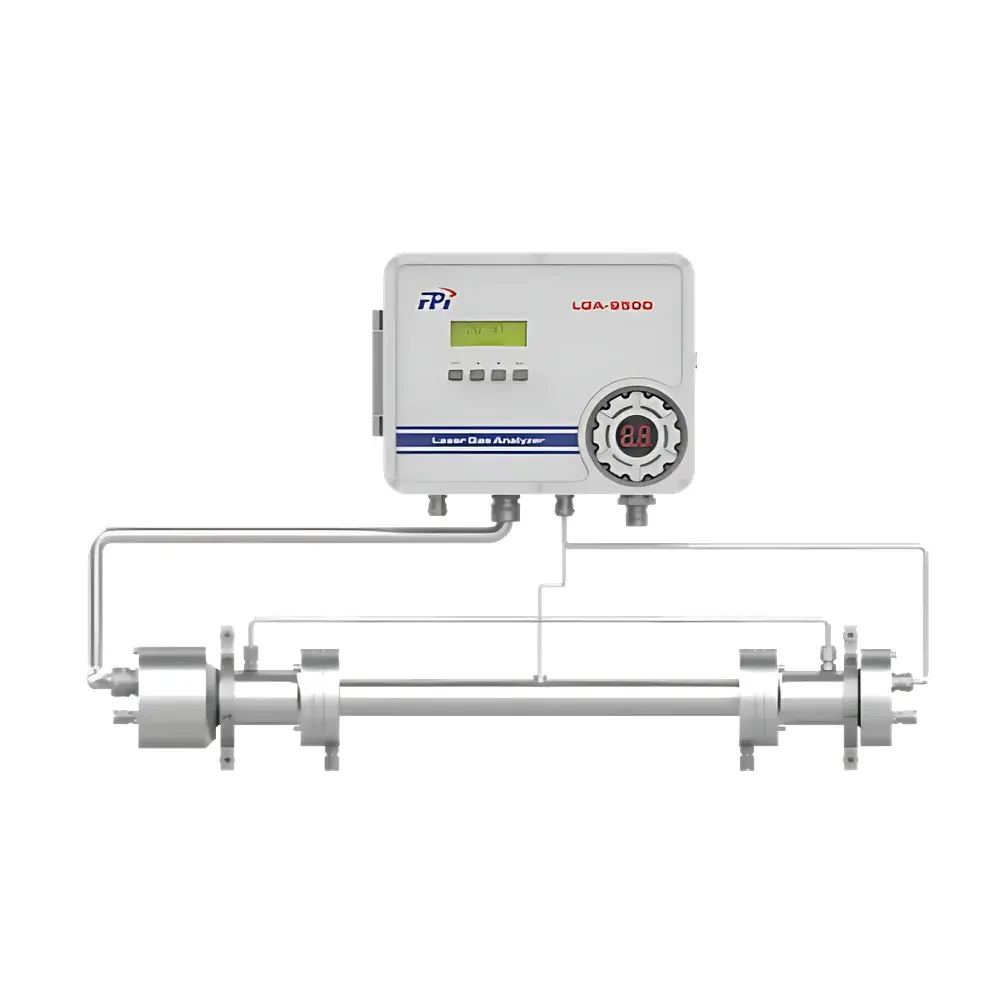
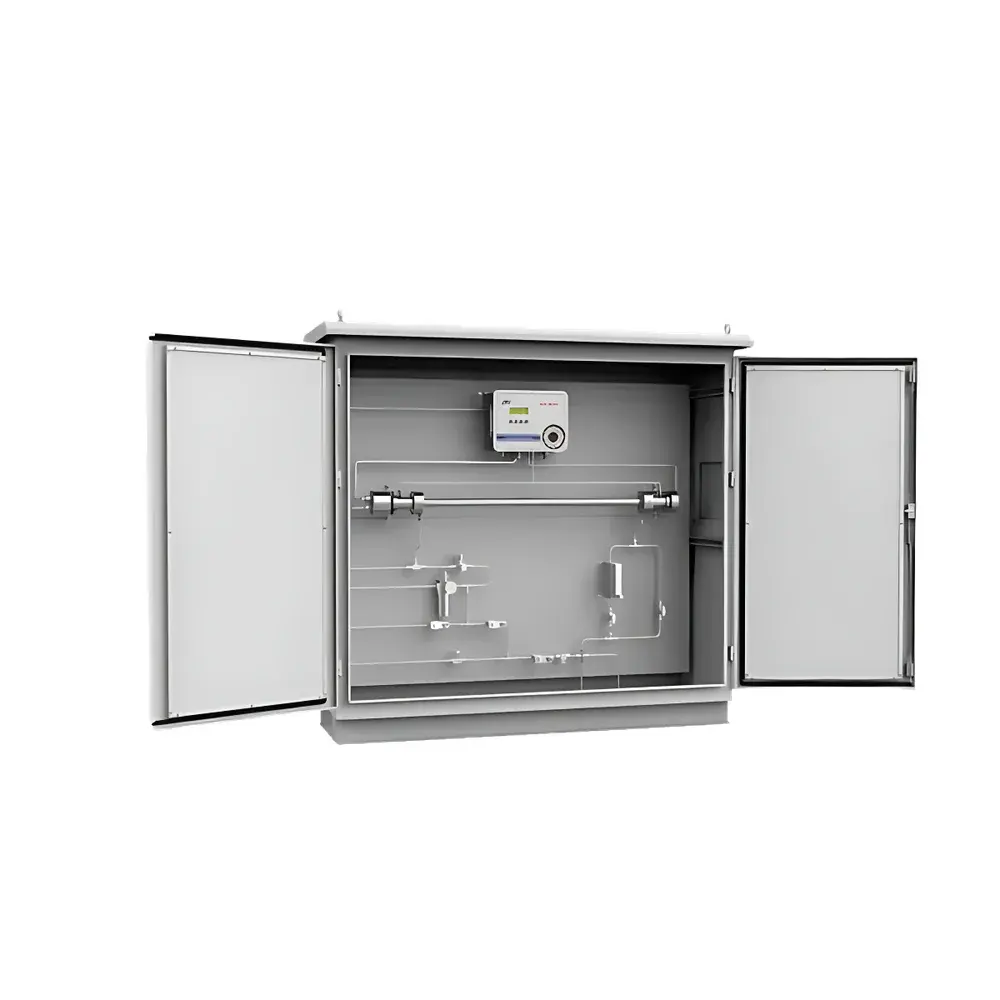
LGA-9500 Online Laser Gas Analyzer by FPI
| Brand | FPI |
|---|---|
| Origin | Zhejiang, China |
| Manufacturer Type | Original Equipment Manufacturer (OEM) |
| Country of Origin | China |
| Model | LGA-9500 |
| Pricing | Available upon Request |
Overview
The LGA-9500 Online Laser Gas Analyzer is a tunable diode laser absorption spectroscopy (TDLAS)-based continuous emission monitoring system engineered for real-time, in-situ measurement of gas concentration in harsh industrial process streams. Designed for permanent installation in stack ducts, bypass sample lines, or process pipes, the analyzer leverages near-infrared (NIR) or mid-infrared (MIR) laser wavelengths selected to target fundamental rotational-vibrational absorption lines of specific analytes—ensuring high selectivity and immunity to cross-interference from background gases such as H₂O, CO₂, and N₂. Unlike extractive systems requiring sample conditioning, the LGA-9500 employs a direct optical path configuration with dual-beam (measurement/reference) architecture, enabling drift-free operation over extended intervals without manual zero/span calibration. Its core application domain includes continuous compliance monitoring per national and regional emission standards, as well as closed-loop process control in high-temperature, high-dust, and corrosive environments.
Key Features
- Edge-integrated computing architecture: Onboard ARM-based processing unit executes real-time spectral fitting, baseline correction, and concentration calculation—minimizing latency and reducing bandwidth demand on central SCADA or DCS networks.
- Intelligent fault classification engine: Utilizes rule-based diagnostics and supervised machine learning models trained on historical field failure patterns to categorize hardware anomalies (e.g., laser current instability, photodetector saturation, window fouling) and communication errors with traceable root-cause metadata.
- Digital twin integration: Each deployed unit is assigned a cloud-synced digital twin that mirrors physical configuration, calibration history, firmware version, and operational health metrics; enables predictive maintenance scheduling based on trend analysis of optical power decay, signal-to-noise ratio (SNR) degradation, and thermal drift profiles.
- Multi-layer status telemetry: In addition to primary gas concentration output (e.g., O₂, CO, NO, SO₂, NH₃, CH₄), the analyzer continuously reports auxiliary parameters including laser temperature stability, detector responsivity, purge air pressure, optical alignment status, and internal ambient humidity—providing comprehensive instrument health visibility.
- Ruggedized industrial design: IP66-rated enclosure with integrated air-purge ports and optional heated optical windows; compliant with IEC 61000-6-2 (immunity) and IEC 61000-6-4 (emissions) for electromagnetic compatibility in plant-floor environments.
Sample Compatibility & Compliance
The LGA-9500 supports in-situ measurement across flue gas, syngas, coke oven gas, and reformer off-gas streams with operating temperatures up to 200 °C and particulate loadings ≤ 5 g/m³ (with standard purge-assisted optics). It meets performance requirements specified in HJ 75–2017 and HJ 76–2017 (China’s Technical Specifications for Continuous Emission Monitoring Systems), and its measurement methodology aligns with ISO 14956:2002 (air quality — evaluation of air quality measurement results) and ASTM D6522–20 (standard test method for determination of nitrogen oxides, carbon monoxide, and oxygen in exhaust gas using portable analyzers). Optional configurations support SIL2 certification per IEC 61508 for safety-related applications.
Software & Data Management
FPI’s proprietary iGasManager™ software suite provides web-based configuration, remote diagnostics, and audit-ready data export. All concentration and diagnostic data are timestamped with microsecond precision and stored locally (SD card, 32 GB) with configurable retention policies. Cloud synchronization supports MQTT/OPC UA protocols and enforces TLS 1.2 encryption. Full data lineage—including raw spectra, calibration certificates, firmware update logs, and user access records—is retained to satisfy GLP/GMP documentation requirements and FDA 21 CFR Part 11 electronic record integrity criteria. Role-based access control (RBAC) ensures separation of duties between operators, engineers, and auditors.
Applications
- Continuous emissions monitoring (CEMS) at coal-fired power plants, sintering machines, and cement kilns for regulatory reporting under China’s “Ultra-Low Emission” policy.
- Process optimization in blast furnace top-gas recycling loops via real-time CO/CO₂ ratio feedback to blast air control systems.
- Ammonia slip monitoring downstream of SCR reactors in thermal power generation and waste-to-energy facilities.
- Combustion efficiency tuning in coke ovens and lime kilns through synchronized O₂ and CO measurement at multiple duct locations.
- Hazardous gas leak detection and quantification in refinery flare stacks and hydrogen production units.
FAQ
What laser wavelengths does the LGA-9500 support?
The analyzer is configurable with single- or multi-line TDL lasers operating in the 1.3–2.3 µm range; exact wavelength selection is determined during specification based on target analyte and interference matrix.
Is the system compatible with existing DCS platforms?
Yes—native support for Modbus TCP, Profibus DP, and HART 7 protocols; optional OPC UA server included for seamless integration with Siemens PCS7, Honeywell Experion, and Yokogawa CENTUM VP.
How often is calibration required?
Zero calibration is performed automatically every 24 hours using built-in reference cell or clean-air purge; span calibration is recommended quarterly or after major maintenance events, traceable to NIM-certified gas standards.
Can the digital twin be accessed via mobile devices?
Yes—the FPI iGasMobile app (iOS/Android) provides authenticated access to real-time status dashboards, fault alerts, maintenance checklists, and historical trend charts for all managed analyzers.
Does the LGA-9500 meet explosion-proof requirements for Zone 1 areas?
Standard units are rated for non-hazardous locations; ATEX/IECEx-certified versions with flameproof enclosure (Ex d IIB T4 Gb) or intrinsic safety (Ex ia IIC T4 Ga) are available upon request.