
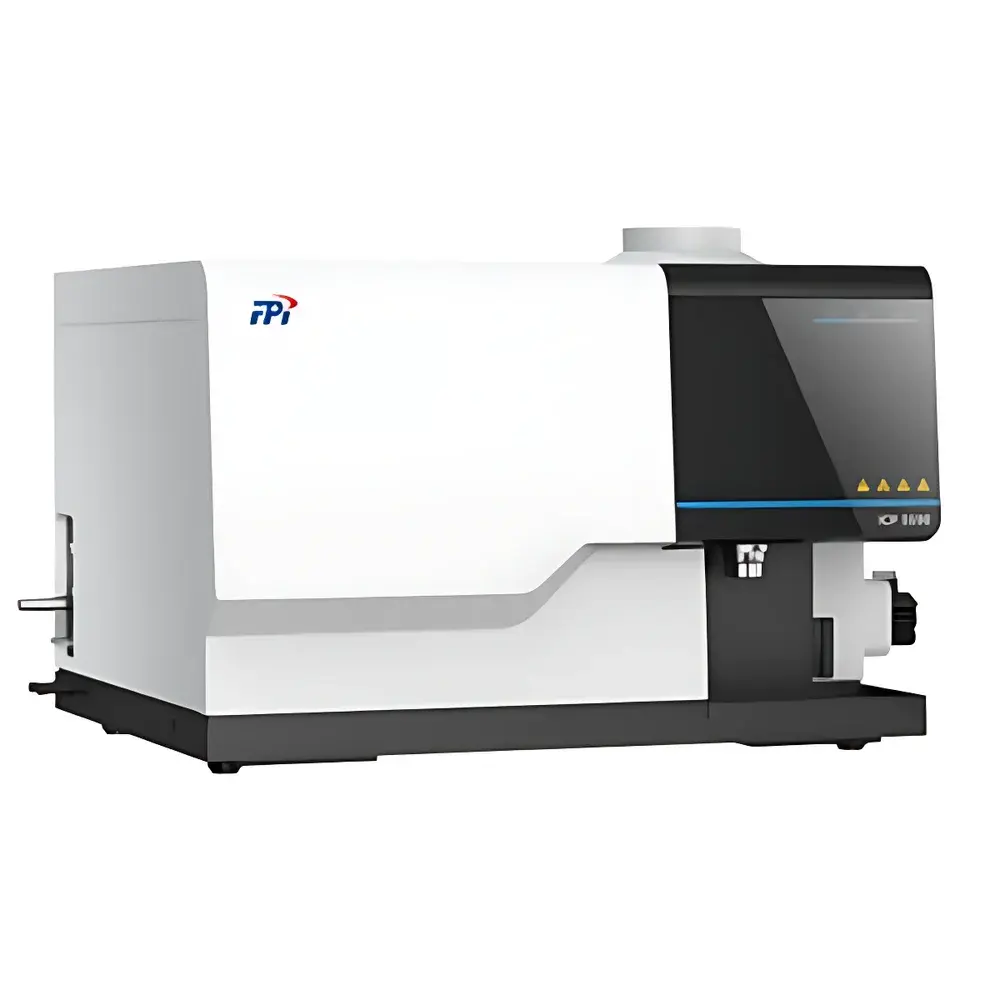
Titan Instruments ICP-5500 Inductively Coupled Plasma Optical Emission Spectrometer
| Brand | Titan Instruments |
|---|---|
| Origin | Beijing, China |
| Model | ICP-5500 |
| Instrument Type | Full-Spectrum Direct-Reading |
| Detection Limits | Al 167.0 nm, P 178.2 nm, B 182.6 nm, Se 196.0 nm, Pb 220.3 nm, Na, K — all < 10 µg/L |
| Precision (RSD) | ≤0.5% at 1 mg/L (n=10) |
| Long-Term Stability (RSD) | ≤2.0% at 1 mg/L over 4 h |
| Wavelength Range | 165–870 nm |
| Optical Resolution | ≤0.007 nm (FWHM at Mo 202.030 nm) |
| RF Generator Power | 0.5–1.6 kW, continuously adjustable |
| Plasma Observation Mode | Dual-view (axial + radial) |
| Detector | High-resolution solid-state CCD/CMOS array (>1 M pixels), thermoelectrically cooled to ≤−45 °C |
| Background Correction | Real-time, pixel-by-pixel |
| Linear Dynamic Range | ≥4–5 orders of magnitude |
| Warm-up Time | ≤30 min (optical chamber stabilized at 35 °C ± 0.1 °C) |
Overview
The Titan Instruments ICP-5500 is a full-spectrum direct-reading inductively coupled plasma optical emission spectrometer (ICP-OES) engineered for high-throughput, multi-element trace metal analysis in environmental, geological, pharmaceutical, and industrial quality control laboratories. It employs a robust echelle grating cross-dispersion optical system, where both the echelle grating and prism remain fixed during acquisition—eliminating mechanical wavelength scanning and ensuring intrinsic spectral fidelity across the entire 165–870 nm range. The optical bench is housed in a precision thermostatic chamber maintained at ≥35 °C with ±0.1 °C stability, removing the need for dynamic wavelength recalibration during routine operation. This architecture delivers exceptional long-term photometric reproducibility and supports simultaneous detection of all elemental emission lines within a single exposure—enabling true multi-element quantification without sequential dwell-time compromises.
Key Features
- Fixed-position echelle grating and prism optics ensure zero mechanical drift and eliminate scan-related intensity artifacts.
- Dual-view plasma observation (simultaneous axial and radial viewing) provides optimal sensitivity for volatile elements (e.g., As, Se, Cd) and robustness for high-matrix samples (e.g., brines, digests).
- High-efficiency solid-state detector with >1 million active pixels, thermoelectrically cooled to ≤−45 °C, delivering low dark current and high quantum efficiency across UV–VIS–NIR regions.
- RF generator with 0.5–1.6 kW continuous power adjustment, <0.1% power and frequency stability, and integrated mass flow controllers (MFCs) for plasma gas, auxiliary gas, and nebulizer gas (precision ≤0.01 L/min).
- Vertical torch assembly with auto-alignment capability and four-channel peristaltic pump with programmable speed control for precise sample introduction and rinse cycle management.
- Real-time, pixel-level background subtraction algorithm applied during acquisition—not post-processing—ensuring accurate net intensity calculation even under complex spectral interferences.
Sample Compatibility & Compliance
The ICP-5500 accommodates liquid samples introduced via pneumatic nebulization (including microflow and concentric glass or quartz nebulizers), as well as hydride generation and laser ablation interfaces (with optional modules). It meets core analytical requirements for regulatory workflows under ISO/IEC 17025, ASTM D1976 (water metals), EPA Methods 200.7 and 6010D, and USP / for elemental impurities in pharmaceuticals. Its software architecture supports audit-trail-enabled data handling compliant with FDA 21 CFR Part 11 when deployed in validated GxP environments. All calibration protocols—including internal standardization, standard addition, and multi-point matrix-matched calibration—are fully documented and exportable for GLP/GMP reporting.
Software & Data Management
Titan’s ICP-Solution v4.x software provides a unified interface for instrument control, spectral acquisition, qualitative identification, semi-quantitative screening, and quantitative analysis. It includes automated spectral library matching (NIST-based), interference correction tables (e.g., ArO⁺ on Fe 238.204 nm), and real-time signal-to-background ratio monitoring. All acquired spectra are stored in vendor-neutral HDF5 format, enabling third-party reprocessing and integration with LIMS via ODBC or RESTful API. The “spectrography” mode captures full 2D echelle images—preserving raw pixel intensities—for retrospective re-extraction of analyte lines or method optimization without re-running samples. Data integrity safeguards include user role-based access control, electronic signatures, and immutable audit logs.
Applications
The ICP-5500 is routinely deployed for trace element quantification in diverse matrices: heavy metals in wastewater (Pb, Cd, Hg, As), nutrient cations in fertilizers (K, Ca, Mg, Na), rare earth elements in geological digests (La, Ce, Nd), and residual catalysts in polymer synthesis (Pd, Pt, Rh). Its dual-view configuration enables method flexibility—e.g., radial view for high-concentration Na/K in seawater, axial view for sub-pptr Se in biological tissues. In contract testing labs, its ≤30-minute warm-up and ≥70-element-per-minute throughput support high-sample-volume workflows while maintaining RSD ≤0.5% at 1 mg/L and detection limits consistently <10 µg/L for key elements including Al, P, B, Se, and Pb.
FAQ
What is the optical resolution specification, and how is it verified?
Optical resolution is defined as full width at half maximum (FWHM) and is certified at ≤0.007 nm using the Mo 202.030 nm emission line under standard operating conditions.
Does the system support regulatory-compliant data archiving?
Yes—the software supports 21 CFR Part 11–compliant audit trails, electronic signatures, and secure, time-stamped data storage when configured with appropriate IT infrastructure and validation documentation.
Can the ICP-5500 analyze solids directly?
Not natively; it requires liquid introduction. However, it is compatible with external laser ablation systems (e.g., CETAC LSX-500) for direct solid sampling with appropriate calibration strategies.
Is the detector cooled during standby or only during acquisition?
Thermoelectric cooling is active continuously once enabled, maintaining ≤−45 °C sensor temperature regardless of acquisition state to minimize thermal noise accumulation.
How does the dual-view configuration affect detection limits?
Axial viewing improves absolute sensitivity (lower detection limits) for most elements, while radial viewing enhances tolerance to dissolved solids and reduces polyatomic interferences—method selection depends on matrix complexity and required LODs.





