
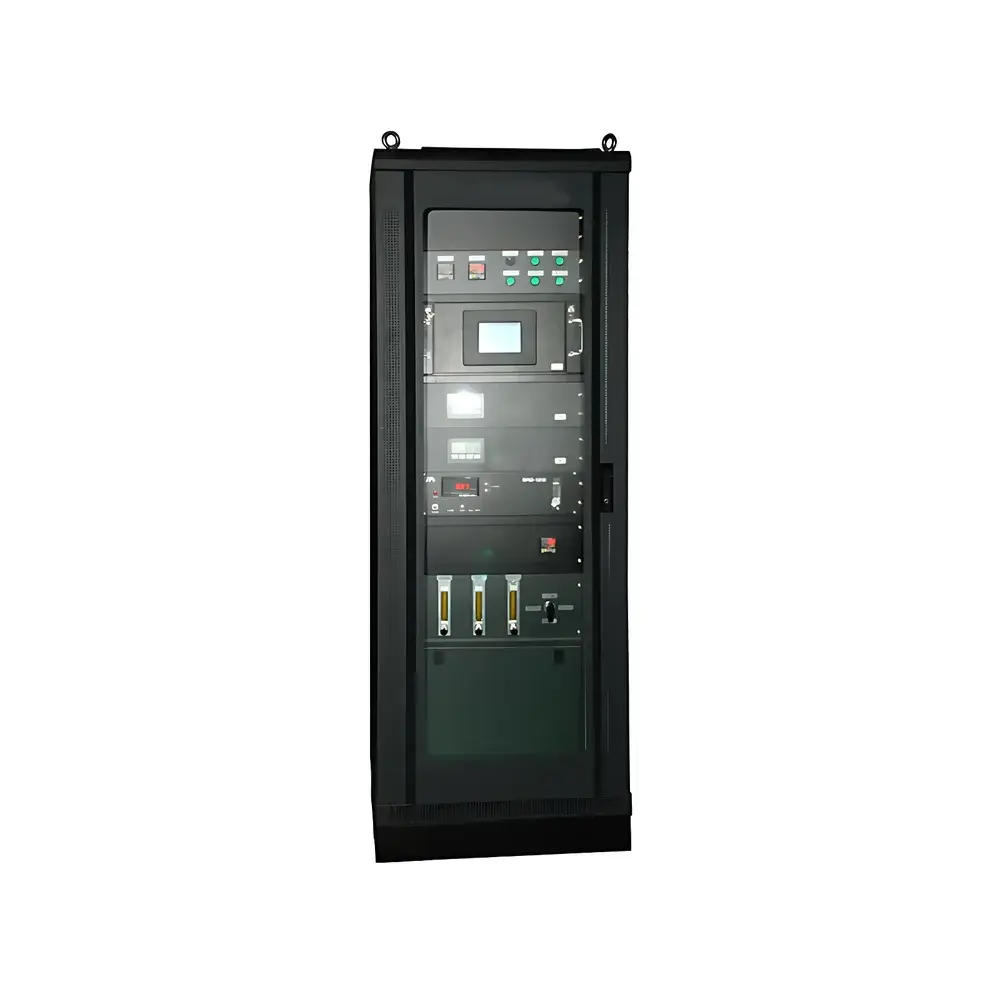
FPI LGA-C300 Online Calorific Value Analyzer for Coal Gas
| Brand | FPI |
|---|---|
| Origin | Zhejiang, China |
| Manufacturer Type | Original Equipment Manufacturer (OEM) |
| Product Category | Domestic |
| Model | LGA-C300 |
| Product Type | Coal Gas Calorific Value Analyzer |
| Measurement Principle | Tunable Diode Laser Absorption Spectroscopy (TDLAS) |
| Sample Compatibility | Coal gas, coke oven gas, blast furnace gas, and mixed industrial fuel gases |
| Safety Certification Option | ATEX/IECEx-certified explosion-proof probe available |
| Data Output | 4–20 mA, RS485, Modbus TCP, optional OPC UA |
| Compliance Framework | Designed to support GLP/GMP-aligned operational records and ASTM D1826 / ISO 6976–2016–based calorific value calculation protocols |
Overview
The FPI LGA-C300 Online Calorific Value Analyzer is an industrial-grade, extractive gas analysis system engineered for continuous, real-time determination of the higher heating value (HHV) and lower heating value (LHV) of coal-derived gaseous fuels. Unlike conventional calorimeters relying on physical combustion or thermal conductivity methods, the LGA-C300 employs tunable diode laser absorption spectroscopy (TDLAS) — a non-contact, in-situ–compatible optical technique — to quantify key combustible components including carbon monoxide (CO), methane (CH₄), hydrogen (H₂), and hydrocarbons (C₂H₆, C₃H₈) with high spectral selectivity and immunity to cross-interference. By applying stoichiometric combustion enthalpy models (per ISO 6976:2016 and ASTM D1826-94), the system computes net calorific value directly from measured component concentrations, eliminating calibration drift associated with flame-based reference standards and enabling traceable, physics-based thermal energy quantification.
Key Features
- Non-intrusive TDLAS detection with dual-wavelength compensation for dust, moisture, and pressure-induced spectral broadening
- Simultaneous multi-component quantification (CO, CH₄, H₂, C₂H₆) at sub-ppm detection limits under process-relevant conditions
- Zero external combustion source: all optical and electronic modules operate without hot surfaces, meeting Class I, Division 1 hazardous area requirements when configured with ATEX/IECEx-rated probe housing
- Integrated gas conditioning unit with heated sampling line (180 °C), particulate filtration (0.1 µm), and water removal via Nafion™ membrane dryer — optimized for high-dust, high-humidity coal gas streams
- Modular architecture supporting field-replaceable optical cells and laser sources; mean time between failures (MTBF) > 12,000 hours per ANSI/ISA-84.00.01
- Self-diagnostic firmware with automated wavelength verification, baseline stability monitoring, and laser current/temperature trending logs
Sample Compatibility & Compliance
The LGA-C300 is validated for use with heterogeneous coal gas matrices including coke oven gas (COG), blast furnace top gas (BFG), converter gas (LDG), and syngas blends containing CO (1–30 vol%), CH₄ (0.5–15 vol%), H₂ (1–60 vol%), and inert diluents (N₂, CO₂). It meets mechanical and environmental robustness requirements per IEC 61290-1 (laser product safety) and IEC 60079-0/-11 (explosive atmospheres). While not a certified metrological standard instrument, its measurement traceability is established through periodic validation against gravimetrically prepared reference gas mixtures (certified to ISO 6141) and correlation to laboratory-grade gas chromatography (GC-TCD/FID) per ISO 10101-2. System documentation supports audit readiness for GLP-compliant operations and aligns with data integrity expectations outlined in FDA 21 CFR Part 11 when deployed with optional secure audit trail logging.
Software & Data Management
The embedded FPI Analytical Engine v3.2 provides real-time composition-to-calorific-value conversion using thermodynamically consistent combustion enthalpies (ΔH°c) derived from NIST Chemistry WebBook values. All raw absorbance spectra, concentration time-series, and HHV/LHV outputs are timestamped with microsecond precision and stored locally (8 GB internal SSD) for ≥90 days. Remote access is enabled via encrypted HTTPS interface with role-based user permissions (admin/operator/viewer). Data export supports CSV, XML, and industry-standard PI System tags. Optional integration with DeltaV, Emerson DCS, or Siemens PCS7 is achieved through native Modbus TCP or OPC UA PubSub over MQTT — with full support for alarm state reporting (ALARM/ACK/RESET) and diagnostic health status mapping.
Applications
- Real-time optimization of coke oven battery heating control via dynamic HHV feedback to combustion air ratio setpoints
- Blending ratio management in integrated steel plant fuel gas networks to maintain stable furnace temperature profiles
- Performance monitoring of gas cleaning units (e.g., desulfurization, tar removal) by tracking H₂/CH₄ ratio trends as indicators of upstream process efficiency
- Energy accounting and billing reconciliation at inter-plant gas transfer points where volumetric flow meters require HHV correction
- Commissioning support for new gasifiers and waste-to-energy facilities requiring rapid validation of syngas quality against design specifications
FAQ
Does the LGA-C300 require daily calibration with certified gas standards?
No — the TDLAS platform uses absolute spectroscopic line strength referencing and built-in wavelength stabilization; routine calibration is limited to quarterly verification using a single-point CH₄/N₂ reference gas (certified to ISO 6141).
Can the system operate in ambient temperatures below 0 °C?
Yes, with optional heated enclosure (IP66-rated, -20 °C to +50 °C operating range) and trace-heated sample transport line.
Is raw spectral data accessible for third-party modeling?
Yes — the analyzer exposes full-resolution absorbance spectra (wavenumber vs. intensity) via Ethernet API for custom thermodynamic or machine learning–based HHV regression development.
What maintenance intervals are recommended for the gas conditioning subsystem?
Particulate filter replacement every 3 months; Nafion™ dryer membrane every 12 months; optical window purge gas filter every 6 months — all documented in the FPI Preventive Maintenance Schedule (PMS-042 Rev. D).





