
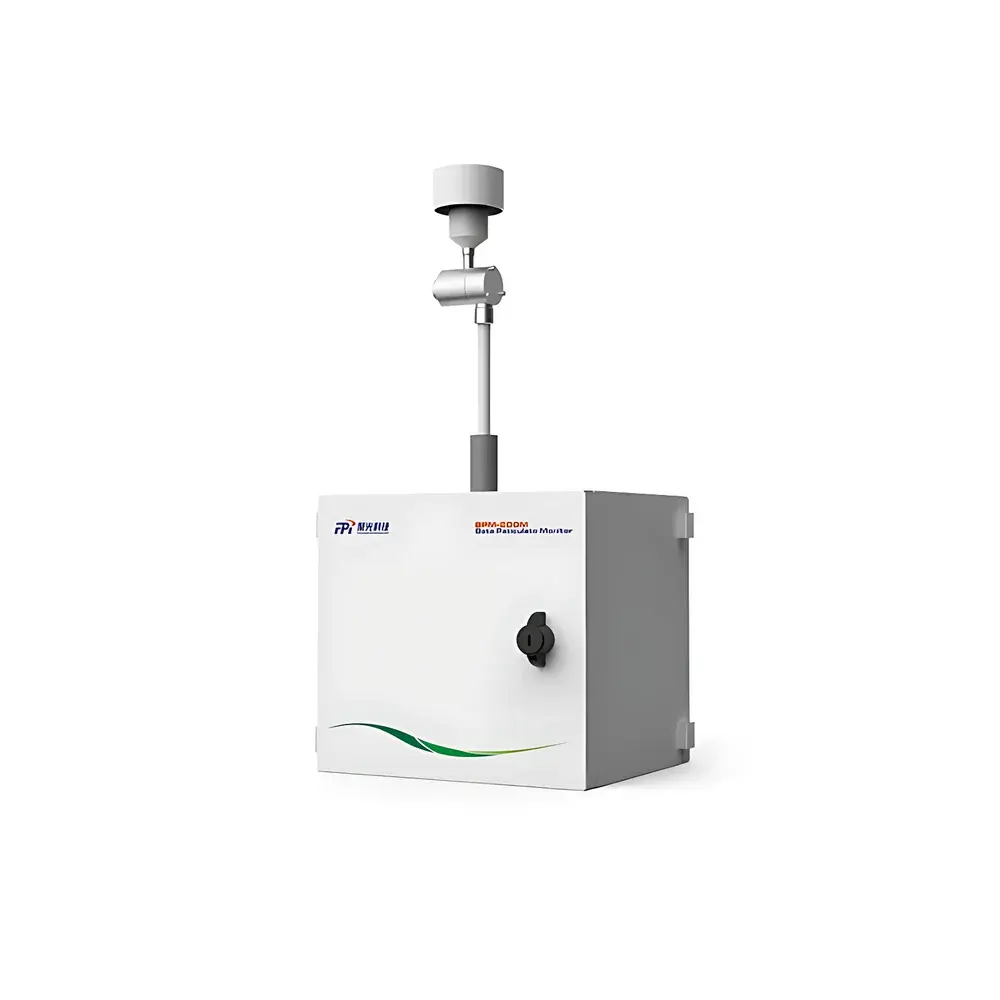
FPI BPM-200M Compact Beta-Ray Atmospheric Particulate Matter Monitor
| Brand | FPI |
|---|---|
| Origin | Zhejiang, China |
| Manufacturer Type | OEM/ODM Producer |
| Country of Origin | China |
| Model | BPM-200M |
| Measurement Principle | Beta-ray Absorption (¹⁴C source) |
| Measured Parameters | PM₁₀ / PM₂.₅ |
| Measurement Ranges | 0–10 mg/m³, 0–20 mg/m³, 0–50 mg/m³, 0–100 mg/m³ (selectable) |
| Sampling Flow Rate | 2 L/min |
| Lower Detection Limit | 5 µg/m³ |
| Flow Stability | ≤ ±2% of setpoint over 24 h |
Overview
The FPI BPM-200M Compact Beta-Ray Atmospheric Particulate Matter Monitor is an ISO/EN 12341- and EPA EQPM-compliant continuous ambient air monitoring instrument engineered for high-reliability, long-term deployment in regulatory-grade environmental monitoring networks. It operates on the beta-ray absorption principle using a calibrated ¹⁴C radioactive source — a reference method endorsed by the U.S. EPA (Method PS-4), EU Directive 2008/50/EC, and China’s HJ 653-2013 standard. As air is drawn through a size-selective inlet (PM₂.₅ or PM₁₀ cyclone), particulate matter deposits onto a continuously advancing quartz-fiber tape. The instrument measures attenuation of beta particles before and after deposition, converting the differential signal into mass concentration (µg/m³ or mg/m³) via Beer-Lambert law-based calibration. Unlike oscillating microbalance or optical scattering instruments, the BPM-200M delivers gravimetric-equivalent accuracy without reliance on particle density or refractive index assumptions — critical for regulatory reporting and trend analysis across heterogeneous aerosol environments.
Key Features
- Compact, integrated architecture with embedded vacuum pump, humidity-controlled sampling path, and low-power electronics — designed for unattended operation in remote or space-constrained sites (e.g., rooftop stations, mobile platforms, border monitoring posts).
- Dynamic heating and real-time humidity compensation algorithm mitigates hygroscopic bias during high-humidity or precipitation events, ensuring measurement integrity across >95% RH conditions.
- Extended tape lifetime (>90 days at 1-hour sampling interval) enabled by intelligent tape advancement logic and “tape-saving” mode — reduces consumables cost and field maintenance frequency.
- Onboard self-diagnostic suite monitors flow stability, tape tension, source activity decay, detector linearity, and heater performance; generates automated event logs compliant with ISO/IEC 17025 data integrity requirements.
- Dual communication architecture: embedded quad-band 4G LTE modem (China Unicom, Mobile, Telecom) + RS-232 serial interface — supports MQTT, Modbus RTU, and custom TCP/IP protocols for seamless integration into national air quality management platforms (e.g., CNEMC, AirNow, AQICN).
- Brushless sampling motor rated for >20,000 hours MTBF; internal rechargeable LiFePO₄ battery sustains full functionality for ≥72 hours during grid outage — validated per IEC 62040-3 for backup power resilience.
Sample Compatibility & Compliance
The BPM-200M accepts standard 40-mm-wide quartz-fiber tapes (ASTM D1357, ISO 9096) and integrates certified PM₂.₅ and PM₁₀ impactors meeting EN 12341:2014 cut-point tolerances (50% cutoff at 2.5±0.2 µm and 10±0.5 µm aerodynamic diameter). All firmware and calibration procedures are traceable to NIM (National Institute of Metrology, China) and NIST SRM 1648a urban dust reference material. The system meets electromagnetic compatibility (EMC) per GB/T 18268.1-2010 and environmental operating specifications: −30 °C to +50 °C ambient, 0–95% RH non-condensing. Data output complies with China’s HJ 212-2017 communication protocol and supports 21 CFR Part 11 audit trails when deployed with FPI’s optional secure data logger module.
Software & Data Management
FPI’s proprietary AirSight™ v3.2 firmware provides local configuration via web UI (HTTPS-enabled) and remote parameter adjustment through encrypted TLS 1.2 channels. Raw beta-count data, flow logs, temperature/humidity telemetry, and diagnostic flags are timestamped at 1-second resolution and stored internally (8 GB eMMC) for ≥90 days. Export formats include CSV (ISO 8601 timestamps), NetCDF4 (CF-1.8 compliant), and XML (AQMS-compliant schema). Optional cloud synchronization enables automatic ingestion into FPI Cloud — a GDPR- and MLPS Level 2–certified platform supporting multi-site dashboarding, statistical process control (SPC) charts, and automated exceedance alerts aligned with WHO Air Quality Guidelines (2021).
Applications
- Regulatory ambient air quality monitoring networks (national, provincial, municipal)
- Industrial fence-line and stack emission verification (e.g., cement plants, coal-fired power stations, waste incinerators)
- Urban traffic pollution hotspot mapping and source apportionment studies
- Indoor air quality assessment in schools, hospitals, and transit hubs (with optional low-flow adapter)
- Research-grade time-series analysis for epidemiological cohort studies requiring PM₂.₅ exposure reconstruction
- Mobile monitoring on vehicles, drones (with vibration-dampened mounting kit), and portable shelters
FAQ
Is the ¹⁴C source exempt from nuclear regulatory licensing in most jurisdictions?
Yes — the BPM-200M uses a <10 kBq ¹⁴C source, classified as “exempt quantity” under IAEA Safety Standards Series No. SSG-24 and equivalent national frameworks (e.g., NRC 10 CFR 30.71, UK EA EPR 2016 Schedule 2). Documentation package includes source certificate, shielding verification report, and transport compliance letter.
Can the instrument be recalibrated in-field without returning to the factory?
Yes — users may perform span calibration using NIST-traceable PM₂.₅ test aerosols (e.g., Arizona Road Dust, ammonium sulfate) via the built-in calibration port; zero calibration is auto-executed daily using clean-air purge. All calibrations generate ISO/IEC 17025-compliant electronic records.
Does the BPM-200M support co-location with reference-grade FRM/FEM monitors for validation studies?
Yes — it meets EPA’s co-location criteria (40 CFR Part 53.30) for comparative testing, including synchronized sampling intervals, matched inlet heights (2–4 m AGL), and identical data averaging protocols (e.g., hourly arithmetic mean). Field validation reports are available upon request.
Related Products







