
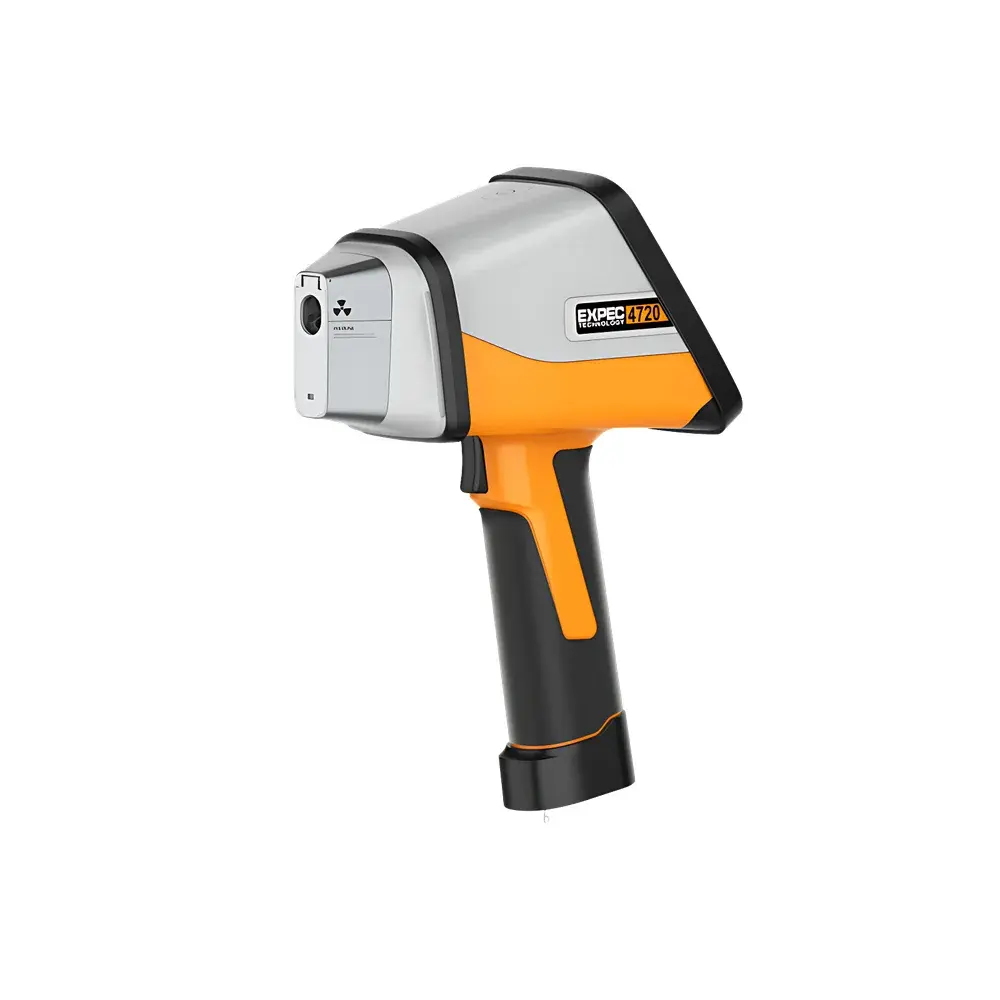
EXPEC EXPEC 4720 Handheld XRF Soil Heavy Metal Analyzer
| Brand | EXPEC (Puyu Technology) |
|---|---|
| Origin | Zhejiang, China |
| Model | EXPEC 4720 |
| Instrument Type | Heavy Metal Contaminant Analyzer for Soil |
| Detection Principle | Energy-Dispersive X-ray Fluorescence (EDXRF) |
| Weight (incl. battery) | 1.5 kg |
| Operating Temperature Range | −10 °C to 50 °C |
| Ingress Protection Rating | IP54 |
| Detection Speed | ~10 s per measurement |
| Detection Limit | Sub-ppm to ppm level for key heavy metals (e.g., Pb, As, Cd, Cr, Hg, Ni, Cu, Zn) |
| Sample Preparation | None required (direct in-situ analysis) |
| Software Platform | Android-based embedded OS with customizable environmental enforcement modules |
| Moisture Compensation | Integrated real-time soil moisture correction algorithm |
| Elemental Coverage | ≥40 elements including heavy metals and regulated toxic elements |
Overview
The EXPEC EXPEC 4720 Handheld XRF Soil Heavy Metal Analyzer is an industrial-grade, field-deployable energy-dispersive X-ray fluorescence (EDXRF) instrument engineered for rapid, non-destructive quantification of heavy metal contaminants in soil and related solid matrices. Designed specifically for environmental site assessment and regulatory compliance workflows, the EXPEC 4720 operates on the fundamental principle of X-ray excitation and characteristic secondary emission: a miniature high-stability X-ray tube irradiates the sample surface, inducing element-specific fluorescent X-rays that are resolved by a silicon drift detector (SDD). The resulting spectral data are processed in real time using factory-calibrated, matrix-matched algorithms—optimized for heterogeneous soil compositions including clay, silt, sand, and organic-rich substrates. Unlike laboratory-based ICP-MS or AAS methods requiring digestion and dilution, the EXPEC 4720 delivers quantitative results in under 10 seconds without sample preparation, enabling immediate decision-making during site reconnaissance, remediation planning, and regulatory inspection.
Key Features
- Real-time, in-situ elemental analysis of ≥40 regulated metals—including Pb, As, Cd, Cr(VI), Hg, Ni, Cu, Zn, Mn, Co, and Se—with detection limits consistently achieving sub-ppm to low-ppm sensitivity across diverse soil types.
- Ergonomic handheld architecture weighing only 1.5 kg (including rechargeable Li-ion battery), featuring balanced center-of-gravity design and textured grip for extended field operation without operator fatigue.
- Robust mechanical construction rated to IP54 standards—dust-resistant and protected against water splashes—validated for continuous operation in ambient temperatures from −10 °C to 50 °C and relative humidity up to 90% non-condensing.
- Intelligent multi-position primary beam filtration system dynamically selects optimal excitation conditions based on target elements and soil matrix composition, enhancing signal-to-noise ratio and minimizing spectral interferences.
- Integrated soil moisture compensation algorithm corrects for attenuation effects caused by variable water content (5–35% w/w), significantly improving measurement reproducibility across field-moist samples without drying or homogenization.
- One-touch trigger interface with visual and audible stabilization feedback ensures consistent measurement geometry and minimizes operator-induced variability.
Sample Compatibility & Compliance
The EXPEC 4720 is validated for direct analysis of unprepared, heterogeneous soil samples—including dredged sediments, landfill cover soils, construction fill, agricultural topsoil, and weathered industrial waste. It also supports screening of associated media such as dust wipes, filter membranes, paint chips, aerosol collection substrates, and slurry-processed solids. Method performance aligns with ASTM D8065–22 (Standard Guide for Field Screening of Soils Using Portable XRF Analyzers) and EPA Method 6200 (Field Portable X-Ray Fluorescence Spectrometry). Data output supports traceability requirements under ISO/IEC 17025:2017 and GLP-compliant audit trails when paired with optional secure logging firmware. While not a replacement for certified lab analysis in final risk assessment reporting, the instrument meets Tier 1 screening criteria defined in US EPA Region 9’s “XRF Field Screening Guidance” and China’s HJ 1019–2019 standard for soil pollution investigation.
Software & Data Management
Running a hardened Android 11-based operating system, the EXPEC 4720 features an intuitive touchscreen interface with multilingual support (English, Chinese, Spanish). The embedded software includes configurable alarm thresholds per element—triggering visual highlighting and audio alerts when concentrations exceed jurisdictional action levels (e.g., China’s GB 15618–2018 or US EPA Regional Screening Levels). All measurements are timestamped, geotagged via integrated GPS (±3 m CEP), and stored with full spectral metadata. Data export formats include CSV, PDF reports, and encrypted SQLite databases compatible with GIS platforms (ArcGIS, QGIS) and LIMS integration via RESTful API. Optional enforcement-grade modules support interoperability with handheld gas detectors, VOC analyzers, and radiation survey meters—enabling unified incident documentation and cross-parameter correlation during joint inspections.
Applications
- Environmental site assessment: Rapid delineation of contamination plumes at brownfield sites, former industrial facilities, and mining-impacted land.
- Regulatory compliance monitoring: Pre-construction baseline surveys, post-remediation verification, and long-term stewardship tracking for residential, educational, and public service land use categories.
- Agricultural land management: Screening of arable soils for cumulative heavy metal accumulation, irrigation source impact evaluation, and crop safety risk stratification.
- Infrastructure development: Real-time assessment of excavation spoil, backfill material, and pavement demolition debris prior to off-site disposal or reuse.
- Emergency response: On-scene triage of spill-affected soils, illegal dumping investigations, and post-disaster sediment characterization following flood or fire events.
- Research & education: Field-based geochemical mapping, pedological studies, and method validation exercises in university environmental science programs.
FAQ
Does the EXPEC 4720 require calibration with site-specific soil standards?
No—factory calibrations are developed using >200 reference materials spanning USDA soil textural classes and organic matter contents. However, for high-accuracy quantification in atypical matrices (e.g., high-salt coastal soils or metallurgical slag), optional empirical calibration with local standards is supported.
Can it detect hexavalent chromium (Cr(VI)) directly?
No—EDXRF measures total chromium. Speciation requires complementary techniques (e.g., alkaline extraction + colorimetry or IC-ICP-MS). The EXPEC 4720 flags elevated Cr as a risk indicator warranting further speciation testing.
Is spectral data accessible for third-party reprocessing?
Yes—raw spectra (.spe files) and processed results (.csv) are fully exportable via USB-C or Wi-Fi. No proprietary lock-in prevents independent validation or algorithmic refinement.
What is the typical battery life per charge during continuous field use?
Approximately 8–10 hours under mixed-use conditions (15-second measurements every 90 seconds), verified per IEC 61960 standards.
How does the instrument handle heterogeneous particle size distribution?
Measurement repeatability is maintained through automatic beam collimation, adaptive counting time extension, and statistical averaging across multiple 2-second sub-integrations—minimizing bias from grain-size-related heterogeneity.







