
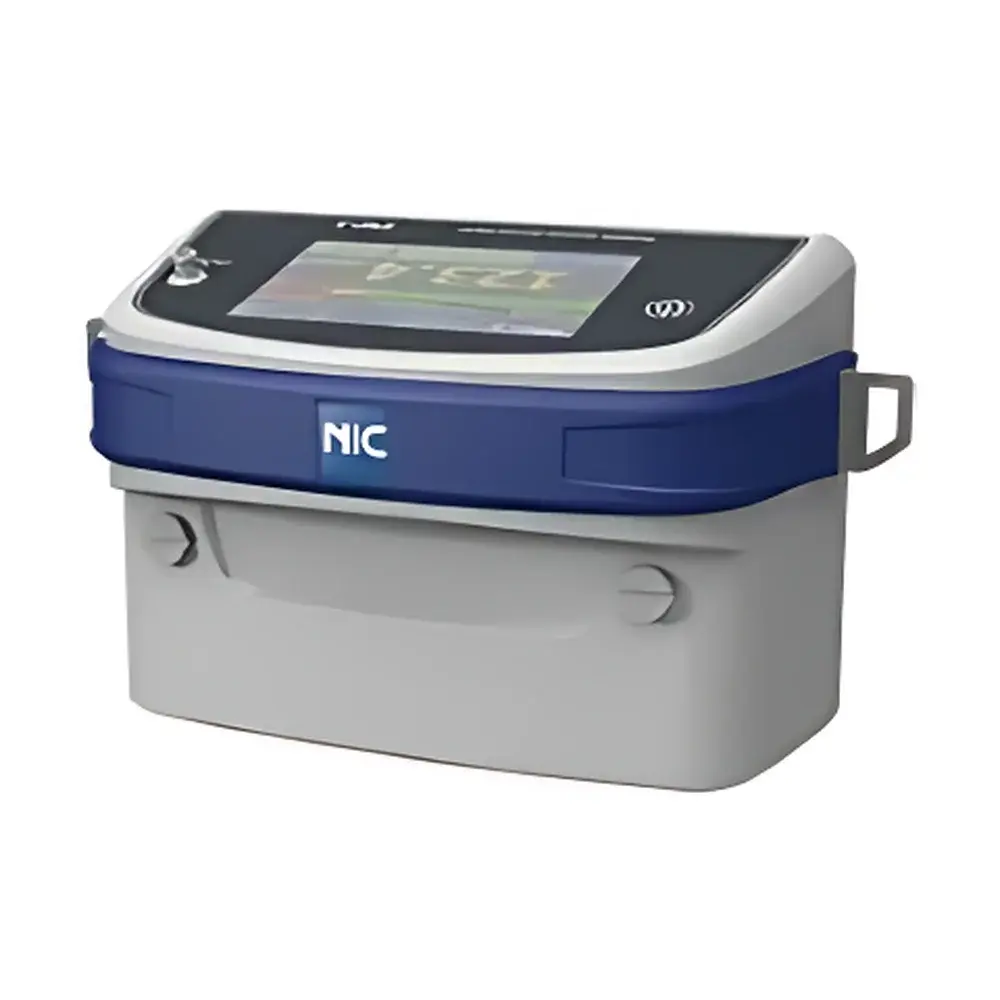
NIC EMP-3 Portable Mercury Analyzer
| Brand | NIC |
|---|---|
| Origin | Japan |
| Manufacturer Type | Authorized Distributor |
| Origin Category | Imported |
| Model | EMP-3 |
| Price Range | USD 21,000 – 35,000 (FOB Yokohama) |
| Sampling Flow Rate | ~1 L/min |
| Flow Accuracy | ±3% of reading |
| Sampling Temperature Range | 0–45 °C |
| Sample Form | Particulate-Bound Mercury (Hg<sub>p</sub>) and Elemental Mercury Vapor (GEM) |
| Regulatory Compliance | HJ 597–2011 (China), ASTM D6784–22 (Optional Configuration) |
Overview
The NIC EMP-3 Portable Mercury Analyzer is a field-deployable, cold-vapor atomic fluorescence spectrometry (CVAFS)-based instrument engineered for real-time, on-site quantification of elemental mercury vapor (GEM) and particulate-bound mercury (Hgp) in ambient and workplace air. Unlike fixed-laboratory analyzers requiring sample transport and preservation, the EMP-3 integrates a heated sampling probe, integrated gold amalgamation trap, thermal desorption module, and dual-beam CVAFS detection cell into a single ruggedized chassis weighing under 8.5 kg. Its operational principle relies on selective preconcentration of mercury species onto gold-coated quartz traps at ambient or elevated temperatures (up to 120 °C for Hgp), followed by rapid thermal release and atomization in a quartz cell where mercury atoms are excited by a 253.7 nm UV lamp and their fluorescence intensity—proportional to concentration—is measured with photomultiplier tube (PMT) detection. This methodology delivers sub-ng/m³ detection capability with high specificity and minimal interferences from halogens, sulfur compounds, or hydrocarbons.
Key Features
- True portable architecture: Battery-operated (≥4 hours continuous operation) with internal rechargeable Li-ion pack and optional external 12 V DC input for vehicle or generator use.
- Integrated heated sampling train: Adjustable probe heating up to 120 °C ensures quantitative capture of thermally labile Hgp without filter clogging or breakthrough.
- Dual-trap configuration: Primary gold trap for GEM preconcentration; secondary backup trap enables automatic verification of breakthrough and supports method validation per ISO 17025 QA/QC protocols.
- Onboard flow calibration: Integrated mass flow sensor with NIST-traceable calibration certificate, auto-compensated for temperature and pressure drift.
- Ruggedized IP54 enclosure: Designed for industrial environments including power plant stack access platforms, LNG terminals, and refinery maintenance zones.
- Real-time data logging: Internal SD card storage (≥16 GB) with timestamped spectra, flow logs, trap temperatures, and diagnostic flags.
Sample Compatibility & Compliance
The EMP-3 is validated for direct analysis of gaseous matrices including workplace ambient air, natural gas streams, shale gas effluents, and Tedlar®-bag-collected LPG samples—without chemical derivatization or catalytic conversion. It meets the performance criteria specified in China’s HJ 597–2011 “Determination of Total Mercury in Ambient Air—Cold Vapor Atomic Fluorescence Spectrometry”, including required detection limit (≤0.05 ng/m³), precision (RSD ≤10% at 0.5 ng/m³), and recovery (90–110%). Optional firmware and hardware modules support ASTM D6784–22 Annex A4 (for coal-fired flue gas mercury speciation) and EPA Method 29 compliance when coupled with an isokinetic probe adapter. All firmware versions maintain audit trails compliant with GLP and FDA 21 CFR Part 11 requirements for electronic records and signatures.
Software & Data Management
The EMP-3 operates via the proprietary NIC MercuryView™ v3.2 software suite, installed on Windows-based tablets or laptops connected via USB-C or Bluetooth 5.0. MercuryView provides real-time spectral visualization, dynamic baseline correction, multi-point calibration curve management (linear and quadratic), and automated calculation of corrected concentrations using standard temperature/pressure (STP) normalization. Export formats include CSV (for LIMS integration), PDF reports with embedded metadata (operator ID, GPS coordinates, calibration certificates), and XML files compatible with EPA’s CEMS Data Acquisition Systems (DAS). Audit logs record all user actions—including method changes, calibration events, and data deletions—with immutable timestamps and digital signature fields.
Applications
- Occupational health monitoring in chlor-alkali plants, dental laboratories, and fluorescent lamp recycling facilities.
- Pre-commissioning and routine surveillance of mercury removal systems (e.g., activated carbon injection units) in coal- and biomass-fired power stations.
- Field validation of continuous emission monitoring systems (CEMS) for mercury in flue gas streams per EN 14181 QAL2/QAL3 protocols.
- Mobile source emissions testing for mercury content in natural gas transmission pipelines and LNG bunkering operations.
- Research-grade mercury flux measurements over contaminated soils or water surfaces using dynamic flux chambers.
FAQ
Does the EMP-3 measure oxidized mercury (Hg2+) species directly?
No. The EMP-3 quantifies elemental mercury (GEM) and particulate-bound mercury (Hgp). Oxidized gaseous mercury (Hg2+) requires prior reduction (e.g., with SnCl2) or conversion via thermal dissociation modules—available as optional accessories.
What is the recommended calibration frequency for routine workplace monitoring?
Daily zero/span checks using certified Hg permeation tubes (NIST SRM 2799) are required. Full multi-point calibration must be performed every 7 days or after maintenance, per ISO/IEC 17025 Clause 7.7.
Can the EMP-3 operate unattended for extended periods?
Yes—when powered externally and equipped with an optional weatherproof enclosure (IP65-rated), it supports unattended 24/7 operation for up to 72 hours with programmable sampling cycles and remote status alerts via SMS or email.
Is method validation documentation available for regulatory submissions?
Yes. NIC provides a complete validation package including system suitability test reports, uncertainty budgets (k=2), and traceability statements aligned with ISO/IEC 17025 and CNAS-CL01:2018 requirements.
Related Products







