
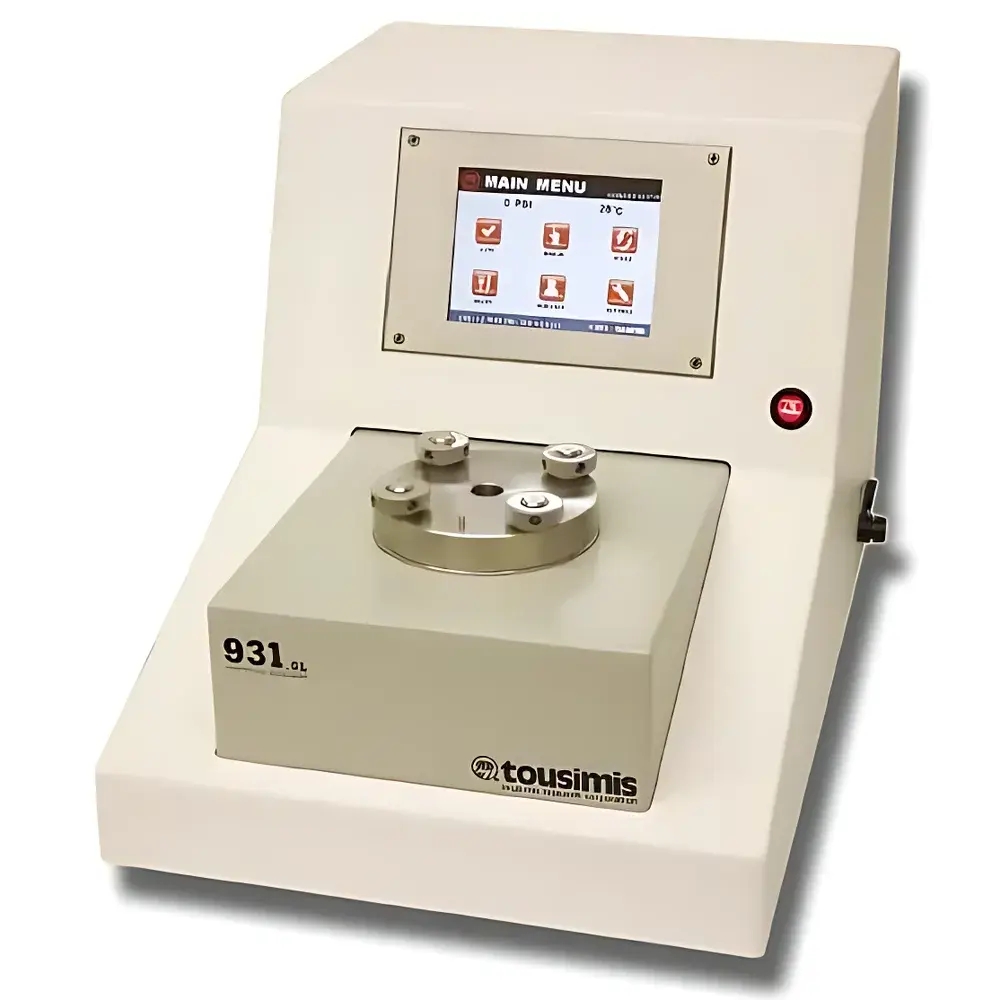
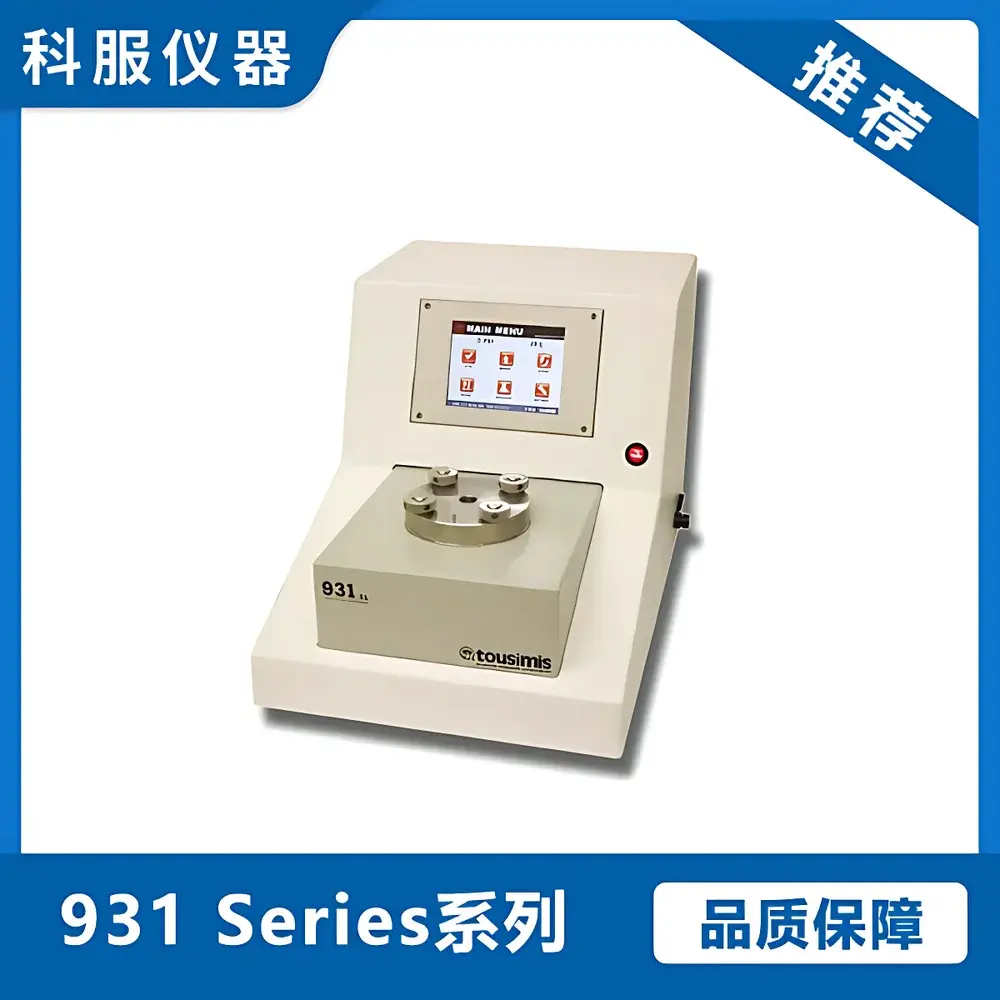
Tousimis 931 Series Supercritical Point Dryer
| Brand | Tousimis |
|---|---|
| Origin | USA |
| Model | 931 Series |
| Temperature Range | −40 °C to +60 °C |
| Pressure Range | 0–2000 psi |
| Display | LCD Touchscreen Interface |
| Sample Chamber Diameters | 31.75 mm, 63.50 mm, 86.36 mm (all × 31.75 mm depth) |
| Power Supply | 120 V, 50–60 Hz (optional voltages available) |
| Compliance | UL, CE, U.S. Military Standards |
| Filtration | Integrated 0.5 µm particulate filter (internal and external purge path) |
| Cooling | Closed-loop internal refrigeration system |
| Software | Stasis™ automated drying protocol engine |
Overview
The Tousimis 931 Series Supercritical Point Dryer is an engineered solution for the high-fidelity dehydration of delicate hydrated specimens—particularly hydrogels, aerogels, biological tissues, and MEMS/NEMS structures—without inducing surface tension-induced collapse. It operates on the principle of supercritical fluid processing, using liquid carbon dioxide (LCO2) as the transitional medium. By precisely controlling temperature and pressure above CO2’s critical point (31.1 °C, 1070 psi), the instrument eliminates the liquid–gas phase boundary, enabling solvent removal in a single-phase state. This avoids capillary stress during evaporation—a primary cause of structural distortion in electron microscopy (SEM/TEM) sample preparation and nanomaterial fabrication. Designed for reproducibility and operational integrity, the 931 Series integrates closed-loop thermal management, precision metering valves, and ISO Class 5–compatible mechanical architecture.
Key Features
- Bright, intuitive 7-inch LCD touchscreen interface with real-time parameter visualization and multi-level user access control
- Stasis™ software suite enabling programmable, multi-step drying protocols—including hold steps, ramped pressure/temperature profiles, and automated vent/purge sequencing
- Factory-loaded default protocols plus customizable program storage (up to 99 user-defined methods)
- Micrometer-adjustable stainless-steel metering valves with vernier scale for repeatable, low-flow LCO2 introduction—minimizing mechanical disturbance to fragile samples
- Dual-stage filtration: integrated 0.5 µm sintered stainless-steel filter inside the chamber and externally mounted coalescing filter for LCO2 supply lines (removes moisture, oil, and sub-micron particulates)
- Self-contained closed-cycle refrigeration system for rapid chamber cooldown (−40 °C capability), eliminating dependency on external chillers or dry ice
- SOTER™ condenser module that separates residual ethanol from exhaust CO2, suppressing acoustic emissions and preventing solvent carryover into exhaust ducts
- Vertically oriented sample chamber with LED illumination and optically clear quartz viewport on hinged lid—enabling real-time visual monitoring without process interruption
- Non-mechanical, diffusion-based PURGE cycle utilizing controlled gas displacement—eliminating shear forces that compromise nanostructured surfaces
- Cleanroom-compatible enclosure with static-dissipative finish (surface resistivity <1×10⁹ Ω/sq) and EMI-shielded electronics meeting MIL-STD-461F requirements
Sample Compatibility & Compliance
The 931 Series accommodates three interchangeable sample chamber inserts (31.75 mm, 63.50 mm, and 86.36 mm internal diameter; all 31.75 mm deep), supporting standard SEM stubs, TEM grids, silicon wafers, and custom holders. Its pressure and thermal envelope (0–2000 psi, −40 °C to +60 °C) complies with ASTM D7112–19 (for polymer aerogel drying) and ISO 21568:2021 (for biological specimen preservation). Electrical subsystems are certified to UL 61010–1, CE EN 61326–1 (EMC), and EN 61000–6–3 (emissions), with full traceability documentation provided for GLP/GMP audit readiness. Optional 21 CFR Part 11–compliant software logging (with electronic signatures and audit trail) is available upon request.
Software & Data Management
Stasis™ software provides deterministic control over all process variables—including fill rate, soak duration, purge frequency, bleed rate (via calibrated flowmeter), and final vent sequence. All parameters are timestamped and logged in CSV format with checksum validation. The system supports USB export, network-enabled remote status polling (Modbus TCP), and integration with LIMS via OPC UA. Protocol versioning, user authentication (role-based), and automatic firmware update notification ensure long-term maintainability and regulatory alignment. Raw sensor data (pressure transducer, PT100 thermistors, valve position feedback) is sampled at 10 Hz and retained for ≥30 days unless archived externally.
Applications
- Preparation of high-aspect-ratio nanostructures for scanning electron microscopy (SEM) and focused ion beam (FIB) analysis
- Drying of silica, cellulose, and chitosan aerogels without shrinkage or cracking
- Stabilization of cryo-fixed biological tissues for correlative light-electron microscopy (CLEM)
- Post-lithography release of microelectromechanical systems (MEMS) devices
- Processing of metal–organic frameworks (MOFs) and porous coordination polymers requiring solvent-free pore retention
- Quality assurance in pharmaceutical nanoparticle formulation where residual solvent must be quantified per ICH Q5C guidelines
FAQ
What LCO2 purity specifications are recommended for optimal performance?
Tousimis specifies Grade 5.0 (99.999% pure) CO2 with ≤1 ppm H2O and ≤0.5 ppm total hydrocarbons. Use of lower-grade supply may saturate internal filters prematurely and induce ethanol phase separation.
Can the 931 Series be integrated into an automated sample prep workflow?
Yes—via RS-232/USB-C serial interface or optional Ethernet module. Digital I/O ports support interlock signaling with glovebox antechambers, robotic handlers, and vacuum transfer systems.
Is routine maintenance required beyond filter replacement?
Scheduled tasks include quarterly calibration verification of pressure transducers (NIST-traceable), annual refrigerant charge assessment, and biannual O-ring inspection per manufacturer’s PM checklist (included in manual).
Does the system support inert gas purging prior to LCO2 introduction?
Yes—the integrated purge manifold accepts N2 or Ar feed (regulated to ≤100 psi) for oxygen-sensitive samples, with programmable pre-fill dwell time and flow-controlled evacuation.
How is data integrity ensured during extended drying cycles (e.g., >48 hours)?
The embedded controller uses write-protected flash memory with cyclic redundancy checking (CRC-32) on all log entries. Power-loss recovery preserves active protocol state and resumes from last validated step upon reboot.



