
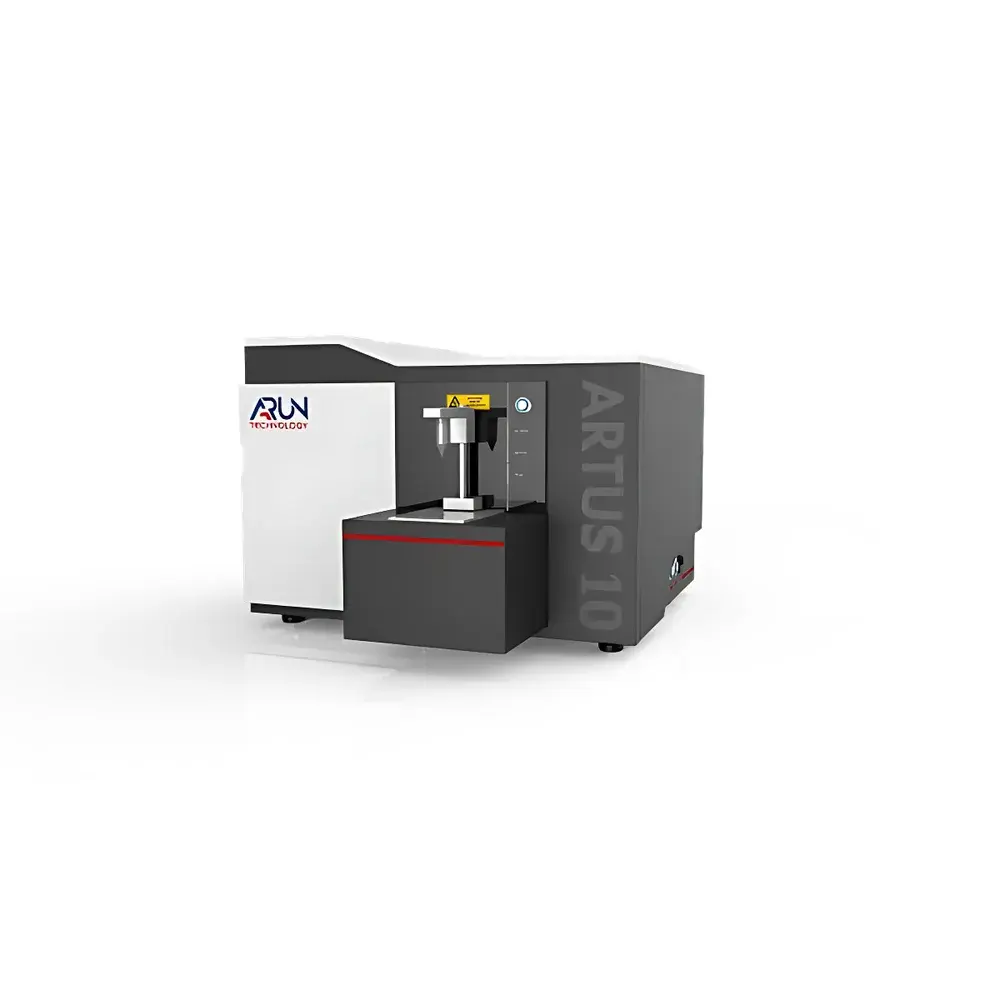
Arun ARTUS 10 Full-Spectrum Direct-Reading Optical Emission Spectrometer
| Brand | Arun Technology Ltd. |
|---|---|
| Origin | United Kingdom |
| Instrument Type | Benchtop |
| Excitation Method | Spark Discharge |
| Detector Type | Scientific-grade CMOS Sensor with Active Cooling |
| Wavelength Range | 130–700 nm |
| Element Analysis Time | ≤10 s per measurement |
| Detection Limit | ≤1 ppm for key metallic elements |
| Compliance | Designed for ISO/IEC 17025-compliant laboratories, supports GLP/GMP audit trails and ASTM E415, E1086, E1479 methodologies |
Overview
The Arun ARTUS 10 is a benchtop full-spectrum direct-reading optical emission spectrometer (OES) engineered for high-precision elemental analysis of solid metallic samples. Based on spark-induced plasma excitation and high-resolution spectral dispersion, the ARTUS 10 captures emitted radiation across the ultraviolet to near-visible range (130–700 nm) and converts it into quantitative compositional data using a scientific-grade, thermoelectrically cooled CMOS detector array. Unlike traditional PMT-based spectrometers with fixed channels, the ARTUS 10 employs a true full-spectrum acquisition architecture—enabling retrospective re-analysis, multi-element calibration flexibility, and method-independent spectral evaluation. Its design reflects over three decades of Arun’s expertise in metallurgical spectroscopy, targeting laboratories requiring trace-level detection, rapid turnaround, and long-term analytical stability without routine optical recalibration.
Key Features
- Scientific CMOS Detection Platform: Integrates a back-illuminated, deep-depletion CMOS sensor with Peltier-based active cooling (–15 °C operating temperature), delivering enhanced quantum efficiency in the UV region and reduced dark current—critical for achieving sub-ppm detection limits for C, P, S, N, and trace alloying elements.
- Optimal Element-Oriented (OEO) Acquisition: Dynamically assigns integration time, gain, and readout parameters per element during each spark sequence—maximizing signal-to-noise ratio without sacrificing cycle time or dynamic range.
- Aberrant Spark Removal (ASR) Algorithm: Real-time spectral outlier rejection identifies and excludes non-representative sparks caused by surface defects, micro-cracks, or inhomogeneity—reducing dependency on ultra-flat sample preparation and improving repeatability on as-cast or machined surfaces.
- Sub-10-Second Routine Analysis: Full-spectrum acquisition, background correction, peak integration, and matrix-matched quantification completed in ≤10 seconds—including argon purge stabilization—optimized for high-throughput foundry QA/QC environments.
- Zero-Drift Optical Architecture: Monolithic optical bench with low-expansion materials, passive thermal stabilization, and sealed vacuum or purged optical path eliminates need for daily wavelength recalibration (‘re-tuning’) or mechanical slit adjustment—ensuring >12-month calibration stability under typical lab conditions.
Sample Compatibility & Compliance
The ARTUS 10 supports standardized solid metal samples conforming to ISO 11577, ASTM E415, and EN 10315 specifications—including ferrous alloys (steels, cast irons), non-ferrous metals (Al, Cu, Mg, Zn, Ti, Ni-based superalloys), and weld deposits. Sample diameter range: 10–40 mm; minimum thickness: 4 mm. The system complies with IEC 61000-6-3 (EMC) and IEC 61010-1 (safety). Software workflows support 21 CFR Part 11-compliant electronic signatures, audit trail logging, and user role-based access control—meeting requirements for ISO/IEC 17025 accreditation and GMP-regulated metal release testing.
Software & Data Management
ARTUS Control Suite v5.x provides unified instrument control, calibration management, spectral visualization, and report generation within a single GUI. Raw spectrum files (.spc) are stored in vendor-neutral HDF5 format with embedded metadata (instrument ID, operator, timestamp, argon pressure, spark statistics). Calibration models use multivariate regression (PLS-R) with internal standard normalization and inter-element interference correction. Data export supports CSV, XML, and LIMS-compatible ASTM WK31522 templates. Optional integration with LabWare LIMS and SAP QM modules via ODBC or REST API.
Applications
- Grade identification and positive material identification (PMI) in piping, valves, and pressure vessels per ASME B16.5 and ASTM A959.
- Residual element monitoring (e.g., Sn, As, Pb, Bi) in stainless steels and aerospace Al-alloys per AMS 2300 and NADCAP AC7101.
- Carbon equivalent (CE) and hardenability index calculation for heat treatment validation.
- Scrap sorting and recycling feedstock qualification in secondary metal production.
- Research-scale spectral library development for novel alloy systems using principal component analysis (PCA) and clustering algorithms.
FAQ
Does the ARTUS 10 require daily wavelength calibration?
No. Its monolithic optical design and thermal stabilization eliminate routine wavelength recalibration; verification is recommended only after major maintenance or environmental relocation.
Can the system analyze coated or painted samples?
Surface coatings must be removed prior to analysis; the spark source requires direct conductive contact with bulk metal. Oxide layers <5 µm thick may be accommodated via extended pre-spark cleaning.
Is argon purity critical for performance?
Yes. Grade 4.8 (99.998% pure) argon with dew point ≤ –60 °C is required to maintain UV transmission and prevent spectral interference from atmospheric nitrogen/oxygen bands.
What sample preparation standards does Arun recommend?
Flatness ≤0.02 mm, surface roughness Ra ≤0.8 µm, and absence of oil, grease, or scale—per ISO 11577. ASR functionality mitigates minor deviations but does not replace metrologically valid preparation.
How is trace carbon measured below 0.005 wt%?
Using the 193.09 nm C I line with optimized spark energy, extended integration, and spectral deconvolution against Fe and Cr overlaps—validated per ASTM E1086 Annex A1.




