
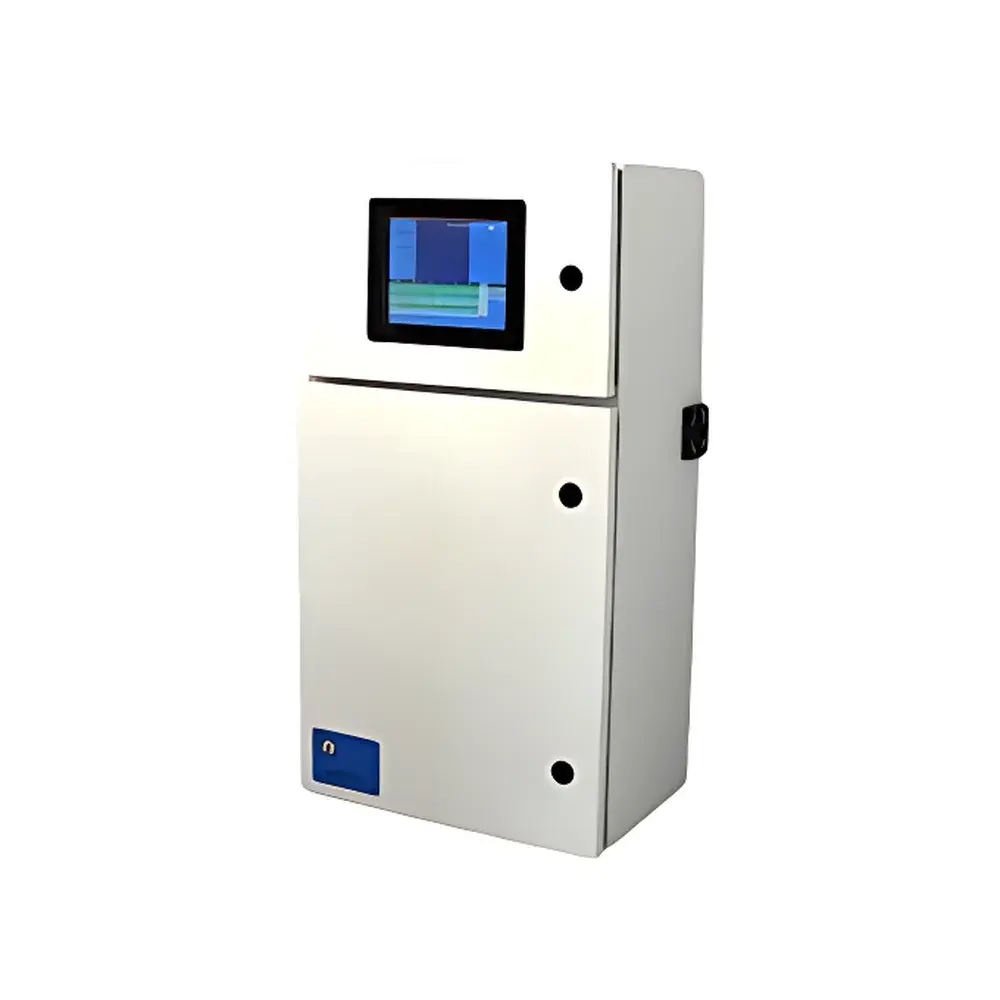
FPI MICROMAC C Series Online Water Quality Analyzer
| Brand | FPI |
|---|---|
| Origin | Zhejiang, China |
| Manufacturer Type | Original Equipment Manufacturer (OEM) |
| Product Category | Domestic |
| Model | MICROMAC C Series |
| Instrument Type | Online Water Quality Analyzer |
| Detection Principle | Colorimetric Analysis with Microprocessor Control |
| Analytical Technology | Loop Flow Analysis (LFA) |
| Key Feature | Auto-Dilution Function for Over-Range Measurement |
| Compliance Framework | Designed for Continuous Emission Monitoring Systems (CEMS) and Industrial Effluent Monitoring Applications |
| Software Interface | RS485/Modbus RTU, Optional 4–20 mA Analog Output |
| Enclosure Rating | IP65 |
| Power Supply | 220 VAC ±10%, 50/60 Hz |
Overview
The FPI MICROMAC C Series Online Water Quality Analyzer is an industrial-grade, microprocessor-controlled analytical platform engineered for continuous, unattended water quality monitoring in municipal wastewater treatment plants, industrial effluent discharge points, and environmental regulatory compliance stations. It operates on the well-established principle of colorimetric analysis—where target analytes react with specific reagents to form chromophores whose absorbance is quantified photometrically at defined wavelengths. Unlike batch-mode laboratory spectrophotometers, the MICROMAC C integrates a closed-loop fluidic architecture based on Loop Flow Analysis (LFA), enabling real-time, in-line measurement without manual sampling or operator intervention. Its design prioritizes operational robustness under variable field conditions—including fluctuating temperature, suspended solids load, and intermittent power supply—making it suitable for deployment in Class I–III water quality monitoring networks as defined by China’s HJ/T 353–2007 and compatible with international frameworks such as ISO 5667-16 (water sampling—guidance on on-line analyzers) and EPA Method 365.4 (phosphate determination).
Key Features
- Loop Flow Analysis (LFA) fluidic architecture: Eliminates interference from turbidity, coloration, and entrained air bubbles through continuous sample recirculation and optical path stabilization—ensuring high reproducibility across diverse water matrices.
- Auto-dilution capability: Integrated peristaltic dilution module automatically engages when sample concentration exceeds the calibrated upper limit, extending effective dynamic range without manual recalibration or hardware modification.
- Modular reagent management system: Supports up to four independent reagent channels with temperature-controlled storage (10–30 °C), enabling multi-parameter sequential analysis (e.g., nitrate, phosphate, ammonia, COD surrogate) within a single instrument footprint.
- Ruggedized industrial enclosure (IP65-rated): Designed for outdoor cabinet or wall-mount installation in humid, dusty, or chemically aggressive environments typical of wastewater lift stations and chemical manufacturing outfalls.
- Embedded real-time diagnostics: Continuous self-monitoring of pump performance, valve actuation cycles, LED source intensity decay, and photodiode baseline drift—loggable via internal SD card or remote SCADA interface.
Sample Compatibility & Compliance
The MICROMAC C Series accepts raw influent, secondary effluent, surface water, and industrial process streams with total suspended solids (TSS) ≤ 100 mg/L and pH 4–10. Pre-filtration (50 µm mesh) is recommended for applications involving high particulate load. All wetted components—including fluidic manifolds, reaction coils, and flow cells—are constructed from PTFE, PVDF, and borosilicate glass to resist corrosion from chlorine, nitric acid, and sodium hydroxide-based reagents. The analyzer meets electromagnetic compatibility requirements per IEC 61326-1 and conforms to functional safety principles aligned with IEC 61508 SIL 2 for critical control loop integration. Data integrity protocols support audit-ready operation under GLP/GMP-aligned workflows, including timestamped event logging and non-volatile memory retention for ≥12 months of 15-minute interval data.
Software & Data Management
The embedded firmware supports dual communication modes: Modbus RTU over RS485 (default) and optional analog 4–20 mA output with HART protocol compatibility. Configuration, calibration, and diagnostic access are performed via a secure web interface (HTTPS) or local USB-C terminal connection. All measurement events—including zero/span checks, reagent consumption logs, and auto-dilution triggers—are time-stamped and stored with SHA-256 hash integrity verification. Export formats include CSV and XML, structured to align with national environmental monitoring platforms such as China’s National Environmental Monitoring Network (NEMN) data ingestion schema. Remote firmware updates are digitally signed and validated prior to installation, satisfying traceability requirements under ISO/IEC 17025 Clause 7.7.
Applications
- Real-time compliance monitoring of municipal wastewater discharge against GB 18918–2002 limits for NH₃-N, TP, TN, and CODCr.
- Process optimization in electroplating, pharmaceutical, and petrochemical facilities where rapid detection of nutrient surges or oxidant residuals informs dosing control.
- Early-warning systems for combined sewer overflows (CSOs) and stormwater retention basins, leveraging LFA’s immunity to transient turbidity spikes.
- Integration into distributed sensor networks for river basin-wide water quality trend analysis, interfacing with GIS-based dashboards via MQTT or OPC UA gateways.
FAQ
What detection methods does the MICROMAC C support?
It performs colorimetric analysis only; no electrochemical, optical fluorescence, or ion-selective electrode modules are included in the base configuration.
Is the instrument certified for use in explosion-hazardous areas?
No—MICROMAC C carries no ATEX, IECEx, or UL HazLoc certification; it is intended for Zone 2 / Class I, Division 2 environments only.
Can multiple parameters be measured simultaneously?
No—measurements are sequential due to shared fluidic path and reagent manifold; however, cycle time per parameter is configurable between 5–30 minutes.
Does the system support remote calibration verification?
Yes—standard procedure includes automated zero-point verification using deionized water and span validation via certified reference standards injected via external port.
What is the minimum maintenance interval under continuous operation?
Reagent replacement every 30 days (typical), tubing and filter replacement every 90 days, and full optical path cleaning every 180 days—per manufacturer-recommended PM schedule.
Related Products







