
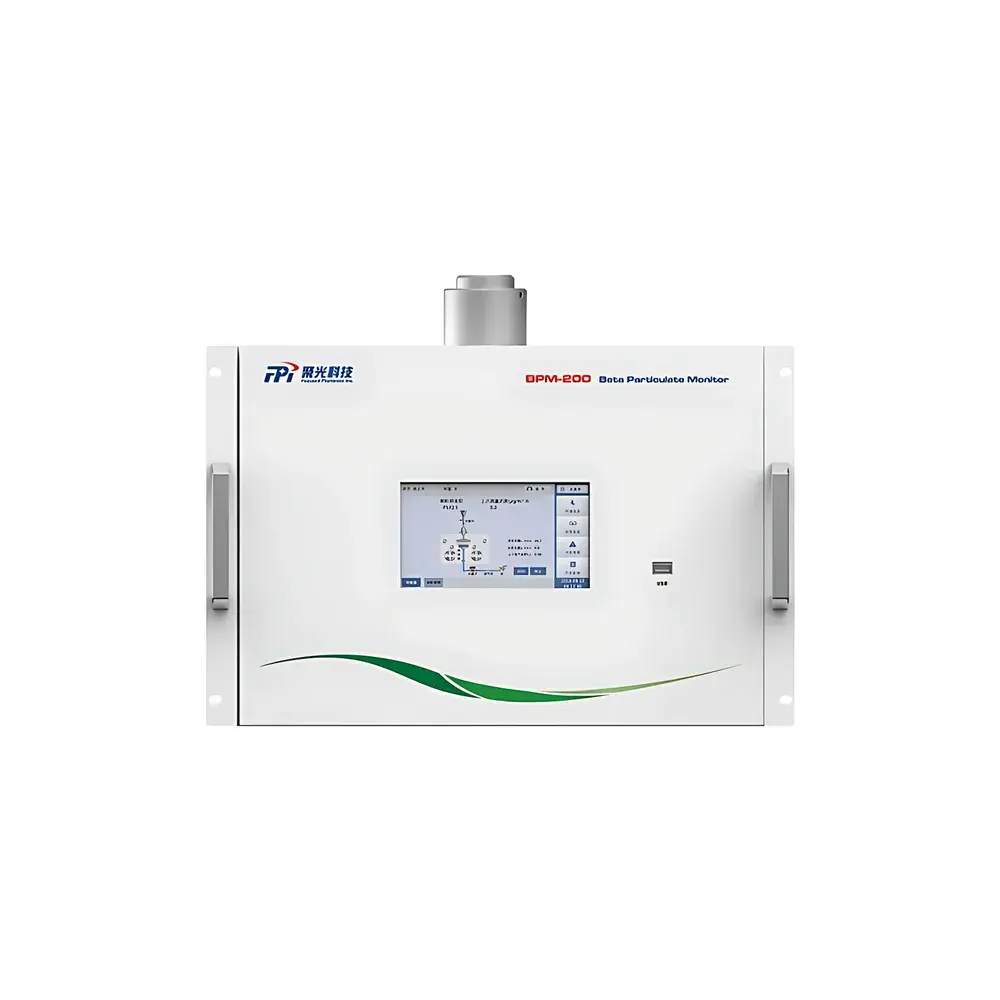
FPI BPM-200 Series Ambient Particulate Matter Monitor
| Brand | FPI (Fortune Photonics Instrumentation) |
|---|---|
| Origin | Zhejiang, China |
| Manufacturer Type | Original Equipment Manufacturer (OEM/ODM) |
| Country of Origin | China |
| Model | BPM-200 |
| Measurement Principle | Beta-Ray Attenuation Method (β-ray) |
| Safety Rating | Explosion-Proof (Class I, Division 1, Group A–D compliant per UL 1203 / IEC 60079-0) |
| Sampling Flow Rate | 16.7 L/min (standardized per ISO 10473 and EPA PM2.5 Reference Method EQPM-0805-190) |
| Particle Size Cuts | TSP, PM₁₀, PM₂.₅ (interchangeable impactors) |
| Compliance | Meets technical requirements of HJ 653–2013 (China), EN 12341:2014, and compatible with US EPA Federal Equivalent Method (FEM) framework for continuous ambient PM monitoring |
Overview
The FPI BPM-200 Series Ambient Particulate Matter Monitor is an industrial-grade, continuous real-time instrument engineered for regulatory-grade measurement of airborne particulate mass concentration in ambient air environments. It operates on the beta-ray attenuation principle—a gravimetrically traceable physical method widely adopted in reference and equivalent monitoring networks globally. A calibrated 14C radioactive source emits beta particles (electrons) through a precision-calibrated sampling tape; attenuation of the beta flux is directly proportional to the mass loading of deposited particulate matter (PM). This relationship—governed by the Lambert–Beer law—is converted into quantitative mass concentration (µg/m³) after compensation for tape background, humidity effects, and flow rate stability. Designed for unattended operation in diverse climatic conditions—including high-humidity and rain-prone regions—the BPM-200 integrates active humidity control, dynamic zero calibration, and temperature-compensated flow regulation to ensure metrological integrity across seasonal and diurnal variations.
Key Features
- Explosion-proof certified enclosure (UL 1203 / IEC 60079-0), enabling safe deployment in hazardous area Zone 1/Division 1 environments such as chemical plants, oil refineries, and coal handling facilities
- Integrated humidity management system featuring Nafion™-based drying and real-time relative humidity compensation—eliminates hygroscopic bias in PM₂.₅ measurements during fog, rain, or dew events
- Automated tape advancement with dual-stage verification: optical tape position sensing + motor current feedback ensures precise sample deposition alignment
- Self-diagnostic architecture with comprehensive fault logging, including pump performance trending, filter saturation detection, and beta-source activity decay monitoring
- Configurable sampling protocols: fixed-interval (minimum 10-minute cycles), scheduled hourly averaging, or external trigger synchronization via dry contact or Modbus RTU
- Low-consumables design with extended tape life (≥30 days at 1-hour intervals), programmable “low-paper” mode, and predictive filter replacement alerts based on cumulative mass load and pressure drop
Sample Compatibility & Compliance
The BPM-200 supports interchangeable inertial impactors meeting ISO 23294:2021 (PM₁₀) and ISO 23295:2021 (PM₂.₅) specifications, as well as TSP inlets compliant with ISO 7708:1995. All inlet assemblies are constructed from electropolished stainless steel and feature heated stagnation points to prevent condensation-induced particle loss. The system meets the functional and performance criteria outlined in China’s HJ 653–2013 Technical Specification for Continuous Ambient Air Quality Monitoring Systems, and its measurement uncertainty profile aligns with EN 12341:2014 Annex B for reference-grade equivalence. While not EPA-designated, its beta-ray methodology and hardware architecture conform to the core physical principles underpinning U.S. EPA Federal Reference Methods (FRMs) and Federal Equivalent Methods (FEMs) for PM₂.₅ and PM₁₀ (40 CFR Part 53).
Software & Data Management
Embedded firmware supports local data storage (≥12 months of 1-minute averaged records on internal SD card) and dual-channel communication: RS-232/RS-485 Modbus RTU for SCADA integration and GPRS-based TCP/IP transmission for remote telemetry. Optional SMS alert module delivers configurable threshold-triggered notifications (e.g., PM exceedance, power failure, maintenance due). Data output complies with ISO 14001 environmental management reporting formats and supports direct ingestion into national air quality platforms (e.g., CNEMC AQMS, EU AirBase). Audit trails—including calibration logs, tape change timestamps, and source decay corrections—are retained with immutable timestamps and user-accessible digital signatures, satisfying GLP-aligned data integrity requirements.
Applications
- Ambient air quality monitoring networks operated by municipal and provincial environmental protection bureaus
- Industrial fence-line monitoring for cement plants, steel mills, waste incinerators, and bulk material handling terminals
- Construction site PM compliance verification per local dust control ordinances (e.g., Shanghai Municipal Regulation No. 260)
- Research-grade exposure assessment in epidemiological cohort studies requiring long-term, stable baseline PM data
- Calibration reference for co-located optical scatter monitors and low-cost sensor networks
FAQ
What radiation safety certifications does the BPM-200 hold?
The 14C source is encapsulated in double-walled stainless steel and certified to IAEA SSG-46 standards. Full documentation includes national license (MEP approval No. CN/NR/2022-BPM200) and transport compliance per ADR/RID Class 7 regulations.
Is the instrument suitable for outdoor installation without shelter?
Yes—rated IP65 with integrated sunshield, thermal stabilization, and condensation-resistant electronics; operational range: −30 °C to +50 °C.
Can the BPM-200 be integrated into existing air quality data platforms?
Yes—supports standard protocols including Modbus RTU, MQTT, and HTTP POST; pre-configured drivers available for EnviroSuite, AQMesh, and OpenAQ-compatible gateways.
How often does the beta source require replacement?
The 14C source has a half-life of 5730 years; no replacement is required during the instrument’s service life (design lifetime ≥10 years).
Does the system meet FDA 21 CFR Part 11 requirements for electronic records?
While primarily deployed in environmental monitoring—not pharmaceutical manufacturing—the audit trail, electronic signature, and data immutability features satisfy core Part 11 principles for regulated data integrity where applicable.
Related Products







