
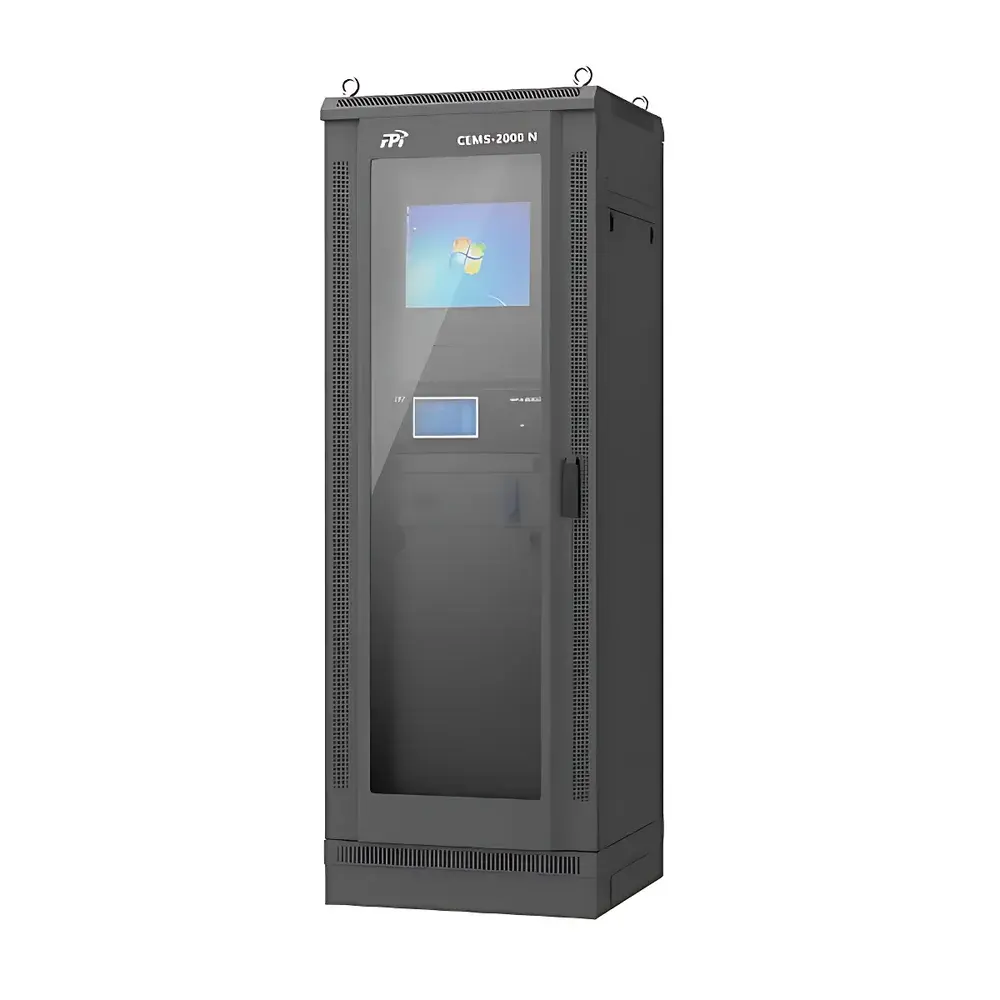
EXPEC CEMS-2000 N Continuous Emission Monitoring System (CEMS) for Flue Gas
| Brand | EXPEC (Pubugene Technology) |
|---|---|
| Origin | Zhejiang, China |
| Model | CEMS-2000 N |
| Measurement Principle | UV Differential Optical Absorption Spectroscopy (UV-DOAS) |
| Target Analytes | SO₂, NO, NO₂, O₂, H₂O (humidity), flue gas temperature, pressure, velocity, and particulate matter (dust) |
| Sampling Method | Full-path high-temperature extractive sampling (180–190 °C) |
| Compliance Basis | Designed to meet GB/T 16157, HJ 75–2017, HJ 76–2017, and reference-compatible with EPA Method 6C, 7E, 10, and EN 15267 |
Overview
The EXPEC CEMS-2000 N Continuous Emission Monitoring System is an engineered solution for regulatory-grade, real-time quantification of gaseous and physical parameters in industrial flue gas streams. Built upon ultraviolet differential optical absorption spectroscopy (UV-DOAS), the system enables selective, interference-resistant detection of SO₂, NO, and NO₂—without chemical conversion—thereby eliminating cross-sensitivity artifacts common in chemiluminescence or electrochemical approaches. Its full-path high-temperature extractive sampling architecture maintains sample integrity by sustaining the entire gas path—including probe, heated line, and conditioning unit—at 180–190 °C. This prevents condensation, adsorption losses, and nitrous acid (HONO) formation—critical for accurate NO₂ measurement at ultra-low concentrations (<2 mg/m³). The system integrates parallel sensors for O₂ (zirconia-based), temperature (Pt100 RTD), static/total pressure (capacitive transducers), and isokinetic flow velocity (S-type Pitot tube), enabling compliant stack emission calculations per ISO 16911 and EPA Performance Specification 2.
Key Features
- UV-DOAS Core Engine: Dual-beam, spectrally resolved UV absorption (190–230 nm) with real-time spectral fitting algorithms; supports simultaneous multi-component analysis with built-in baseline correction for dust scattering and lamp drift compensation.
- True High-Temperature Extraction: Entire sampling train—from stack probe to analyzer cell—operates continuously at ≥180 °C, minimizing wall loss of reactive nitrogen species and preserving volatile organic compound (VOC) integrity where co-monitoring is deployed.
- Ultra-Low Range Capability: Optimized optical pathlength and signal-to-noise ratio enable sub-1 ppmv detection limits for NO₂ and SO₂, satisfying China’s “ultra-ultra-low emission” thresholds (e.g., SO₂ ≤ 10 mg/m³, NOₓ ≤ 35 mg/m³, particulate ≤ 5 mg/m³) and aligning with EU BREF LCP Annex VIII benchmarks.
- Modular Hardware Architecture: Analyzer cabinet accommodates optional add-ons including paramagnetic O₂, IR-based CO/CO₂, and laser scattering-based dust monitors—all sharing synchronized data acquisition and unified calibration traceability.
- Robust Industrial Design: IP54-rated enclosure with redundant power supply, internal purge air management, and self-diagnostic firmware supporting remote health monitoring via Modbus TCP or OPC UA.
Sample Compatibility & Compliance
The CEMS-2000 N is validated for use across heterogeneous flue gas matrices typical of high-dust, high-moisture, and corrosive environments—including sintering exhausts (steel), clinker cooler vents (cement), FCCU regenerator off-gas (petrochemical), and fluidized bed boiler stacks (biomass/waste-to-energy). It complies with Chinese national standards HJ 75–2017 (quality assurance procedures) and HJ 76–2017 (technical requirements), and its measurement uncertainty profiles are benchmarked against certified reference gases traceable to NIM (National Institute of Metrology, China). For international deployment, system documentation supports alignment with ISO/IEC 17025 laboratory quality systems and provides audit-ready records for GLP/GMP-aligned environmental reporting frameworks.
Software & Data Management
The embedded EXPEC CEMS Manager software provides CE-certified data acquisition, automated zero/span validation (per HJ 76–2017 §6.4), and dynamic dilution correction based on real-time O₂ and moisture readings. All raw spectra, calibration logs, maintenance timestamps, and QA/QC events are stored locally with SHA-256 hashing for data integrity verification. Export formats include CSV, XML (compatible with China’s national pollution source monitoring platform), and MQTT for integration into enterprise SCADA or cloud-based environmental dashboards. Audit trails comply with electronic record retention requirements under HJ 212–2017 and support 21 CFR Part 11–aligned user access control when configured with external authentication servers.
Applications
- Continuous compliance monitoring for coal-fired, gas-fired, and biomass boilers subject to provincial or national emission permits.
- Process optimization in iron sinter plants, coke ovens, and blast furnace stoves—where NO₂/NO ratio tracking informs combustion tuning and SCR catalyst efficiency assessment.
- Stack testing support for pharmaceutical clean utility systems (e.g., thermal oxidizers treating solvent-laden vent streams).
- Multi-point monitoring networks in integrated steel complexes, enabling spatial emission mapping and fugitive source attribution.
- Baseline characterization and long-term trend analysis for carbon intensity reporting under China’s national carbon market (CCER) framework.
FAQ
Does the CEMS-2000 N require catalytic converters for NOx measurement?
No. UV-DOAS enables direct, simultaneous quantification of NO and NO₂ without molybdenum or stainless-steel converters—eliminating conversion inefficiency and thermal decomposition artifacts.
How is calibration traceability maintained across operating cycles?
Certified standard gases (NIST-traceable or CNAS-accredited) are used for initial calibration; subsequent validations employ dynamic dilution systems with mass flow controllers meeting ISO 6145-7 accuracy class B requirements.
Can the system operate under high-dust conditions (>10 g/Nm³)?
Yes. The heated probe incorporates ceramic filtration and reverse-pulse cleaning; particulate loading on optical windows is monitored via integrated light attenuation diagnostics and triggers automatic purge cycles.
Is remote firmware update supported?
Yes—via secure HTTPS-based OTA (over-the-air) updates with cryptographic signature verification and rollback capability to previous stable versions.
What cybersecurity protocols are implemented?
TLS 1.2 encryption for data transmission, role-based access control (RBAC), disabled default credentials, and configurable password policy enforcement per GB/T 22239–2019 (China’s Multi-Level Protection Scheme Level 3).
Related Products







