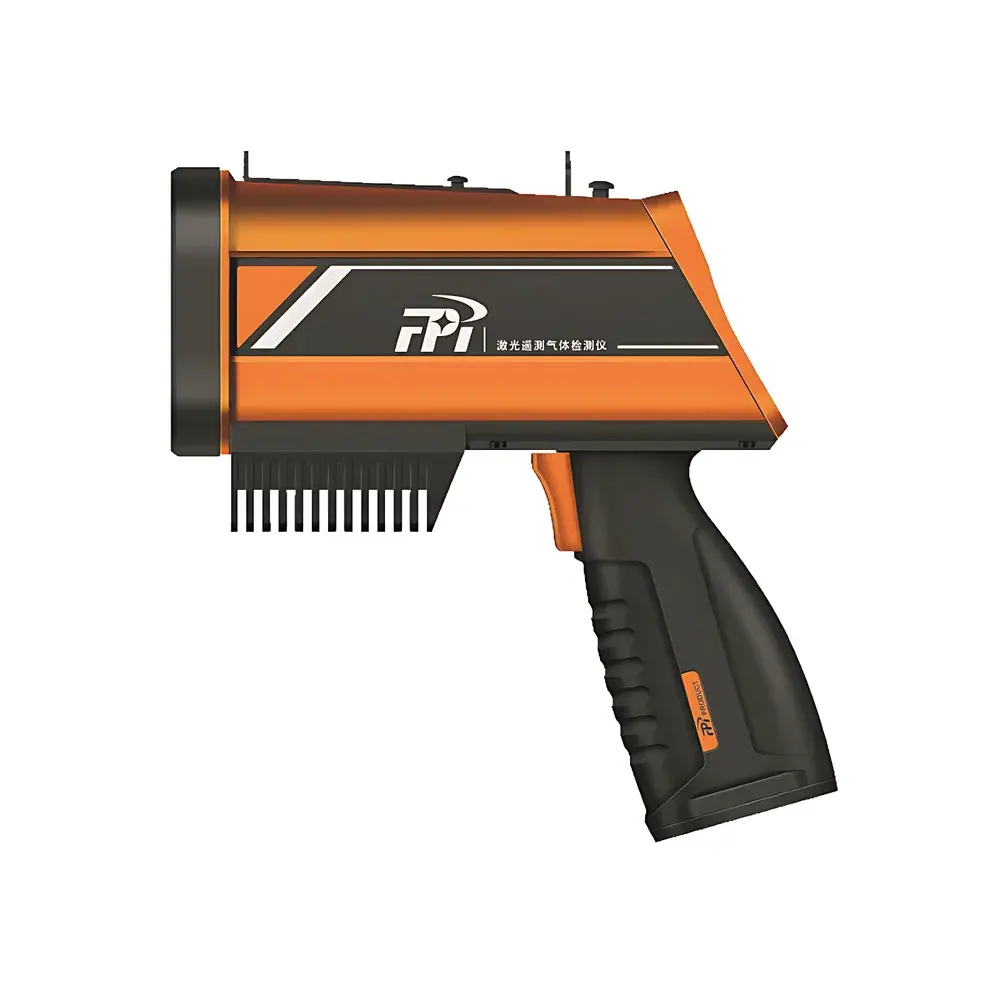
FPI LGRS-100 Laser Gas Remote Sensor
| Brand | FPI |
|---|---|
| Origin | Zhejiang, China |
| Manufacturer Type | Original Equipment Manufacturer (OEM) |
| Country of Origin | China |
| Model | LGRS-100 |
| Pricing | Available upon Request |
Overview
The FPI LGRS-100 Laser Gas Remote Sensor is a field-deployable, portable open-path optical analyzer engineered for real-time, non-contact detection and quantification of methane (CH₄) gas plumes at distances up to 100 meters. It operates on the principle of Tunable Diode Laser Absorption Spectroscopy (TDLAS), utilizing a narrow-linewidth distributed feedback (DFB) laser tuned precisely to a strong, isolated ro-vibrational absorption line of methane near 1653 nm. Unlike point-sampling or catalytic bead sensors, the LGRS-100 measures integrated column concentration—expressed in ppm·m—by analyzing the attenuation of backscattered laser light along an open optical path. This enables rapid identification of fugitive emissions without physical access to infrastructure, making it suitable for safety-critical, hard-to-reach, or hazardous environments where traditional contact-based methods are impractical or unsafe.
Key Features
- Open-path TDLAS architecture with inherent immunity to cross-interference from water vapor, CO₂, and common hydrocarbons
- Integrated dual-axis alignment system enabling rapid setup and stable beam pointing under field vibration or thermal drift
- Real-time signal processing unit with embedded digital lock-in amplification and baseline correction algorithms
- Ruggedized aluminum alloy housing rated IP65 for outdoor operation in ambient temperatures from −20 °C to +50 °C
- Low-power consumption design (6 hours via hot-swappable Li-ion packs
- Onboard GPS and inclinometer for georeferenced leak localization and path-length validation
- Modular interface architecture supporting RS485, Ethernet (TCP/IP), and optional 4–20 mA analog output for integration into SCADA or DCS systems
Sample Compatibility & Compliance
The LGRS-100 is specifically calibrated for methane detection in ambient air and is validated for use across natural gas infrastructure where CH₄ is the primary target analyte. It complies with ISO 16000-23 for indoor air quality monitoring methodology principles and aligns with ASTM D7922–20 for open-path optical gas detection performance evaluation. While not certified for SIL-rated safety instrumented systems (SIS), its design adheres to IEC 61508 functional safety guidelines for measurement subsystems. The instrument supports GLP-compliant data logging with timestamped, tamper-evident records and meets basic requirements for auditability under FDA 21 CFR Part 11 when used in regulated utility asset integrity programs.
Software & Data Management
The LGRS-100 ships with FPI’s proprietary GasView™ Desktop Suite, a Windows-based application enabling configuration, real-time visualization, spectral diagnostics, and post-processing of column density time-series. Raw spectral data (absorbance vs. wavenumber) and processed ppm·m values are stored in HDF5 format with embedded metadata including GPS coordinates, atmospheric pressure, temperature, and laser current telemetry. Export options include CSV, PDF reports, and KML overlays for GIS integration. Firmware updates and remote diagnostics are supported over secure SSH or TLS-enabled Ethernet connections. Audit trails record all user-initiated parameter changes, ensuring traceability in QA/QC workflows.
Applications
- Leak detection and quantification across urban gas distribution networks—including buried pipeline corridors, valve pits, and regulator stations
- Pre-commissioning and routine integrity verification at LNG receiving terminals, CNG refueling stations, and satellite liquefaction units
- Continuous perimeter monitoring of natural gas processing plants, compressor stations, and metering skids
- Compliance-driven LDAR (Leak Detection and Repair) surveys per EPA Method 21 and EU IED Annex VI requirements
- Emergency response screening during odor complaints, seismic events, or post-storm infrastructure assessment
- Research-grade emission flux estimation when coupled with wind speed profiles and dispersion modeling tools
FAQ
What does “ppm·m” mean, and how is it related to actual concentration?
ppm·m (parts-per-million-meter) represents the integrated column density—the product of average volumetric concentration (ppm) and effective optical path length (m). It is not a direct ppm value but enables comparative leak magnitude ranking and plume mapping. Conversion to localized ppm requires ancillary meteorological data and inverse dispersion modeling.
Can the LGRS-100 detect gases other than methane?
No. The LGRS-100 is factory-calibrated exclusively for methane using a fixed-wavelength DFB laser. Multi-gas capability would require hardware-level redesign with tunable lasers or multi-channel detector arrays.
Is calibration required in the field?
The instrument performs automatic zero-reference checks using internal reference cells and does not require routine span calibration. Annual verification against NIST-traceable methane standards is recommended for metrological continuity.
How is alignment maintained during extended deployment?
The dual-axis gimbal mount incorporates closed-loop position feedback and auto-reacquisition logic; minor misalignments due to thermal expansion or ground settlement are corrected autonomously within ±0.5° angular tolerance.
Does the system support ATEX or IECEx certification for Zone 1 use?
The standard LGRS-100 is rated for general industrial environments (non-hazardous area classification). Explosion-proof variants are available under separate model designation (LGRS-100-EX) with full IECEx/ATEX certification documentation.
Related Products