
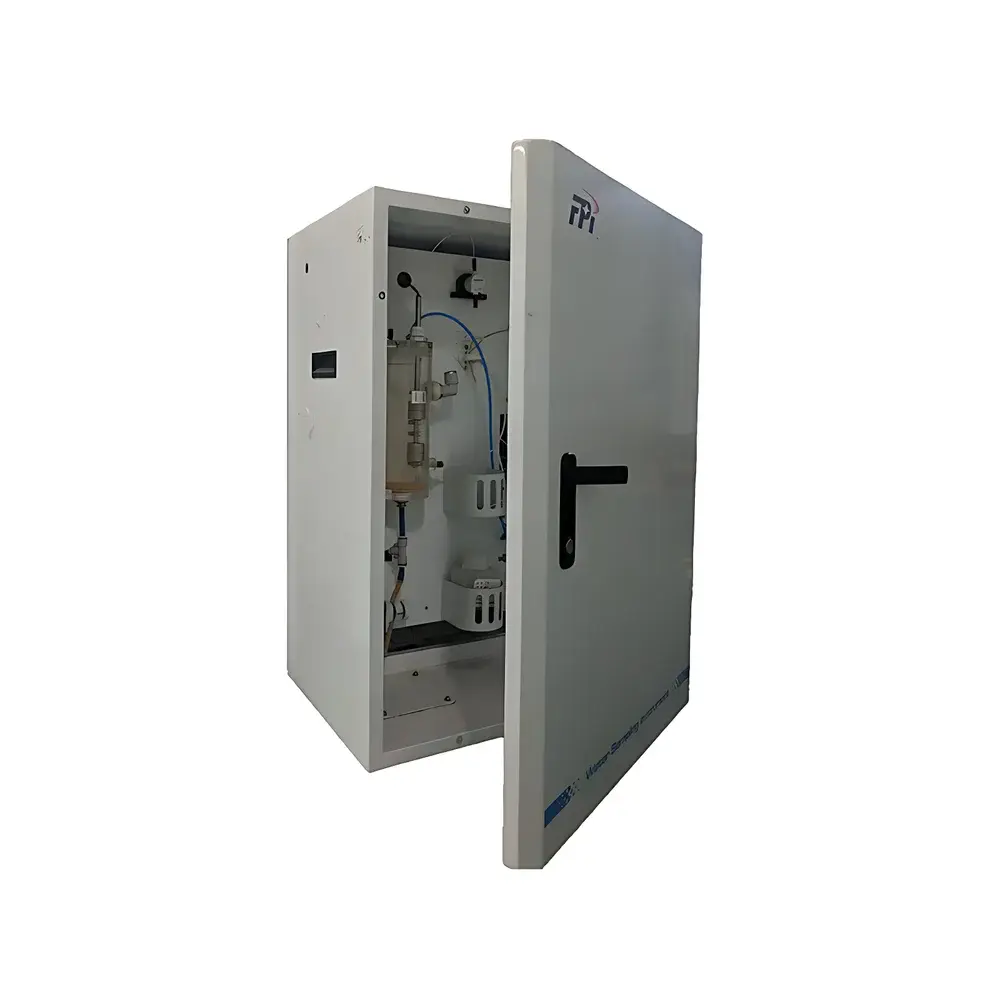
FPI QCD Series Remote Quality Control System for Online Water Quality Monitoring
| Brand | FPI |
|---|---|
| Origin | Zhejiang, China |
| Manufacturer Type | Original Equipment Manufacturer (OEM) |
| Country of Origin | China |
| Model | QCD |
| Pricing | Available Upon Request |
Overview
The FPI QCD Series Remote Quality Control System is an engineered solution designed to ensure data integrity and analytical validity in continuous online water quality monitoring environments. Operating on the principles of automated reference material introduction, standardized recovery testing, and parallel sample verification, the QCD system interfaces directly with installed online analyzers—including COD, NH3-N, TP, TN, heavy metal, and multi-parameter sensors—to perform independent, traceable quality control (QC) procedures without interrupting routine operation. Its architecture aligns with internationally recognized QC frameworks such as ISO/IEC 17025:2017 (General requirements for the competence of testing and calibration laboratories) and supports regulatory compliance under China’s “Environmental Monitoring Network Construction Plan” (2015), the “13th Five-Year Environmental Monitoring Quality Management Work Plan” (2016), and judicial interpretations governing environmental crime evidence admissibility (2016). The system does not measure water quality parameters itself; rather, it provides metrologically sound verification of analyzer performance through three core protocols: standard addition recovery, certified reference material (CRM) verification, and duplicate sample analysis.
Key Features
- Automated Standard Addition Recovery Workflow: Integrates precision peristaltic metering and gravimetrically calibrated injection to deliver exact volumes of certified standard solutions into representative process samples—enabling quantitative assessment of matrix interference and method accuracy per EPA Method 1664A and ISO 5667-16 guidelines.
- CRM-Based Verification Mode: Supports scheduled or on-demand injection of NIST-traceable or CNAS-accredited reference standards to validate instrument bias, drift, and linearity across operational ranges.
- Duplicate Sample Handling Capability: Automatically splits incoming sample streams into two identical aliquots for concurrent analysis by the primary online analyzer—providing real-time assessment of measurement repeatability (RSD ≤ 5% typical).
- Intelligent Liquid-Level Monitoring: Uses capacitive sensing and optical level detection to prevent dry-run operation, trigger low-sample alerts, and initiate fault-safe shutdown sequences.
- Multi-Protocol Digital Communication: Native RS-232 and RS-485 interfaces enable seamless integration with SCADA, DCS, and third-party data acquisition systems; supports Modbus RTU and custom ASCII command sets.
- Flexible Trigger Logic: Configurable via embedded controller for time-based, event-driven (e.g., analyzer cycle completion), or manual remote activation—ensuring QC execution aligns with site-specific QA/QC schedules.
Sample Compatibility & Compliance
The QCD system accommodates aqueous matrices across municipal wastewater, industrial effluent, and surface water applications—with compatibility verified for samples containing suspended solids ≤ 100 mg/L, turbidity ≤ 400 NTU, and pH 4–10. All fluid-contact components (tubing, valves, mixing chamber) are constructed from PTFE, PFA, and 316L stainless steel to resist chemical degradation and minimize adsorption artifacts. The system meets CE marking requirements for electromagnetic compatibility (EN 61326-1) and functional safety (IEC 61508 SIL 2). It supports audit-ready data logging aligned with GLP and GMP principles, including timestamped QC event records, operator ID tagging, and tamper-evident digital signatures for full chain-of-custody documentation.
Software & Data Management
Local operation is managed via a ruggedized 7-inch touchscreen HMI running embedded Linux, offering intuitive configuration of QC frequency, standard concentrations, volume ratios, and alarm thresholds. Remote supervision and historical data retrieval are enabled through OPC UA and MQTT protocols, allowing integration into centralized environmental data platforms (e.g., China’s National Environmental Monitoring Platform or enterprise LIMS). All QC results—including recovery percentages, CRM deviation values, and duplicate RSDs—are exported in CSV/Excel format with ISO 8601 timestamps. Audit trails comply with FDA 21 CFR Part 11 requirements for electronic records and signatures when deployed with validated server infrastructure.
Applications
- Quality assurance for continuous emission monitoring systems (CEMS) at industrial wastewater discharge points
- Regulatory compliance validation for municipal wastewater treatment plant (WWTP) effluent analyzers
- Data credibility enhancement in national surface water quality surveillance networks (e.g., Yangtze River Basin monitoring stations)
- Third-party verification services supporting environmental due diligence and ESG reporting
- Method validation support during analyzer commissioning, recalibration, or post-maintenance requalification
FAQ
Does the QCD system replace the primary online analyzer?
No—it functions exclusively as a quality control adjunct and does not perform primary parameter measurement.
Can the QCD verify multiple analyzers simultaneously?
Yes, up to four analyzers can be supported via programmable sample routing and multiplexed communication channels.
What calibration standards are required for QCD operation?
Certified reference materials (CRMs) accredited to ISO Guide 34 and traceable to NIST or BAM must be used for all verification and recovery tests.
Is remote firmware update capability available?
Yes—secure OTA (over-the-air) updates are supported via TLS-encrypted Ethernet or 4G LTE connections.
How is data security ensured during transmission?
All network communications employ AES-256 encryption; local storage uses write-once-read-many (WORM) partitioning to prevent unauthorized modification of QC logs.
Related Products







