
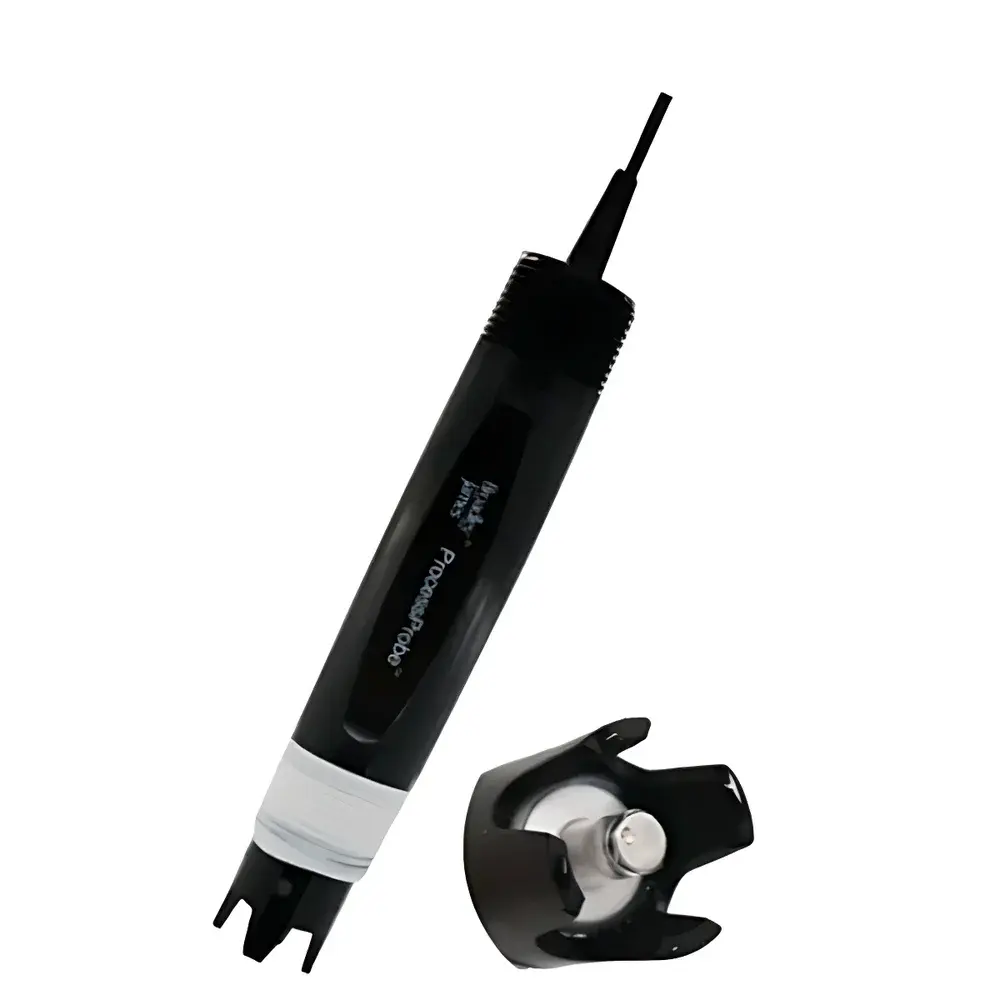
ORP-300 Online Oxidation-Reduction Potential Analyzer by EXPEC
| Brand | EXPEC |
|---|---|
| Origin | Zhejiang, China |
| Manufacturer Type | Authorized Distributor |
| Country of Origin | China |
| Model | ORP-300 |
| Pricing | Available Upon Request |
Overview
The EXPEC ORP-300 is a dedicated online oxidation-reduction potential (ORP) analyzer engineered for continuous, real-time monitoring of redox status in aqueous environments. Operating on the fundamental electrochemical principle of potentiometric measurement, the system consists of a rugged, submersible ORP sensor and a wall-mounted or panel-integrated transmitter. The sensor employs a noble-metal reference electrode (typically platinum or gold) paired with a stable Ag/AgCl reference element, enabling direct measurement of the millivolt-level potential difference between the sample solution and the internal reference—expressed in mV relative to the Standard Hydrogen Electrode (SHE). This voltage correlates directly with the electron activity in the solution and serves as a critical surrogate indicator for disinfection efficacy, chemical dosing control (e.g., chlorine, ozone, peroxide), and overall oxidative stress in water matrices. Designed for industrial robustness, the ORP-300 delivers high reproducibility under fluctuating flow, temperature, and ionic strength conditions typical of wastewater influent, reclaimed water distribution, and agricultural irrigation channels.
Key Features
- Two-way digital communication (RS-485 Modbus RTU) between transmitter and sensor eliminates analog signal degradation and supports cable runs up to 100 meters without repeaters;
- Three-point calibration via front-panel keypad with real-time electrode efficiency diagnostics—displaying polarization resistance and response time trends to support predictive maintenance;
- Automatic Temperature Compensation (ATC) using integrated Pt1000 thermistor; compensation algorithm conforms to DIN 38404-5 and ASTM D1293 standard practices;
- Independent high/low hysteresis adjustment for relay outputs—prevents chattering during setpoint transitions in dynamic effluent streams;
- Secure configuration access via dual-key combination (e.g., “Mode + Enter”) to prevent unauthorized parameter changes—supports audit-ready operational integrity;
- Optional solution grounding terminal mitigates stray current interference and electrochemical noise in electrically noisy environments such as pump stations or electroplating outfalls.
Sample Compatibility & Compliance
The ORP-300 is validated for use across a broad range of conductive aqueous media, including municipal and industrial wastewater (COD < 500 mg/L), tertiary-treated reclaimed water (TDS ≤ 2,000 µS/cm), and low-salinity irrigation sources (EC < 3 dS/m). Its IP68-rated sensor housing withstands prolonged submersion and mechanical abrasion from suspended solids. While not certified for explosive atmospheres (ATEX/IECEx), the system meets CE electromagnetic compatibility (EMC) Directive 2014/30/EU and RoHS 2011/65/EU requirements. Data logging and relay activation events comply with GLP principles when integrated with external SCADA systems supporting timestamped event records and user-access logs.
Software & Data Management
The transmitter supports native Modbus RTU output (holding registers for mV reading, temperature, calibration status, and relay states), enabling seamless integration into PLC-based process control architectures. Optional EXPEC DataBridge software (Windows-based) provides local configuration, trend visualization over 30-day rolling windows, and CSV export for QA/QC reporting. All calibration entries—including date, operator ID (manual entry), and measured mV values at each standard—are stored with write-protected timestamps. When deployed in regulated environments (e.g., ISO 14001-certified facilities or EPA NPDES-permitted dischargers), the system supports traceability through manual logbook correlation; full 21 CFR Part 11 compliance requires integration with validated third-party LIMS or historian platforms.
Applications
- Pollution Source Effluent Monitoring: Real-time ORP tracking at discharge points to verify oxidant residual levels prior to environmental release—supporting compliance with national discharge standards (e.g., China’s GB 8978-1996, US EPA NPDES limits);
- Water Reuse Systems: Closed-loop control of sodium hypochlorite dosing in greywater recycling networks, where ORP > +650 mV (vs. SHE) typically indicates adequate disinfection barrier performance;
- Agricultural Irrigation Management: Early detection of anaerobic soil leachate ingress or organic overload in surface-fed canals—abrupt ORP drops below +200 mV may signal onset of denitrification or sulfide generation;
- Biological Treatment Optimization: Correlation of ORP gradients across aerobic/anoxic zones in MBR or SBR basins to fine-tune dissolved oxygen setpoints and carbon dosing strategies.
FAQ
What reference electrode system does the ORP-300 sensor use?
The sensor integrates a double-junction Ag/AgCl reference electrode with ceramic junction and KCl electrolyte gel—designed to minimize liquid junction potential drift in variable salinity conditions.
Is automatic temperature compensation mandatory for accurate ORP readings?
Yes—temperature affects both electrode kinetics and Nernst slope sensitivity; ATC is enabled by default and cannot be disabled in field operation.
Can the ORP-300 be used in seawater or high-TDS brines?
Not recommended—standard configuration is rated for TDS ≤ 5,000 mg/L; extended-range variants with titanium body and specialized reference fill solution are available under EXPEC ORP-300-H series.
How frequently should calibration be performed?
Initial calibration before commissioning; thereafter, verification every 7–14 days in stable applications, or daily in high-fouling or highly variable redox environments—per ISO 5667-22 guidance.
Does the transmitter support analog 4–20 mA output in addition to Modbus?
Yes—configurable isolated 4–20 mA output (HART-enabled option) is available for legacy DCS interfacing, with user-defined scaling (e.g., −1000 to +1000 mV).
Related Products







