
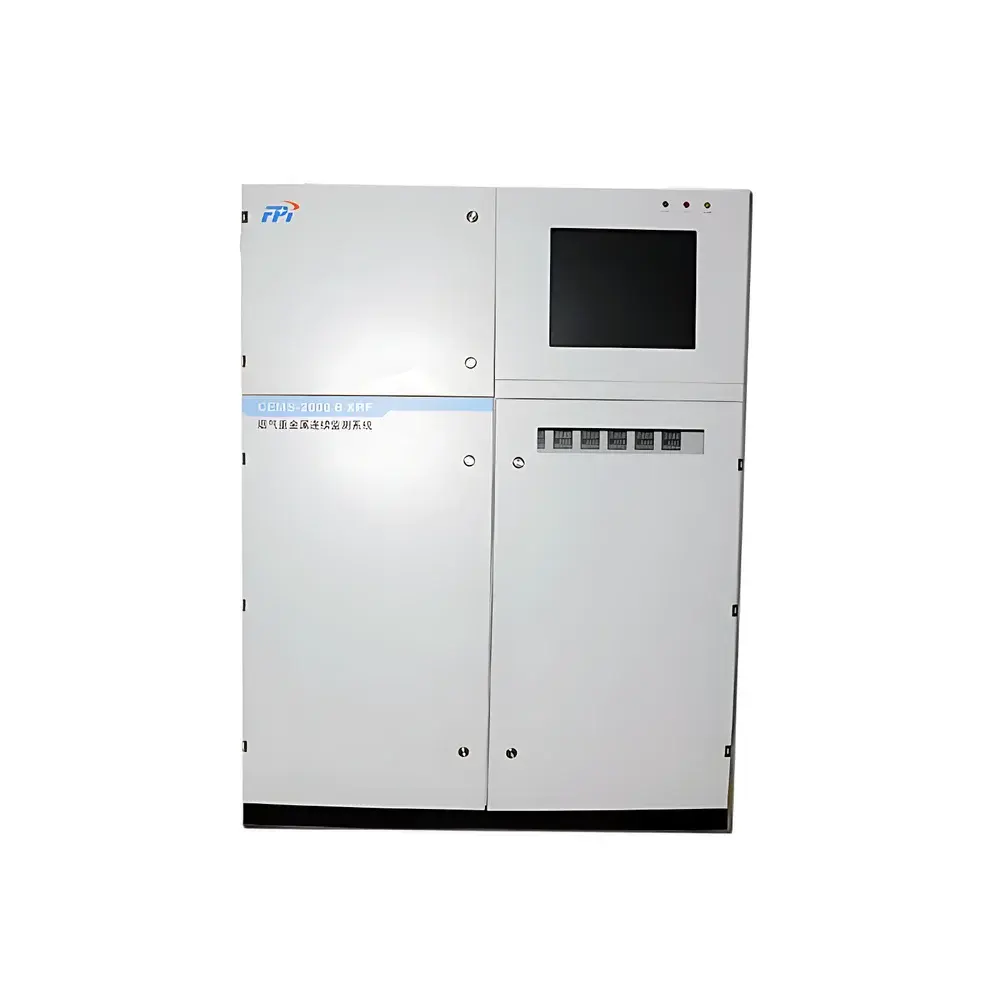
FPI CEMS-2000B XRF Atmospheric Heavy Metal Continuous Emission Monitoring System
| Brand | FPI (Focus Photonics Inc.) |
|---|---|
| Origin | Zhejiang, China |
| Manufacturer Type | Original Equipment Manufacturer (OEM) |
| Product Category | Flue Gas Heavy Metal Analyzer |
| Measurement Principle | Energy-Dispersive X-Ray Fluorescence (ED-XRF) |
| Elemental Coverage | Pb, Hg, Cr, Cd, As, and up to 26 heavy metals (expandable via spectral library calibration) |
| Detection Limit | < 0.1 µg/m³ (for key elements under ISO 14927-compliant sampling conditions) |
| Filter Replacement Interval | ≥ 30 days (typical, dependent on particulate loading) |
| Operating Ambient Temperature | 0–40 °C |
| Operating Ambient Humidity | 10–90 % RH (non-condensing) |
| Operating Ambient Pressure | 86–106 kPa |
| Compliance | Meets China’s HJ 1131–2020 and EU EN 14385 technical requirements for continuous heavy metal emission monitoring |
Overview
The FPI CEMS-2000B XRF Atmospheric Heavy Metal Continuous Emission Monitoring System is an industrial-grade, in-situ flue gas analyzer engineered for regulatory-grade compliance and long-term unattended operation. It employs energy-dispersive X-ray fluorescence (ED-XRF) spectroscopy — a non-destructive, multi-element analytical technique — to quantify trace-level heavy metal concentrations directly in stack emissions. Unlike wet-chemical or atomic absorption-based methods, ED-XRF requires no sample digestion, reagents, or consumable gases, eliminating chemical waste streams and reducing operational overhead. The system draws isokinetic flue gas samples through a heated probe (typically maintained at >180 °C to prevent condensation and adsorption losses), filters particulates onto a rotating quartz or PTFE membrane, and performs real-time elemental quantification via high-resolution silicon drift detector (SDD) acquisition. Its measurement cycle — from sampling to spectral deconvolution and concentration reporting — is completed within ≤ 60 minutes per analysis interval, supporting both regulatory hourly averaging and sub-hourly trend tracking.
Key Features
- Multi-element capability: Simultaneous quantification of up to 26 regulated heavy metals (including Hg, Pb, Cd, Cr, As, Ni, Zn, Cu, Mn, Sb, Se, Co, V, Mo, Sn, Tl, Be, Ba, Sr, Bi, Te, Ag, Au, Pt, Pd, and Ir) using factory-calibrated spectral libraries and matrix-matched reference standards.
- Low detection sensitivity: Achieves sub-0.1 µg/m³ detection limits for priority metals (e.g., Pb, Cd, As) under representative flue gas matrices (≤ 10 g/m³ dust load, ≤ 15 % O₂, ≤ 12 % H₂O), validated per ISO/IEC 17025-accredited inter-laboratory comparison protocols.
- Minimal sample conditioning: Integrated heated sampling line and filter module eliminate need for dilution, scrubbing, or cryogenic trapping — preserving volatile species such as Hg⁰ and organometallic compounds.
- Modular architecture: Comprises independent subsystems — probe assembly, heated transport line, filtration unit, XRF measurement chamber, and control/data module — enabling field serviceability, staged commissioning, and retrofit integration into existing CEMS infrastructure.
- Self-diagnostic firmware: Embedded health-monitoring algorithms continuously validate X-ray tube output stability, detector resolution (FWHM ≤ 140 eV at Mn Kα), filter positioning accuracy, and flow calibration integrity; alerts trigger automated log entries and remote notification via Modbus TCP or OPC UA.
Sample Compatibility & Compliance
The CEMS-2000B XRF system is validated for use across diverse combustion and industrial process exhaust streams, including coal-fired boiler flue gas (with ESP or fabric filter upstream), sintering machine emissions, secondary lead smelter off-gas, municipal solid waste incinerator (MSWI) ducts, hazardous waste thermal treatment stacks, and chemical manufacturing reactor vents. It complies with national and international regulatory frameworks governing heavy metal emissions: China’s HJ 1131–2020 “Technical Specification for Continuous Monitoring of Heavy Metals in Flue Gas”, EU BREF documents for Waste Incineration (WI-BREF) and Non-Ferrous Metals (NFM-BREF), and aligns with the measurement performance criteria outlined in EN 14385:2021 “Air Quality — Determination of Metals in Ambient Air — XRF Method”. All data outputs are timestamped, audit-trail enabled, and support GLP/GMP-aligned electronic record retention per 21 CFR Part 11 when integrated with validated data acquisition software.
Software & Data Management
The system operates with FPI’s proprietary CEMS-View™ control and analysis suite, deployed on an embedded Linux platform with dual Ethernet ports (one for plant DCS integration, one for secure remote access). The interface supports multilingual configuration (English, Chinese, Spanish), real-time spectral visualization, automatic peak identification using fundamental parameter (FP) modeling, and dynamic background subtraction. Data export formats include CSV, XML, and MODBUS register mapping compatible with Siemens Desigo, Honeywell Experion, and Yokogawa CENTUM VP DCS systems. Historical datasets are stored locally (≥ 18 months at 15-min resolution) and synchronized to cloud-hosted platforms via TLS 1.2–encrypted MQTT or HTTPS endpoints. Audit logs capture all user actions, calibration events, maintenance interventions, and system alarms — fully traceable for environmental agency inspections.
Applications
This analyzer serves as a primary compliance tool for facilities subject to stringent heavy metal emission limits under national air quality standards and industrial permitting regimes. Key deployment sectors include: primary and secondary non-ferrous metal smelters (Pb, Zn, Cu); lead-acid battery recycling plants; coal-fired power generation units equipped with flue gas desulfurization (FGD) and selective catalytic reduction (SCR); cement kilns co-processing hazardous waste; medical and municipal waste incinerators; chemical synthesis facilities handling catalyst metals (e.g., Ni, Cr, V); and metallurgical roasting operations. It is also employed in research settings for source apportionment studies, process optimization, and validation of abatement device efficiency (e.g., activated carbon injection + baghouse performance).
FAQ
Does the system require daily calibration or standard gas injections?
No. The ED-XRF method relies on physical constants and stable detector response; calibration is performed quarterly using certified multi-element thin-film standards traceable to NIST SRM 2783. Drift correction is applied automatically using internal reference peaks (e.g., Fe Kα from ambient iron oxide particulates).
Can it measure elemental mercury (Hg⁰) in gaseous phase without oxidation?
Yes. Because the heated sampling path preserves volatile species and the XRF excitation detects total mercury regardless of speciation, the system reports total Hg mass concentration — consistent with EN 14884 and HJ 1131–2020 requirements for stack monitoring.
Is the system suitable for high-dust environments (>5 g/m³)?
Yes. The rotating filter design ensures uniform particulate loading and minimizes clogging; optional ceramic pre-filters and back-pulse cleaning modules are available for extreme-duty applications.
How does it interface with third-party environmental data management platforms (e.g., China’s National Emission Trading System)?
Via standardized API (RESTful JSON) and protocol gateways (Modbus TCP, OPC UA), supporting mandatory data upload formats defined by local EPAs and national monitoring networks.
What is the typical mean time between failures (MTBF) under continuous operation?
≥ 8,500 hours (≥ 12 months), based on field data from over 220 installed units across China and Southeast Asia, with X-ray tube lifetime exceeding 20,000 operating hours.







