
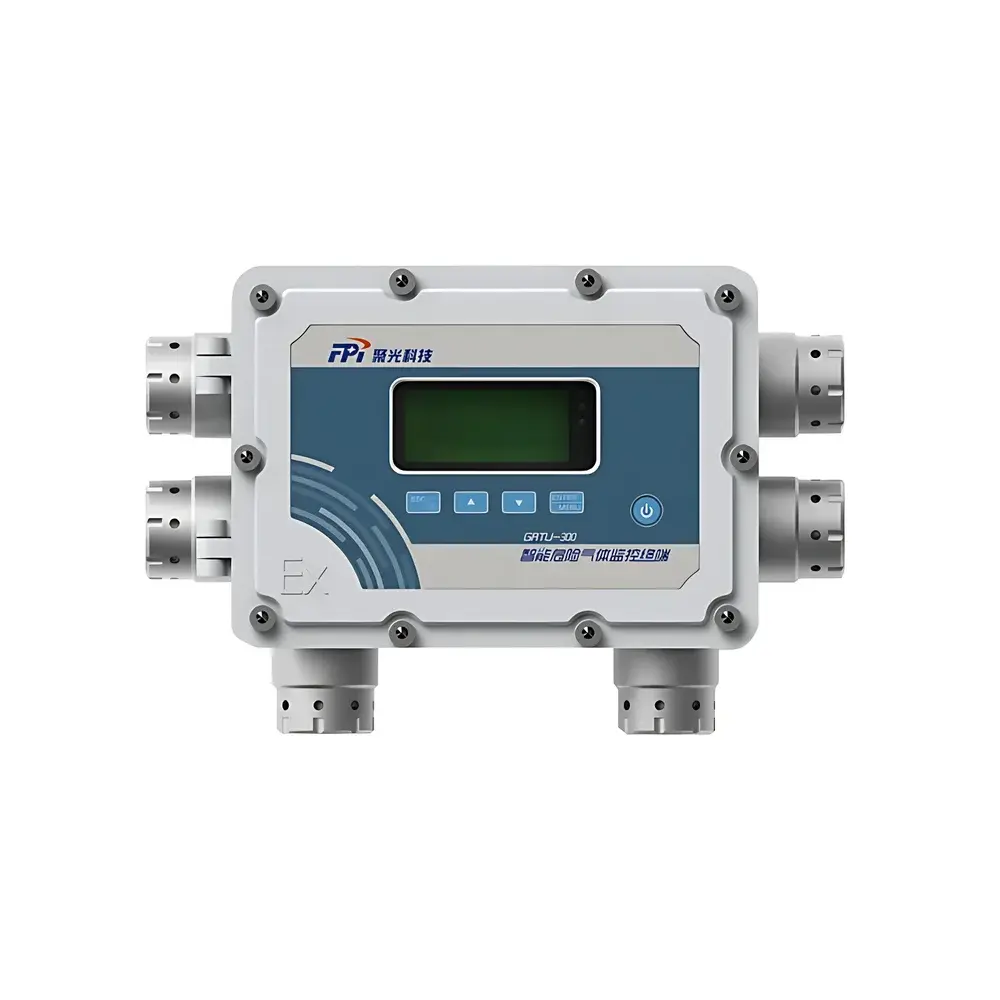
FPI GRTU-200-YG Intelligent Remote Gas Monitoring Terminal
| Brand | FPI |
|---|---|
| Origin | Zhejiang, China |
| Manufacturer Type | OEM/ODM Producer |
| Country of Origin | China |
| Model | GRTU-200-YG |
| Pricing | Upon Request |
Overview
The FPI GRTU-200-YG Intelligent Remote Gas Monitoring Terminal is an autonomous, field-deployable environmental sensing platform engineered for continuous, real-time detection and telemetry of hazardous gaseous emissions in industrial perimeters—particularly chemical industrial parks and their surrounding ambient air zones. Operating on the principle of electrochemical and/or metal-oxide semiconductor (MOS) gas sensing—depending on configured sensor modules—the terminal delivers quantitative concentration measurements for up to six target gases simultaneously, including but not limited to H₂S, Cl₂, NH₃, SO₂, CO, and VOCs (volatile organic compounds). Its embedded telemetry architecture integrates dual-mode positioning (GPS + GLONASS) and GPRS-based cellular communication to transmit time-stamped concentration data, device health metrics, and georeferenced coordinates at user-configurable intervals (e.g., 1–60 minutes) to a centralized cloud or on-premise data acquisition server. Designed for unattended operation in harsh outdoor environments (IP65-rated enclosure, -30 °C to +60 °C operational range), the GRTU-200-YG supports long-term deployment without grid connectivity, relying on its internal rechargeable lithium battery pack with >12 months runtime under standard duty cycle (15-minute reporting interval, 80% sensor active time).
Key Features
- Integrated multi-gas detection: Supports simultaneous measurement of up to six gases via plug-and-play sensor cartridges; individual sensors calibrated traceably to NIST-traceable standards.
- Autonomous power management: Built-in high-capacity lithium iron phosphate (LiFePO₄) battery system with intelligent low-power sleep mode; typical service life exceeds 12 months between charges under nominal reporting frequency.
- Robust environmental resilience: Die-cast aluminum housing with IP65 ingress protection; operating temperature range certified from –30 °C to +60 °C; anti-corrosion coating suitable for coastal or high-humidity installations.
- Geospatial intelligence: Dual-satellite GNSS receiver (GPS + GLONASS) providing <5 m CEP horizontal accuracy; configurable geofencing capability triggers alert notifications upon unauthorized physical displacement.
- Local human-machine interface: Backlit monochrome LCD display (128 × 64 pixels) with tactile membrane keypad; full Chinese-language UI compliant with GB/T 22239–2019 information security guidelines for environmental monitoring systems.
- Secure over-the-air (OTA) firmware update support: AES-128 encrypted channel for remote configuration and software maintenance without site visit.
Sample Compatibility & Compliance
The GRTU-200-YG is validated for ambient air sampling in open-path and point-source proximity scenarios. It complies with China’s HJ 654–2013 technical specification for ambient air quality monitoring instruments and meets electromagnetic compatibility (EMC) requirements per GB/T 17626 series. While primarily deployed in domestic regulatory frameworks (e.g., MEP Order No. 8, “Regulations on Environmental Monitoring Data Quality Management”), its data structure aligns with ISO 14001:2015 Annex A.3.2 (environmental performance evaluation) and supports audit-ready logging for GLP-aligned operations. Sensor cross-sensitivity profiles are documented per IEC 60079-29-1 for use in non-explosive atmospheres (Zone 2 / Class I, Division 2 equivalent); intrinsic safety certification (Ex ib IIC T4 Ga) is available upon request for hazardous area variants.
Software & Data Management
Data from the GRTU-200-YG is ingested via MQTT or HTTP(S) protocols into FPI’s proprietary EIS-Cloud™ Environmental Intelligence Suite. The platform provides role-based access control (RBAC), automated baseline drift correction, and temporal interpolation algorithms for gap-filling. All data transactions—including sensor calibration logs, GPS position history, and battery voltage trends—are stored with immutable timestamps and SHA-256 hash integrity verification. Audit trails comply with ISO/IEC 17025:2017 clause 7.10.2 for data integrity and are exportable in CSV/NetCDF formats for third-party modeling (e.g., CALPUFF dispersion simulation input). Optional integration with SCADA systems via Modbus TCP or OPC UA enables interoperability with existing plant-wide control infrastructure.
Applications
- Perimeter air quality monitoring for chemical industrial parks under China’s “Three-Year Action Plan for Preventing and Controlling Pollution from Hazardous Chemicals” (2023–2025).
- Early-warning surveillance of fugitive emissions near storage tanks, loading docks, and pipeline transfer stations.
- Post-incident plume tracking following accidental releases, supporting emergency response coordination via GIS-integrated alert dashboards.
- Long-term trend analysis of background VOC levels in sensitive receptor zones (e.g., residential buffers, ecological conservation areas).
- Compliance reporting for local生态环境 bureaus under HJ 193–2013 (Ambient Air Quality Monitoring Technical Guidelines).
FAQ
What gases can the GRTU-200-YG detect out of the box?
The base configuration includes sensors for H₂S, CO, O₂, NO₂, SO₂, and combustible gas (LEL); custom sensor combinations are available upon specification.
Is the device certified for use in explosion-hazardous areas?
Standard units are rated for non-hazardous locations (IP65); ATEX/IECEx-certified versions with intrinsic safety barriers are offered as optional SKUs.
How is calibration performed and how often is it required?
Field calibration uses span gas bottles traceable to CNAS-accredited reference standards; recommended interval is every 3–6 months depending on exposure conditions and regulatory requirements.
Can the terminal integrate with existing enterprise environmental management systems?
Yes—via RESTful API, MQTT, or Modbus TCP; documentation and SDKs are provided for IT department-level integration.
Does the system support remote diagnostics and troubleshooting?
All units report diagnostic codes (e.g., sensor timeout, GPS lock failure, low-battery warning) in real time; remote reboot and sensor reinitialization are supported through the EIS-Cloud™ portal.







