
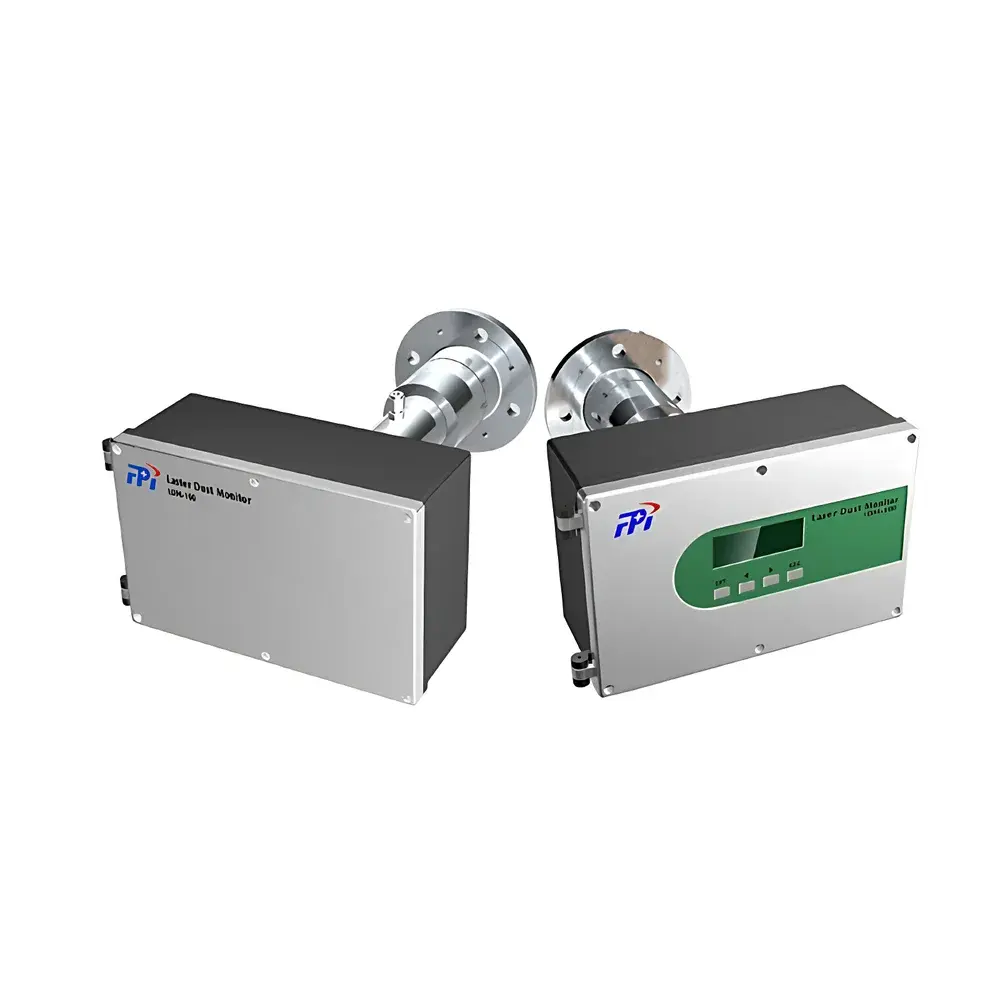
FPI LDM-100 In-Situ Laser Dust Monitor
| Brand | FPI |
|---|---|
| Origin | Zhejiang, China |
| Manufacturer Type | Original Equipment Manufacturer (OEM) |
| Product Category | Domestic |
| Model | LDM-100 |
| Instrument Type | In-Situ Optical Transmissometer for Particulate Emissions Monitoring |
| Extinction Accuracy | ±0.004 |
| Repeatability | ≤2% |
| Response Time | 1–600 s (configurable) |
| Stability | Transmittance/Turbidity ±1% |
| Compliance | Meets GB/T 16157, HJ 76–2017, and HJ 836–2017 requirements for fixed-source emission monitoring |
Overview
The FPI LDM-100 In-Situ Laser Dust Monitor is an optical transmissometer engineered for continuous, real-time measurement of particulate mass concentration in flue gas streams from stationary emission sources. It operates on the principle of laser extinction photometry—where a collimated near-infrared (NIR) laser beam traverses the duct or stack, and the attenuation of beam intensity is quantified to derive extinction coefficient, transmittance, and—via calibrated empirical or Mie-theory-based algorithms—mass concentration of suspended particulates (typically PM10–PM100). Unlike extractive sampling systems, the LDM-100 employs true in-situ measurement: the transmitter and receiver units are mounted directly across the flue, eliminating sample conditioning losses, transport delay, and phase separation artifacts. This architecture ensures high fidelity for applications involving sticky, hygroscopic, or high-temperature dusts—common in cement kilns, coal-fired boilers, waste incinerators, and metallurgical furnaces.
Key Features
- In-situ dual-beam optical design with integrated alignment verification, enabling rapid field commissioning and long-term drift compensation.
- High-stability NIR laser source (850 nm) with automatic power regulation to maintain signal integrity under varying ambient temperatures (−20 °C to +60 °C operating range).
- Integrated local human-machine interface (HMI) on the probe housing, supporting real-time display of extinction, transmittance, and derived concentration; no external controller required for basic operation.
- Modular mechanical architecture: optical head, purge air interface, and electronics compartment are independently serviceable—reducing mean time to repair (MTTR) and enabling hot-swap replacement during scheduled maintenance windows.
- Configurable purge air system (compressed air or instrument-grade nitrogen) with flow monitoring and pressure interlock, preventing lens fouling in high-dust or humid environments.
- Embedded auto-calibration routine using reference path length and zero-air baseline validation—performed at user-defined intervals without manual intervention.
Sample Compatibility & Compliance
The LDM-100 is validated for use in flue gas streams with temperatures up to 200 °C (optional high-temp variant supports 300 °C), gas velocities ≤30 m/s, and dust loadings ranging from 1 mg/m³ to 10 g/m³ (standard range). It maintains metrological performance in presence of condensable vapors, alkaline aerosols, and fly ash with particle size distributions dominated by 1–50 µm aerodynamic diameter. The instrument conforms to Chinese national standards GB/T 16157–1996 (determination of particulate matter in exhaust gases), HJ 76–2017 (technical specification for continuous emission monitoring systems), and HJ 836–2017 (determination of low-concentration particulate matter in exhaust gas—gravimetric method). While not certified to EN 15267 or US EPA PS-11, its measurement uncertainty profile aligns with Tier 2 CEMS performance criteria per ISO 14064-3 and supports GLP-aligned data integrity when deployed with audit-trail-enabled data acquisition systems.
Software & Data Management
The LDM-100 communicates via RS-485 (Modbus RTU) and optional Ethernet (TCP/IP) interfaces, enabling seamless integration into existing DCS, SCADA, or CEMS platforms. Firmware supports configurable analog outputs (4–20 mA) for extinction, transmittance, and concentration channels, each with independent zero/span scaling. Internal data logging stores ≥30 days of 1-minute averaged records (extinction, transmittance, temperature, purge pressure, system status) with timestamping traceable to UTC. Optional FPI CEMS Manager software provides remote configuration, diagnostic trending, calibration history archiving, and PDF report generation compliant with HJ 75–2017 documentation requirements. All configuration changes and calibration events are logged with user ID, timestamp, and pre/post values—supporting 21 CFR Part 11–aligned audit trails when deployed on validated IT infrastructure.
Applications
- Continuous compliance monitoring of particulate emissions from coal- and biomass-fired power plants, per national emission limits (e.g., ≤10 mg/m³ for ultra-low-emission retrofits).
- Process optimization feedback in electrostatic precipitator (ESP) and fabric filter (FF) control loops—enabling dynamic voltage or pulse-jet scheduling based on real-time opacity trends.
- Performance verification of flue gas desulfurization (FGD) and selective catalytic reduction (SCR) systems where particulate carryover indicates upstream operational deviation.
- Stack testing support during Method 5/17 equivalency studies, serving as a reference optical monitor alongside gravimetric samplers.
- Environmental impact assessment (EIA) baseline surveys and fugitive emission hotspot mapping in industrial parks using mobile mounting kits.
FAQ
Does the LDM-100 require periodic factory recalibration?
No—field recalibration is performed via built-in zero-reference and span-check routines using clean air and certified optical attenuators; annual verification against NIST-traceable standards is recommended but not mandatory for regulatory compliance.
Can it operate in explosive atmospheres?
Not natively—the standard unit carries IP66 ingress protection but lacks ATEX/IECEx certification; explosion-proof enclosures or purged cabinets must be supplied by the end user per local hazardous area classification.
Is Mie scattering correction applied in concentration calculation?
Yes—firmware includes selectable particle refractive index presets (e.g., carbonaceous, silicate, sulfate) and supports user-defined complex refractive index inputs for improved accuracy in non-standard aerosol matrices.
What is the minimum detectable extinction change?
The system resolution is 0.001 extinction units, corresponding to <1 mg/m³ detection limit for typical coal fly ash under 1-meter optical path length and stable flow conditions.
How is alignment maintained during thermal expansion of the duct?
The dual-axis motorized alignment system automatically compensates for angular drift up to ±1.5°, with closed-loop feedback from quadrant photodiode signals—no manual re-alignment needed during normal thermal cycling.
Related Products







