
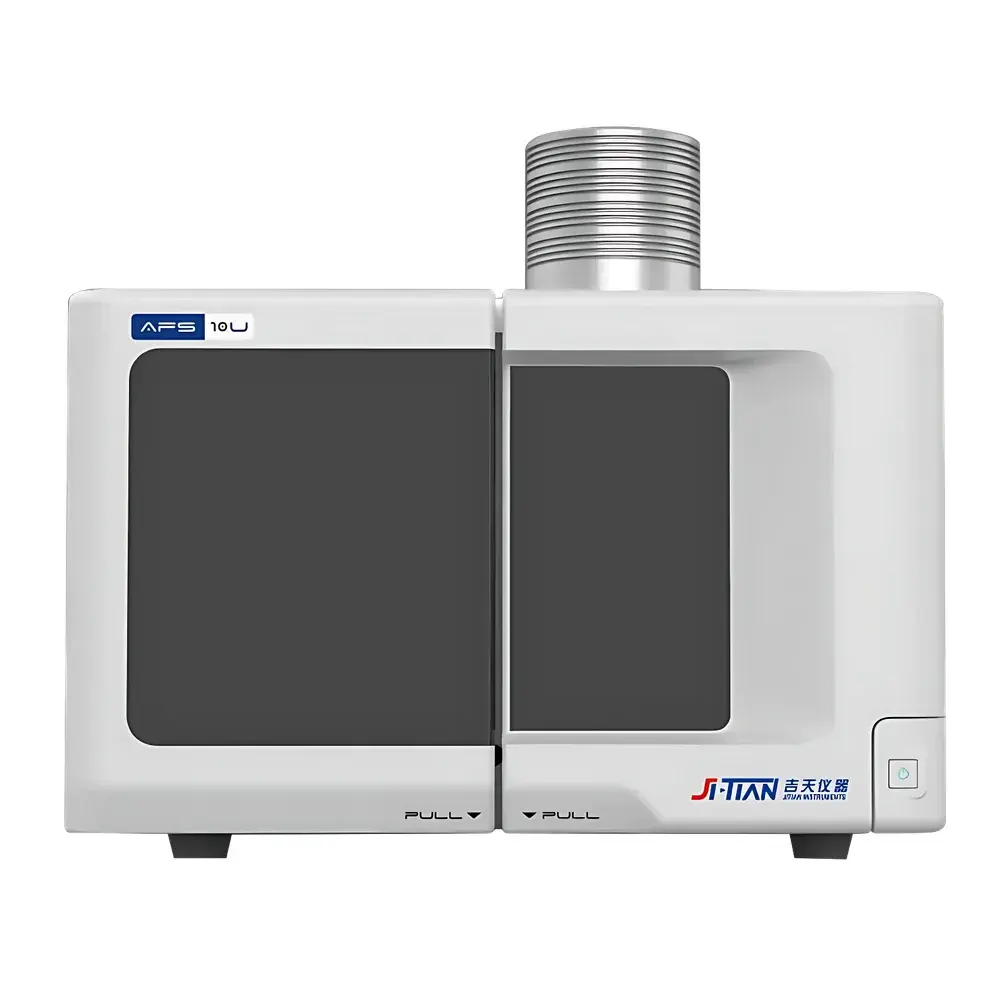
Titan Instruments AFS-10U Intermittent Pump Atomic Fluorescence Spectrometer
| Brand | Titan Instruments |
|---|---|
| Origin | Beijing, China |
| Model | AFS-10U |
| Instrument Type | Multi-channel Atomic Fluorescence Spectrometer |
| Sample Introduction | Peristaltic Pump |
| Waste Disposal | Rear Exhaust Design |
| Hydride Generation Mode | Vapor Generation / Hydride Generation |
| Gas Flow Control | Mass Flow Controller |
| Detectable Elements | As, Sb, Bi, Sn, Se, Te, Pb, Ge, Hg, Cd, Zn |
| Relative Standard Deviation (RSD) | <0.6% |
| Linear Dynamic Range | >3 orders of magnitude |
| Detection Limits | As, Sb, Se, Bi, Te, Hg, Sn, Pb < 0.01 µg/L |
| PMT Wavelength Range | 160–320 nm |
| Atomizer Temperature Control | Yes |
Overview
The Titan Instruments AFS-10U Intermittent Pump Atomic Fluorescence Spectrometer is a high-performance, multi-channel analytical instrument engineered for trace-level quantification of hydride-forming elements in environmental, food, clinical, and industrial matrices. It operates on the principle of atomic fluorescence spectroscopy (AFS), wherein analyte species—pre-reduced to volatile hydride forms (e.g., AsH3, Hg0, SeH2)—are swept into a quartz atomizer, atomized in a hydrogen–argon flame or quartz furnace, and excited by a high-intensity hollow cathode lamp (HCL) or electrodeless discharge lamp (EDL). The resulting element-specific fluorescence emission is detected orthogonally using a low-noise photomultiplier tube (PMT) with spectral response optimized from 160 nm to 320 nm. Designed for compliance with international regulatory frameworks—including US EPA Method 7062, ISO 17294-2, and Chinese national standards such as GB 5009.11–2014, GB 5009.17–2021, and HJ 694–2014—the AFS-10U delivers robust performance in routine quality control and accredited laboratory workflows.
Key Features
- Intermittent peristaltic pump with integrated six-roller head and uniform pressure block design—ensures precise, pulse-free reagent delivery and enhances hydride generation efficiency and reproducibility.
- High-speed sampling circuitry operating at up to 500 Hz—minimizes inter-channel crosstalk and improves temporal resolution during dual- or multi-channel simultaneous detection.
- Drift-compensated soft calibration algorithm—dynamically corrects baseline drift without manual recalibration, sustaining long-term measurement stability over extended run times.
- Dual-core ARM + FPGA main control architecture with distributed microcontroller units (MCUs)—enables parallel real-time management of fluidics, gas flow, lamp power, and signal acquisition, significantly improving system reliability and fault tolerance.
- Mass flow controller (MFC)-based gas regulation—provides accurate, programmable, and stable carrier gas (Ar/H2) flow across all operational modes, critical for consistent atomization and fluorescence yield.
- Intelligent preheating protocol and dual-lamp auto-ignition—reduces startup delay and extends lamp service life; lamp usage time is logged and tracked for preventive maintenance scheduling.
- Overflow-sensing waste reservoir with software-triggered alert—supports unattended operation and ensures safe handling of corrosive digestates and reaction byproducts.
Sample Compatibility & Compliance
The AFS-10U accommodates liquid samples prepared via standard acid digestion (e.g., HNO3/HCl/HF), microwave-assisted digestion (per HJ 680–2013 and HJ 702–2014), or direct hydride generation from aqueous extracts. It supports analysis of solid matrices including soils, sediments, biological tissues, and pharmaceutical excipients following validated sample preparation protocols. Instrumental performance meets or exceeds requirements specified in multiple regulatory methods: GB/T 22105–2008 (soil As/Hg/Pb), HJ 1133–2020 (ambient particulate matter), HJ 694–2014 (aqueous Hg/As/Se/Bi/Sb), and GB 5009.17–2021 (food total and organic mercury). Data integrity complies with GLP and GMP principles; audit trail, user role-based access control, and electronic signature support align with FDA 21 CFR Part 11 readiness.
Software & Data Management
Titan’s proprietary AFS Control Suite provides a modular, Windows-based interface with customizable UI themes, method templating, and hierarchical project organization. The software implements guided workflow wizards for method setup, calibration, and validation—reducing operator dependency and training overhead. Real-time signal visualization, automatic peak integration, and QC flagging (e.g., signal-to-noise ratio, carryover check) are embedded at acquisition level. All analytical events—including method execution, parameter changes, user logins, and result exports—are timestamped and immutably archived within an encrypted database. Remote monitoring and scheduled wake-up with auto-preheat sequence enable lights-out operation in centralized lab environments.
Applications
The AFS-10U serves laboratories engaged in regulatory testing and research across diverse sectors: routine monitoring of arsenic and mercury in drinking water (per WHO and EPA guidelines); speciation-ready analysis of seafood, rice, and infant formula for inorganic As and methylmercury precursors; heavy metal screening in urban wastewater and landfill leachates; quality assurance of catalysts, alloys, and semiconductor-grade reagents; elemental profiling in botanicals, cosmetics, and animal feed; and method development in academic and governmental research institutes. Its expandable architecture supports future integration with LC-AFS hyphenated systems for As(III)/As(V), Hg(II)/MeHg, and Se(IV)/Se(VI) separation.
FAQ
What hydride-forming elements can the AFS-10U quantify with sub-pptr detection capability?
The instrument achieves detection limits below 0.01 µg/L for As, Sb, Se, Bi, Te, Hg, Sn, and Pb under optimized hydride generation conditions.
Is the AFS-10U compatible with automated sample introduction?
Yes—it supports optional 160-position or 212-position autosamplers for fully unattended batch analysis.
Can the system be upgraded for elemental speciation analysis?
Yes—the rear-panel RS-232 port is pre-wired for coupling with HPLC modules; certified application notes for As, Hg, and Se speciation are available upon request.
Does the software support 21 CFR Part 11 compliance?
The audit trail, electronic signatures, and permission hierarchy meet core technical requirements; full validation documentation is provided for IQ/OQ/PQ execution.
What maintenance intervals are recommended for the peristaltic pump tubing and atomizer?
Pump tubing should be inspected every 200 runs and replaced every 500–800 runs depending on acid concentration; quartz atomizers typically require cleaning after 100–150 analyses and replacement every 12–18 months under continuous use.





