
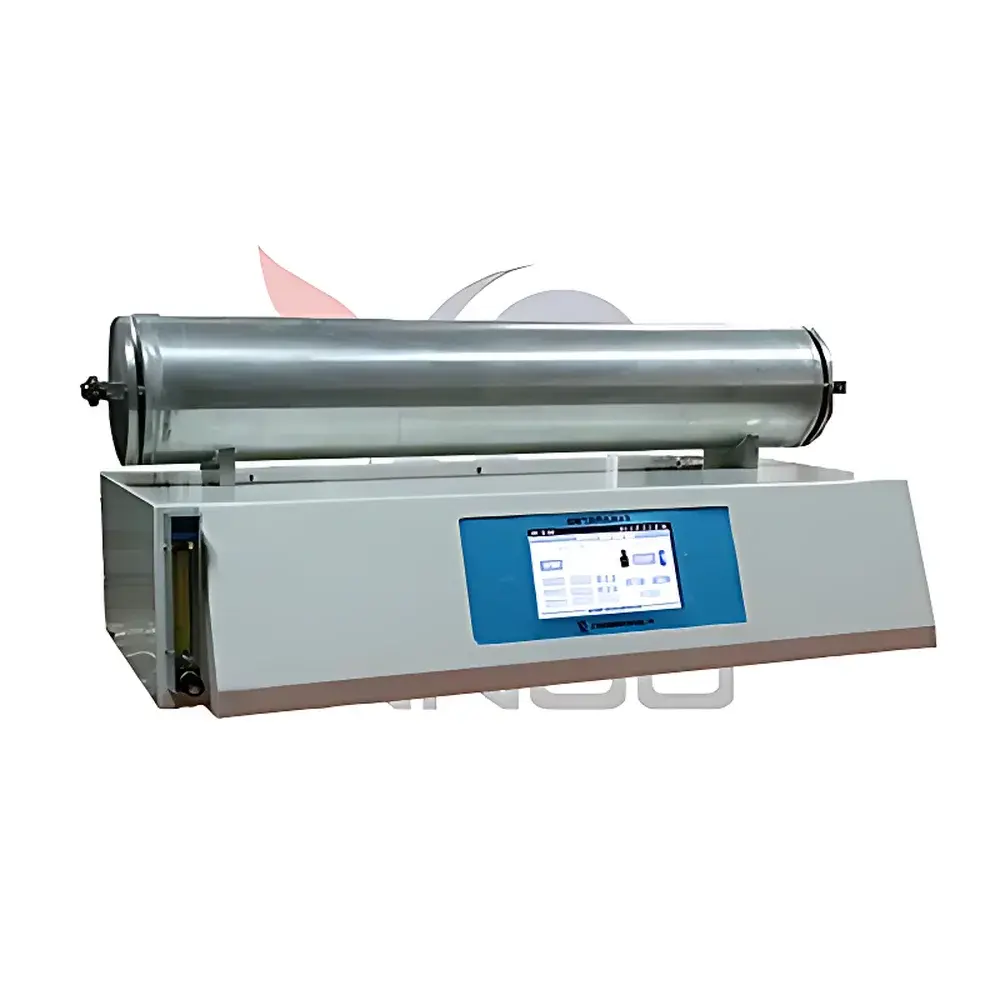
INNUO RS-900B Halogen Acid Gas Evolution Tester
| Brand | INNUO |
|---|---|
| Origin | Shanghai, China |
| Model | RS-900B |
| Display | 7-inch capacitive touchscreen |
| Temperature Range | Ambient to 1000 °C |
| Control Method | PID programmable temperature controller with auto-segment memory |
| Furnace Tube Dimensions | Ø42 mm × 800 mm |
| Rated Power | 4 kW |
| Heating Element | Resistance wire |
| Power Supply | AC 220 V, 50/60 Hz |
| Compliance | GB/T 17650.1–2–1998, IEC 60754-1/2:1994, EN 50305, BS 6853 Annex B |
| Dual-function mode | Halogen gas evolution testing & carbon black content analysis |
| Optional accessory | Rapid cooling unit |
| Insulation material | Nano-ceramic fiber blanket |
| Integrated auxiliary modules | pH meter, conductivity meter, magnetic stirrer |
Overview
The INNUO RS-900B Halogen Acid Gas Evolution Tester is a purpose-built thermal decomposition instrument engineered for precise quantification of halogen-containing acid gases—primarily hydrogen chloride (HCl) and hydrogen bromide (HBr)—released during the controlled pyrolysis of polymeric materials, especially halogenated flame-retarded cables and insulating compounds. Operating on the principle of dynamic tube furnace thermolysis under defined inert or oxidative atmospheres, the system conforms to internationally harmonized test protocols that correlate evolved gas composition with material safety performance in fire scenarios. Unlike generic muffle furnaces, the RS-900B integrates calibrated gas capture, aqueous absorption, and real-time electrochemical measurement of solution-phase acidity and ionic conductivity—enabling direct derivation of total halogen acid yield per unit mass of sample, as required by regulatory frameworks governing railway, aerospace, and building infrastructure applications.
Key Features
- 7-inch industrial-grade capacitive touchscreen interface with real-time visualization of furnace temperature, setpoint tracking, pyrolysis stage status (preheat, decomposition, hold, cool), purge gas flow confirmation, and elapsed operational time—eliminating external controllers and reducing operator dependency.
- Monoblock mechanical architecture integrating furnace chamber, PID temperature controller, and gas-handling manifold into a single rigid chassis—minimizing thermal drift, simplifying lab footprint management, and enhancing long-term calibration stability.
- Pre-programmed thermal profiles compliant with IEC 60754-2 (two-stage ramp: 200 °C for 10 min, then 800 °C for 20 min) and EN 50305 (single-stage 800 °C hold) are stored internally; users initiate full sequences via one-touch execution without manual parameter re-entry.
- Optional rapid cooling module enables forced-air quenching from 800 °C to <100 °C in ≤8 minutes—reducing cycle time by >40% compared to passive cooldown, thereby increasing throughput in high-volume QC environments.
- Dual-latch rotary furnace door design ensures reproducible sealing integrity while enabling unobstructed access to the quartz reaction tube—critical for consistent sample loading geometry and minimizing cross-contamination between runs.
- Nano-ceramic fiber insulation delivers radial temperature uniformity of ±3 °C across the central 200 mm zone of the Ø42 mm × 800 mm alumina-lined quartz tube—meeting the spatial homogeneity requirement specified in IEC 60754-1 Annex A.
Sample Compatibility & Compliance
The RS-900B accommodates solid polymer specimens up to 1.0 g (typical cable jacketing, insulation sheaths, or compounded granules), mounted in pre-weighed quartz boats. Its modular gas absorption train supports dual-mode operation: standard halogen gas evolution per IEC 60754-1/2 and carbon black content determination per ISO 6964 or ASTM D1606, using the same furnace core but with alternate condensate collection and titration configurations. The system meets full traceability requirements for GLP-compliant laboratories: all temperature segments, dwell times, gas flow rates (adjustable 0.5–2.0 L/min N₂), and absorption solution parameters are logged with timestamped metadata. Validation documentation includes as-delivered temperature uniformity mapping, thermocouple calibration certificates (NIST-traceable Type S), and conformance reports against GB/T 17650.1–2–1998, IEC 60754-1/2:1994, EN 50305 Section 10.3, and BS 6853 Annex B toxicity assessment protocols.
Software & Data Management
Embedded firmware records complete thermal history (temperature vs. time), gas flow events, and auxiliary sensor outputs (pH, conductivity, stirrer RPM) in CSV format on internal flash storage. Data export is supported via USB 2.0 port; no proprietary software installation is required. For regulated environments, optional audit trail extension enables user login authentication, electronic signature capture for report approval, and immutable logging aligned with FDA 21 CFR Part 11 principles—including operator ID tagging, parameter change history, and tamper-evident file hashing. All pH and conductivity measurements are referenced to certified buffer standards (pH 4.01, 7.00, 10.01; KCl conductivity standards at 1413 µS/cm), with automatic temperature compensation applied per IUPAC guidelines.
Applications
- Quantitative assessment of HCl/HBr evolution from low-smoke zero-halogen (LSZH) cable compounds during fire exposure simulation.
- Verification of halogen-free declarations per EU RoHS Directive Annex II and IPC-4101D material specifications.
- Supporting toxic gas hazard evaluation in rail vehicle interior materials per EN 45545-2 R22/R23 classifications.
- Method development and validation for halogen content screening in recycled polymer streams prior to extrusion reprocessing.
- Correlative analysis with cone calorimetry (ASTM E1354) to establish structure–fire toxicity relationships in novel flame retardant formulations.
FAQ
What standards does the RS-900B directly support out-of-the-box?
IEC 60754-1/2:1994, GB/T 17650.1–2–1998, EN 50305 (Section 10.3), and BS 6853 Annex B—all implemented via factory-loaded thermal profiles and validated gas absorption geometry.
Can the instrument perform both halogen gas and carbon black testing without hardware modification?
Yes. Dual-function operation is achieved through software-selectable test modes and interchangeable absorption vessel assemblies—no recalibration or component replacement is required.
Is the pH and conductivity measurement system compliant with ISO/IEC 17025 requirements?
The integrated pH/conductivity module includes auto-calibration routines, electrode diagnostics, and raw sensor output logging—satisfying clause 7.8.2 (measurement uncertainty estimation) and 7.7.1 (equipment verification) when used with accredited reference standards.
What maintenance intervals are recommended for sustained accuracy?
Quartz tube inspection every 200 cycles; thermocouple recalibration annually or after 500 h cumulative operation at >700 °C; nano-fiber insulation integrity check during biannual preventive maintenance.
Does the RS-900B support remote monitoring or network integration?
Standard configuration provides local USB data export only; Ethernet or Modbus TCP interfaces are available as factory-installed options for LIMS or MES integration.




