
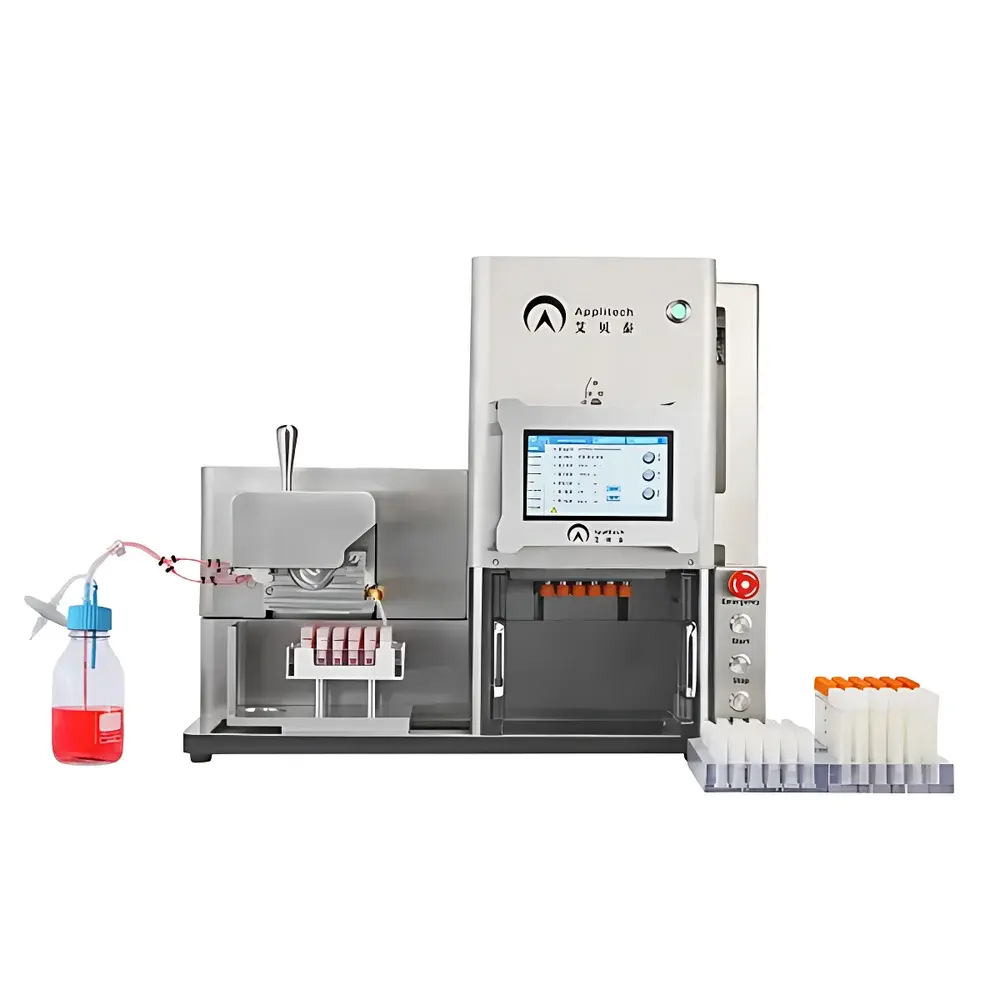
Appliteh AbioFill V100 Automated Cryovial Filling System
| Brand | Appliteh |
|---|---|
| Origin | Guangdong, China |
| Manufacturer Type | OEM/ODM Manufacturer |
| Product Origin | Domestic (China) |
| Model | AbioFill V100 |
| Pricing | Upon Request |
| Fill Volume Range | 250 µL – 5 mL |
| Fill Speed | 350–800 µL/s |
| Accuracy | ±<5% volumetric error |
| Cell Viability Deviation | <2% (across 24 vials) |
| Live Cell Concentration Deviation | <5% |
| Vial Capacity per Batch | Up to 24 cryovials (in multiples of 4) |
| UV Sanitization Option | Optional integrated UV-C module with software control |
| Compliance | Designed for GMP environments with audit trail, multi-level user permissions, and 21 CFR Part 11–ready data integrity architecture |
Overview
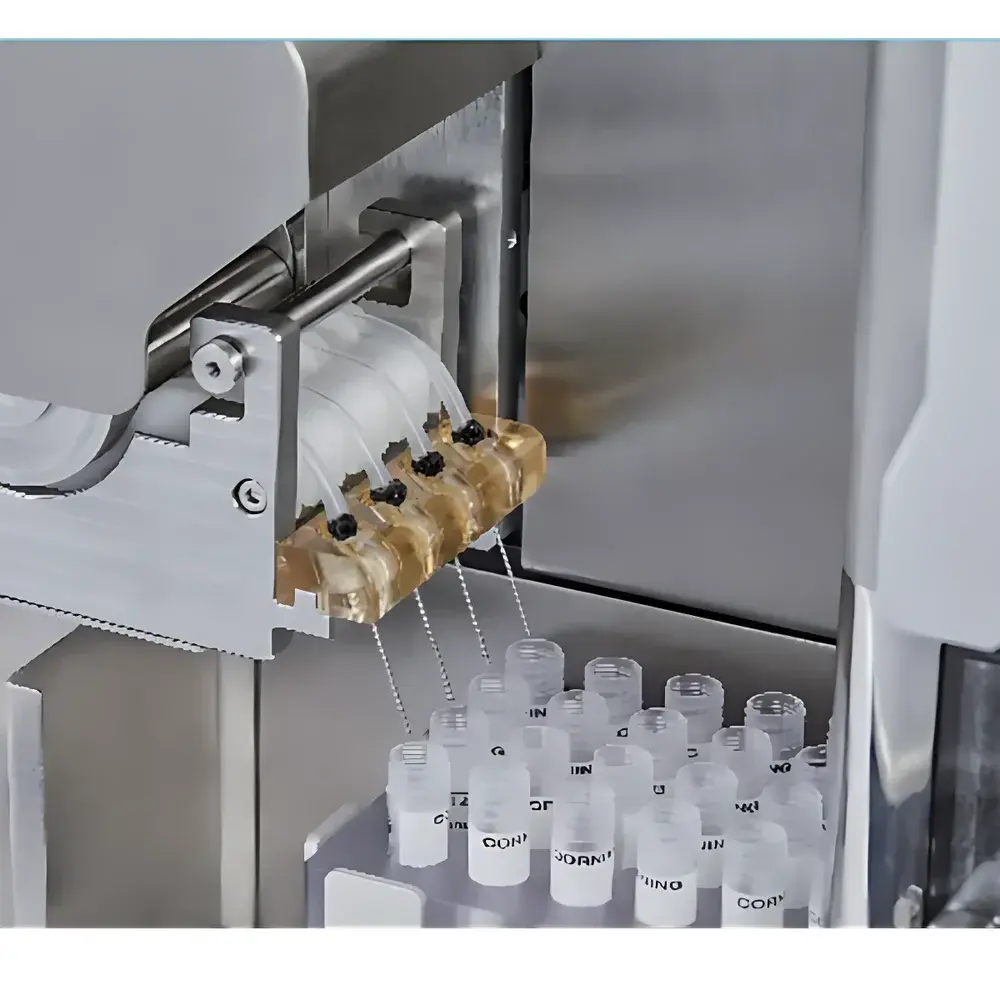
The Appliteh AbioFill V100 Automated Cryovial Filling System is an engineered solution for aseptic, high-precision liquid handling in ultra-low temperature biopreservation workflows. It performs fully automated open-cap-fill-seal cycles on standard cryogenic vials—eliminating manual intervention during critical cryopreservation steps where exposure to cryoprotectants, ambient temperature, or operator variability compromises cell viability and batch consistency. Built upon a modular robotic platform with programmable motion control, the system employs positive-displacement peristaltic or piston-driven dispensing (configurable per application), ensuring laminar, low-shear fluid transfer suitable for sensitive mammalian cells—including mesenchymal stromal cells (MSCs), hybridomas, primary T cells, and viral vectors. Its operational envelope spans from 250 µL to 5 mL per vial, supporting both small-volume clinical-grade aliquots and larger research-scale fills—all within validated repeatability limits required for biobanking, master cell bank (MCB) and working cell bank (WCB) establishment, and cGMP-compliant biologics formulation.
Key Features
- Fully automated “open-fill-seal” sequence with configurable cycle modes: open-only, fill-only, seal-only, or full three-step operation
- High-throughput capability: up to ~1,000 vials processed in ≤30 minutes at nominal fill speeds of 350–800 µL/s
- Volumetric accuracy validated at ±<5% across the full 250 µL–5 mL range; demonstrated with 24-vial batches at 500 µL, 1,000 µL, and 4,000 µL setpoints
- Cell viability preservation: MSC suspensions (1.15 × 10⁶ cells/mL) show <3% post-thaw viability loss after -80 °C cryostorage—confirming minimal mechanical and thermal stress during fill
- Modular hardware design: interchangeable rotating heads, vial holders, and support brackets compatible with major cryovial formats (e.g., Nunc, Thermo Fisher, Corning, Greiner); custom adapters available
- Integrated touch interface with intuitive GUI: real-time monitoring of cumulative vial count, total dispensed volume, cycle status, and error logs
- Optional UV-C irradiation module (254 nm) for automated surface decontamination of fill head and vial staging zones—activated via software scheduling and interlocked with door safety sensors
Sample Compatibility & Compliance
The AbioFill V100 supports sterile processing of diverse biological matrices including suspended mammalian and microbial cells, plasmid DNA solutions, viral supernatants (lentivirus, AAV), cytokines, monoclonal antibodies, and other thermolabile biopharmaceutical intermediates. All wetted components contact only single-use, gamma-irradiated, double-bagged sterile tubing sets and fill tips—eliminating carryover risk and enabling rapid changeover between product campaigns. The system architecture aligns with core regulatory expectations for biomanufacturing equipment: it incorporates role-based access control (RBAC) with password-authenticated login, granular permission tiers (operator, supervisor, administrator), and immutable electronic audit trails compliant with FDA 21 CFR Part 11, EU Annex 11, and ISO 13485:2016 requirements. Full traceability includes timestamped records of all parameter changes, user actions, alarm events, and maintenance interventions—exportable in CSV or PDF format for QA review and regulatory submission.
Software & Data Management
Control firmware and HMI software are developed in accordance with IEC 62304 Class B medical device software standards. The embedded operating system maintains local storage of method protocols, calibration history, and run logs—with optional network connectivity for centralized data aggregation via secure FTP or OPC UA interfaces. Each fill protocol stores user-defined parameters: target volume, flow rate, dwell time, cap torque profile, and UV exposure duration. All data entries are digitally signed and tamper-evident. Software validation documentation (IQ/OQ/PQ templates) and raw data export capabilities support GLP/GMP audits and process validation activities. Remote diagnostics and firmware updates are supported via encrypted HTTPS channels without compromising local data sovereignty.
Applications
- Establishment of Master and Working Cell Banks (MCB/WCB) under ICH Q5D and USP guidelines
- Automated cryopreservation of clonal CHO or HEK293 cell lines for bioprocess development and commercial manufacturing
- cGMP-grade plasmid and viral vector banking for gene therapy programs—supporting tiered strain banks (primary, secondary, working) per ICH Q5A(R2)
- High-fidelity aliquoting of clinical-grade MSCs, NK cells, or CAR-T products into cryovials prior to controlled-rate freezing
- Stable biorepository operations for academic core facilities, contract development and manufacturing organizations (CDMOs), and translational research centers
- Fill-finish of biologics intermediates requiring strict cold-chain integrity—e.g., exosome preparations, recombinant growth factors, and oncolytic viruses
FAQ
Is the AbioFill V100 compliant with 21 CFR Part 11 for electronic records and signatures?
Yes—the system implements audit trail logging, electronic signature enforcement, and role-based authentication in alignment with FDA 21 CFR Part 11 Subpart B requirements. Full validation support packages are available upon request.
Can the system handle non-standard or proprietary cryovial formats?
Yes—custom mounting fixtures, rotating caps, and vial alignment jigs can be engineered and qualified for non-OEM tube geometries, including tapered, conical-bottom, or threaded variants.
What sterilization methods are validated for the fluid path?
The disposable fluid path uses pre-sterilized, gamma-irradiated (25–35 kGy) components supplied in double-layer ISO Class 5 cleanroom packaging. No in-line steam or chemical sterilization is performed; replacement is the sole revalidation pathway.
Does the system support integration with environmental monitoring systems (EMS) or SCADA platforms?
Yes—via configurable digital I/O, Modbus TCP, or OPC UA, enabling real-time status synchronization with facility-wide monitoring networks and MES systems.
What is the recommended maintenance schedule?
Preventive maintenance is advised every 6 months or after 500 operational hours, including torque verification of sealing actuators, calibration of volumetric sensors, and UV lamp intensity measurement using NIST-traceable radiometry.





