
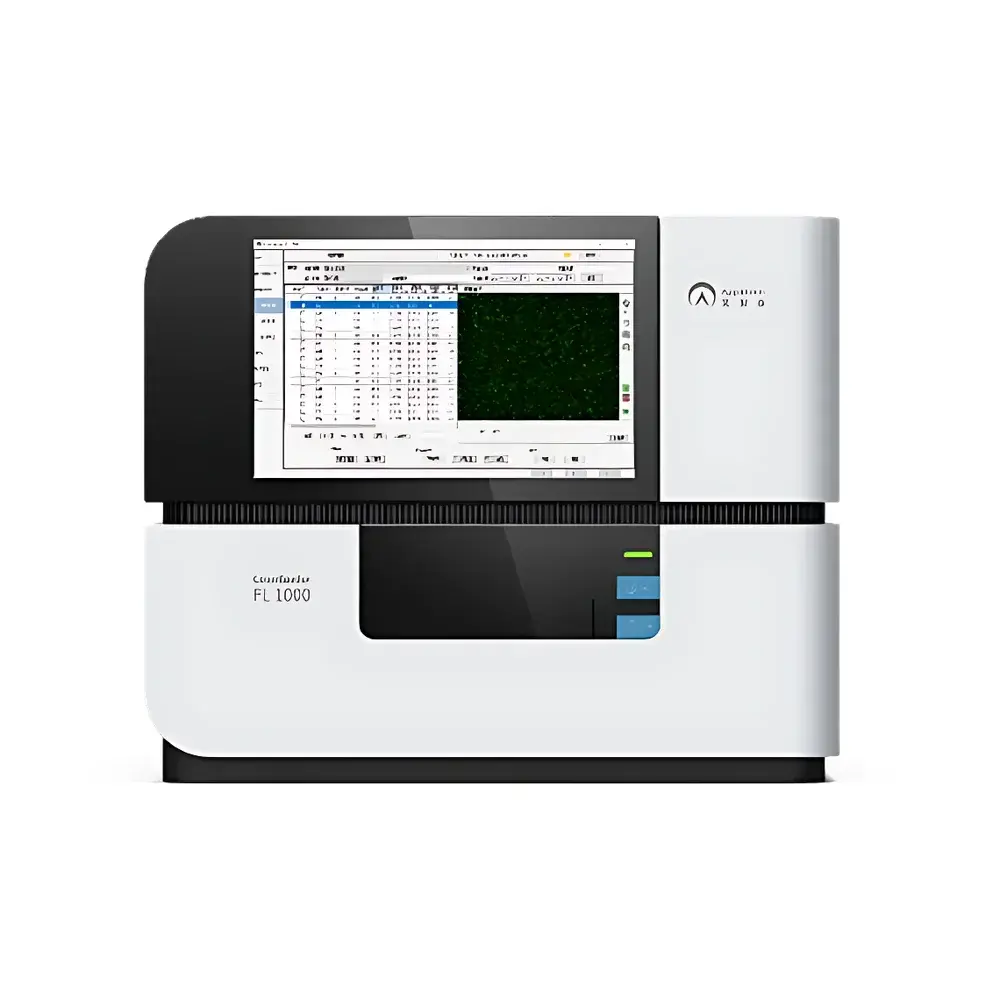
Applitech Countleader FL 1000 Dual-Fluorescence Cell Counter
| Brand | Applitech |
|---|---|
| Origin | Guangdong, China |
| Manufacturer Type | Original Equipment Manufacturer (OEM) |
| Product Category | Domestic |
| Model | Countleader FL 1000 |
| Pricing | Upon Request |
Overview
The Applitech Countleader FL 1000 Dual-Fluorescence Cell Counter is an automated, image-based cell analysis system engineered for high-precision quantification of viable and non-viable mammalian cells in suspension. It employs digital microscopy coupled with dual-channel fluorescence detection (excitation/emission optimized for acridine orange [AO] and propidium iodide [PI]) and brightfield imaging (with trypan blue exclusion), enabling simultaneous morphological assessment and nucleic acid–specific viability discrimination. Unlike flow cytometry–based or impedance-based counters, the FL 1000 utilizes static field-of-view imaging across multiple predefined regions—eliminating fluidic variability and shear-induced cell damage. Its optical architecture integrates a high-resolution CMOS sensor, precision LED excitation sources, and bandpass-filtered detection pathways to ensure consistent signal-to-noise ratios across heterogeneous samples, including low-purity PBMCs, irregularly shaped CAR-T cells, and microcarrier-adherent cells post-detachment.
Key Features
- Dual-fluorescence + brightfield multimodal acquisition: AO/PI nuclear staining enables unambiguous discrimination of membrane-intact (viable) vs. membrane-compromised (non-viable) cells; trypan blue mode supports rapid routine QC.
- High-throughput 8-sample parallel processing: Utilizes proprietary FL8-slides—disposable, pre-aligned 8-channel glass slides compatible with multichannel pipettes; sample volume per channel: only 15 µL.
- Ultra-fast analysis cycle: ≤15 seconds per sample in trypan blue mode; ≤22 seconds per sample in AO/PI mode; full 8-sample AO/PI run completed in 3–4 minutes.
- Zero-maintenance operation: No fluidics, no cleaning protocols, no calibration routines—optical path and illumination are factory-aligned and thermally stabilized.
- 12-inch capacitive touchscreen interface with intuitive workflow navigation and real-time preview of acquired images and histograms.
- Integrated onboard computing: Intel Core i5 processor, 8 GB RAM, 2 TB SSD storage—capable of storing >25,000 assay records with full metadata.
Sample Compatibility & Compliance
The Countleader FL 1000 is validated for use with primary human immune cells (e.g., PBMCs, CAR-T, NK cells), adherent cell lines (post-trypsinization or enzymatic/mild chemical detachment), and microcarrier-cultured cells (using Applitech Reagent A+B lysis protocol). It excludes interference from erythrocytes, platelets, cellular debris, air bubbles, and magnetic beads—critical for immunotherapy manufacturing where sample purity is variable. The system conforms to Good Manufacturing Practice (GMP) requirements under FDA 21 CFR Part 11: it implements role-based user authentication (three-tier access), electronic signatures, immutable audit trails, and time-stamped event logging for all critical operations—including parameter changes, result exports, and user logins.
Software & Data Management
The embedded Countleader Analysis Suite provides comprehensive data governance tools. Users define custom assay templates, assign unique identifiers to each sample, and configure analysis parameters—including number of fields-of-view (1–3 per channel), dilution factor compensation, and diameter gating thresholds. Results are presented as tabular summaries (total cell concentration, viable cell concentration, dead cell concentration, viability %, mean diameter, and aggregation index) and visualized via scatter plots, histograms, and viability heatmaps. The software supports automated growth curve generation from serial passage data and permits cross-experiment comparison using searchable filters (experiment name, date range, operator ID, sample ID). Export formats include PDF (with embedded images and metadata), Excel (.xlsx), and TIFF (raw and processed images). Data transfer occurs via USB 3.0 port with hardware-level write-protection options.
Applications
- Immunotherapy process monitoring: AO/PI-based enumeration of CAR-T and TIL products during expansion, cryopreservation, and release testing—without manual gating adjustments for size or morphology.
- Microcarrier bioprocessing support: Integration with Applitech’s Reagent A+B enables accurate counting of microcarrier-released cells while suppressing background signal from residual carrier fragments.
- Cell line development and bioprocess qualification: Trypan blue mode meets ICH Q5D and USP requirements for viability assessment in upstream biomanufacturing.
- Vaccine production QC: Rapid batch-wise assessment of Vero, MDCK, or CHO cells prior to infection or harvest.
- Academic and translational research labs: Supports longitudinal studies requiring statistically robust sampling (≥3 FOVs per sample) and traceable data lineage for publication or regulatory submission.
FAQ
Does the Countleader FL 1000 require daily calibration or routine optical alignment?
No. The optical train is factory-aligned and sealed; no user-serviceable calibration is required. System performance verification is conducted via included NIST-traceable fluorescent microbeads during IQ/OQ/PQ validation.
Can the instrument distinguish between apoptotic and necrotic cells?
The AO/PI assay differentiates membrane integrity status but does not resolve early apoptosis (annexin V–positive/PI–negative) without additional staining. It reports “viable” (AO+/PI−), “non-viable” (AO+/PI+), and “debris” (low-intensity events).
Is the FL8-slide compatible with automated liquid handlers?
Yes—the slide footprint and well geometry comply with ANSI/SLAS standards, enabling integration with robotic platforms equipped with standard grippers and tip positioning.
How is data integrity ensured during export?
All exported files (PDF, Excel, TIFF) contain embedded digital signatures and hash-verified metadata. USB export triggers an automatic audit log entry recording filename, timestamp, user ID, and destination device serial number.
What validation documentation is provided?
A complete 3Q package is supplied: Installation Qualification (IQ) checklist, Operational Qualification (OQ) test protocols with pass/fail criteria, and Performance Qualification (PQ) reports using certified reference materials—including low-, mid-, and high-concentration fluorescent bead sets and primary PBMC reference samples.



